
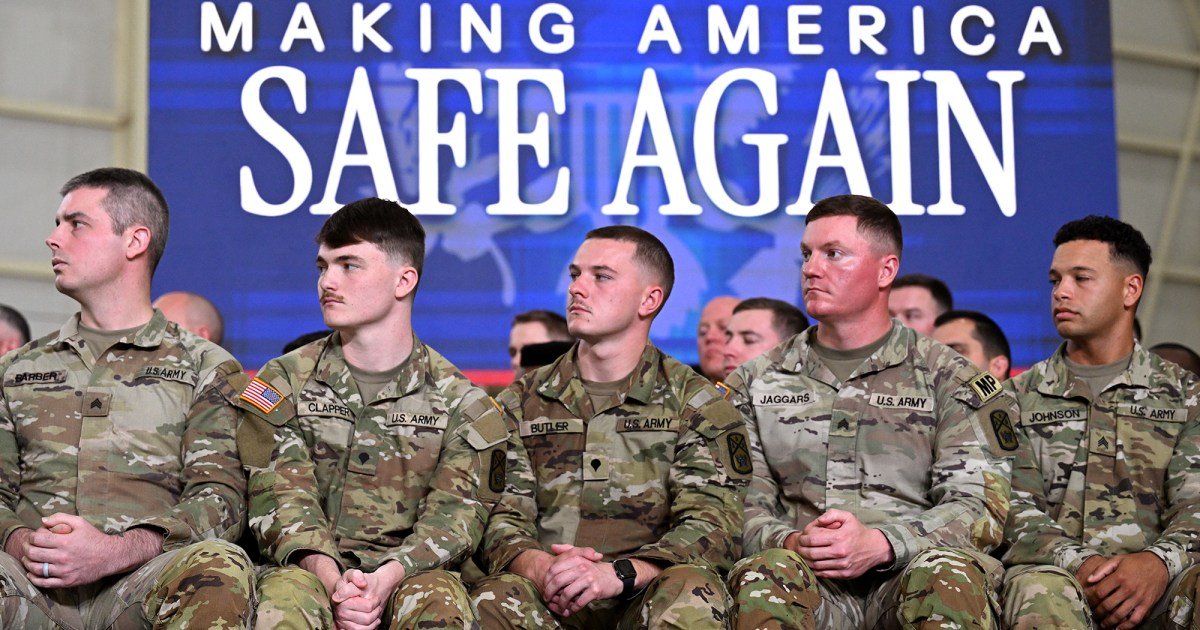
National Guard officers listen as President Trump talks about the Memphis Safe Task Force in March.Roberto Schmidt/Getty
There’s a massive immigration operation in Memphis right now, but you may not have heard about it. It certainly hasn’t gotten as much attention as past surges in Chicago or Minneapolis—even though it’s been going on since September.
Hunter Demster, who runs a soup kitchen in the city, has been trying to get the word out. He often drives around with his phone, looking for officers to film as they arrest immigrants. There are more than 2,700 officers stationed in the city as part of the Memphis Safe Task Force; some are from the Department of Homeland Security (DHS); others are from other law enforcement agencies and the National Guard. None particularly want to be photographed.
“My family still has a lot of fear and worry
anytime I leave the house alone.”
Which means that Demster is facing blowback for trying to document them. So are other community members doing the same thing. Officers have taunted them, shined bright lights at them, and followed them in their cars. One community member was assaulted and jailed for trying to film. Now, they’re suing, with help from the ACLU, which argues that agents are engaged in a pattern of intimidation and retaliation that hampers their First Amendment rights to record the police.
The lawsuit was filed last week against leaders of the task force, and it’s a harrowing read—dozens of pages of examples. Demster, for one, recalls an officer driving quickly as he stood in a parking lot and then swerving toward him, missing him by inches. Another plaintiff was “bumper-rushed” by police while driving—they came up behind him so quickly that it appeared a collision was imminent, before hitting the brakes at the last second.
“It’s retaliation,” Demster told me of the various incidents. “And for what? Holding a phone.”
Plaintiff Jessica Choder was tackled by a task force officer when she tried to film a traffic stop; she was held down and an officer threatened to tase her before taking her to jail. (The charge against her, “resisting official detention,” was later dropped.) Demster says agents sometimes sit in their vehicles outside his house. “It’s terrifying to have to be on guard 100 percent of the time,” he says.
The case in Memphis also challenges Tennessee’s Halo Law, which criminalizes anyone who gets within 25 feet of an officer after they’ve been warned to step away. Task force agents are invoking the law against observers who are not interfering, and sometimes forcing them back even farther than required so they can no longer see or hear. “It unconstitutionally burdens people’s ability to engage in gathering information and recording what task force agents are doing,” ACLU attorney Scarlet Kim told me.
A Department of Justice (DOJ) spokesperson said in a statement that the agency “will not tolerate any action that puts our law enforcement officers at risk.”
“We strongly disagree with the allegations in the lawsuit and remain committed to fair, impartial, and professional law enforcement practices to keep Memphians and the American people safe,” it noted.
Over the past year, the DHS has been sued in multiple cities for allegedly harming protesters and community observers during surges; a case in the Chicago area was dropped by the plaintiffs after Operation Midway Blitz ended, but others in Los Angeles and Minneapolis are ongoing.
It’s hard to overstate how big the Memphis Safe Task Force presence felt early on. It began in September, and when I visited the city in November, I was shocked by the number of law enforcement vehicles I saw. I talked with immigrant families who were afraid to leave their homes for work or to bring their kids to school. Even US citizens carried their passports around. Many described the city as a war zone, as I reported at the time.
“No one should fear their government.”
The surge has not gotten much national attention in part because Tennessee’s Republican governor supports it—he has said it will continue indefinitely. And the Trump administration has framed it not as an immigration crackdown, which would get a lot of press coverage, but as a crime crackdown. (Task force officers from other agencies are arresting people primarily for traffic violations and crimes, but they call DHS officers when they encounter immigrants.)
Demster also believes Memphis has yet to grab the nation’s attention because people like him who want to get the word out are facing retaliation. It’s all part of the task force’s plan “to operate in the shadows,” he says.
Choder, the woman assaulted while trying to observe, no longer goes out to film as much as she used to, and when she does, she stays in her car unless there are other observers on the scene. “My family still has a lot of fear and worry
anytime I leave the house alone,” she told me.
Demster continues to press record whenever he gets a chance. “We are under full-blown occupation and immigrants are going missing,” he says. “No one should fear their government for holding a phone.”



