
Back when dinosaurs ruled the earth and I was in high school, there was a popular song, played on the radio and even featured in the movie “All That Jazz” called “Everything Old is New Again.”
“Don’t throw the past away,” singer Peter Allen warbled, “you might need it some rainy day.”
I started humming that song last week after reading the startling news that the GOP frontrunner for governor, Rep. Byron Donalds, announced that he supports growth management.
“At a campaign event in St. Petersburg last week, Donalds called for a strategy to ensure adequate schools, roads, police and fire protection get built,” the Tampa Bay Times reported. “‘You have to have a growth management plan for the future of our state,’ he said.”
My first reaction when I read this was to check the photo to make sure this was really him and not some Donalds doppelganger punking the press.
It was indeed Donalds, and he was indeed calling for Florida to toss a lasso on its galloping growth. That’s when the song popped into my head, because we used to have a growth management system in Florida.
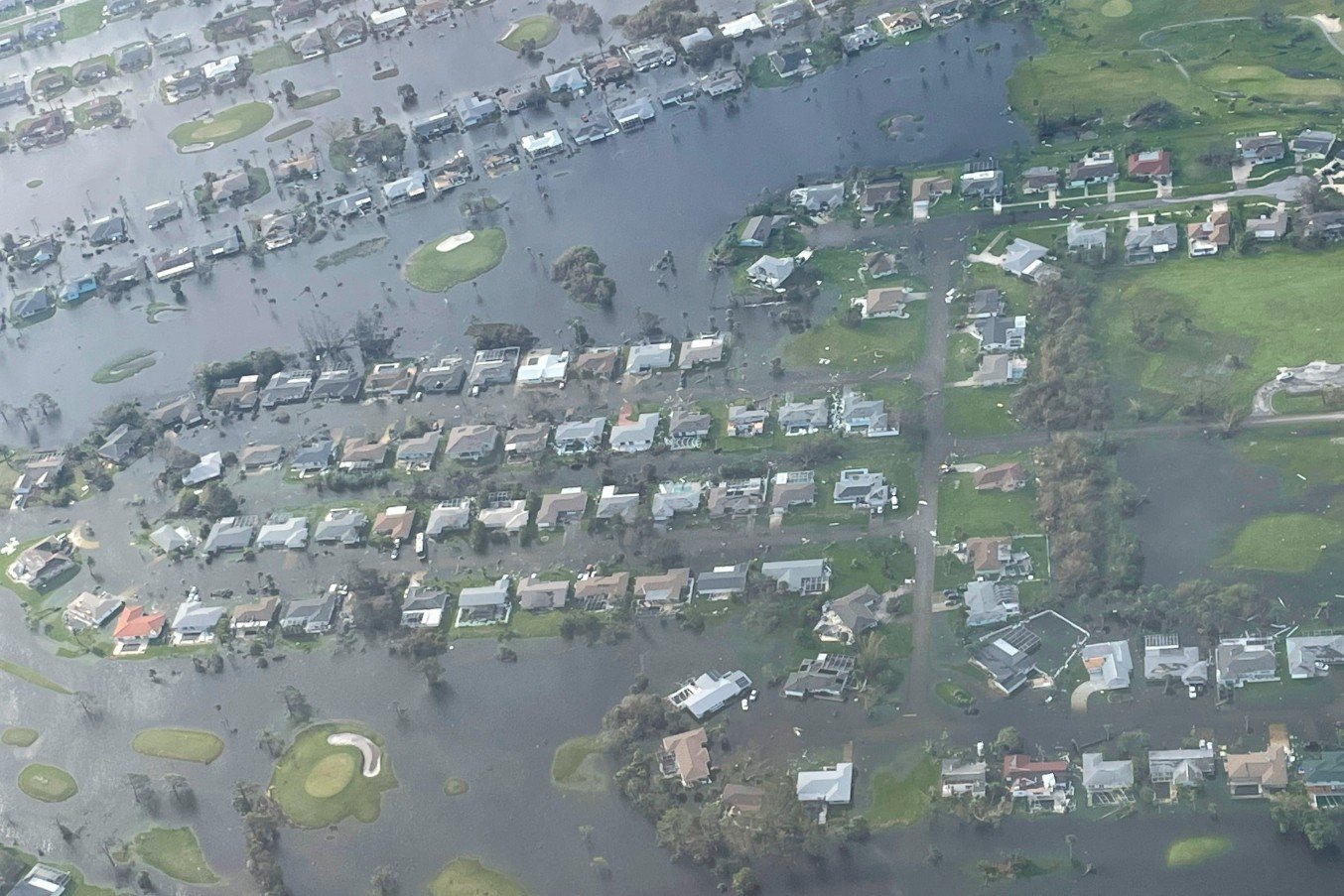
The need to bring it back seems blatantly obvious. Fifteen years after the state repealed the Growth Management Act, our 23 million residents are coping with clogged highways, water shortages, flooding woes, and other signs of significant malfunction.
“Our job is to protect the Florida dream, so it remains the Florida dream,” Donalds told the crowd. “Managing growth is part of this.”
This stance is so out of character for Donalds that I half expected him to next announce that naming the Palm Beach airport after a convicted felon was a bad idea. The Times saw his embrace of growth management as a savvy politician jumping on an increasingly popular bandwagon.
“That the Republican front-runner for governor is now talking up growth management … suggests Florida is at a pivot point,” the story noted, which I would nominate for the Pulitzer Prize for Biggest Understatement of the Year.
I called a number of growth management experts to see what they thought of Donalds’ comments. If I described them as “skeptical,” you could nominate ME for the Pulitzer for the Biggest Understatement.

“I’m glad Rep. Donalds recognizes the public frustration with growth and development and the unrelenting impacts on quality of life,” said Charles Gauthier, who worked as the state’s director of community planning from 2007 to 2011. “Whether the issue is a campaign talking point or serious initiative is to be seen.”
The golden egg
When the Times pressed Donalds for details, he said, “We want to coordinate the plans about how we’re going to map out the future, the future look of each region of Florida. Each county will still have their plan, right, but at least it will be something that we know will be synchronized as well because we have to examine it.”
Let’s take a trip in Mr. Peabody and Sherman’s Wayback Machine, shall we? Our destination: The mid-1980s, a time of big hair, bell bottoms, and a rising recognition that Florida’s growth was a steamroller roaring along out of control.
For decades, Florida builders had constructed whatever they wanted wherever they wanted. That’s how we wound up with communities like Lehigh Acres, where the people who laid out the lots were entirely focused on selling houses to the suckers from up North. They didn’t worry about water lines, sewer lines, schools, or fire and police stations.
As then-Gov. Bob Graham put it, our builders were “killing the goose that laid the golden egg.” He knew it was time for a change.
“Graham was motivated by rapid population expansion and uncontrolled growth and development,” said Estus Whitfield, who was an aide to Graham and four other governors. Those things “led to water quality problems, rampant pollution, sewage spills, and discharges into the Atlantic and Gulf, wetlands losses to dredge and fill and drainage, numerous Everglades issues, and crowded roads.” (Sound familiar?)
Graham cajoled a reluctant Legislature to pass the 1985 Growth Management Act, the most necessary growth law ever written.
The new law required all the local governments to prepare comprehensive plans for growth that would mesh together with the state’s own plan and be approved by the state itself — exactly what Donalds is calling for now.
The law also required “concurrency” for all the new roads, sewers, etc., so that new growth paid for itself prior to any development occurring — another thing that Donalds says he supports.
And it offered enhanced “citizen standing,” meaning you and I had the right to go to court and challenge government land-use decisions. I note that Donalds made no mention of this.
Developers hated that 1985 law. Their poorly formed plans now repeatedly hit red lights, and they hated the improvements they had to make to change the lights to green. They also hated the agency in charge of enforcing the law, the Department of Community Affairs.
To them, the DCA’s greatest sin was that, over and over, it blocked bad ideas. For instance, it thwarted a destructive marina, condo, and resort project for Taylor County that would have cut a wide canal through the Big Bend Seagrass Aquatic Preserve.
After 26 years of plotting, the developers got their wish. Florida elected as governor a developer-backed millionaire named Rick Scott who also despised DCA. He and the Legislature dismantled the growth management system.
By the way, the list of Florida officials now endorsing Donalds for governor includes U.S. Sen. Rick Scott, avowed enemy of growth management.
Behind the curtain
Ever since the repeal in 2011, runaway development has been sprawling all over, and a lot of people are upset. Rather than stop it, every legislative leader has tried to surgically remove local governments’ ability to tell a developer no.
“We’ve had 15 years of anti-growth management actions by the Legislature,” Gauthier told me. “I’d be shocked to see any turnaround.”
The constant traffic tie-ups and sewage spills should be sufficient proof of the consequences, but there’s more. The demolition of our growth management system allowed builders to put a lot of people in the path of Hurricane Ian with an inadequate evacuation route.
Then the Legislature blocked local governments from being able to order builders not to rebuild homes in the exact same places where they had washed away during Ian, Helene, and Milton. The sponsors of those measures were Sen. Nick DiCeglie, Sen. Jonathan Martin, and Rep. Jason Shoaf. Every one of them has endorsed Donalds for governor.
Those legislative changes were made at the behest of Manatee County builder Pat Neal, a former legislator who’s built 25,000 homes in Florida, most of them in Manatee and Sarasota counties. Neal’s now a billionaire, according to Forbes magazine.
Like the Wizard of Oz, though, Neal prefers not to be seen by the public pulling the levers of power. Instead, he deploys lobbyists, engineers, and lawyers to make government bend the knee.
Take a wiiiiiild guess which gubernatorial candidate got a $100,000 campaign contribution from Neal. His initials are B.D., and it sure ain’t Bob Dylan.
Also backing Donalds: the largest commercial construction association in the state, Associated Builders and Contractors. The chairman said he liked Donalds’ promise to cut regulations for builders — not to add more of them.
“Byron Donalds needs to be careful what he says, or he could lose his best supporters,” Whitfield told me. I couldn’t be sure, but I think he had his tongue planted firmly in his cheek.
Phone the friends
If he’s serious about bringing back growth management, one place Donalds could get some good advice is an organization called 1000 Friends of Florida.
The state’s leading nonprofit smart growth advocacy organization, 1000 Friends was co-founded in 1986 by a prominent Republican named Nat Reed.
Reed’s a prime example of what one determined Florida man can do. He co-wrote the Endangered Species Act, helped stop Miami from building a giant airport in the Everglades, and pushed to preserve Biscayne Bay.
Although Reed has gone on, his organization is still around and producing lots of studies and seminars. Surprisingly, Donalds has yet to phone the Friends for tips on how to bring back growth management, according to Kim Dinkins, 1000 Friends’ policy and planning director.
“We’ve been doing this for 40 years,” she told me. “We have a lot of info.”
I asked Dinkins what 1000 Friends would recommend Donalds do first. I mean, just in case he really wants advice on restoring something we desperately need.
“I think we need a better baseline,” Dinkins said. “We don’t have a great handle on how much development has already been approved.”
A lot of Florida counties and cities have said yes to development plans that haven’t been built yet for financial or legal reasons, she explained. That’s something the Department of Community Affairs used to keep track of before it was blown up.
Captured government
Two years ago, I tried repeatedly to get Donalds to comment about a secret water pollution summit he held in Fort Myers that excluded both the press and the public.
He was as easy to get hold of as the Cheshire Cat. I expected Donalds to be just as elusive this time when I contacted his campaign seeking details about what he was proposing.
To my surprise, I got a right-on-deadline, one-paragraph e-mail from his press secretary, Gates McGavick. I was not surprised, however, to see that what he sent was as solid as an early morning fog.
“We must have a management plan for the future of our state that realistically balances growth with safeguards,” McGavick told me. “Byron’s regional approach focuses on building the roads, schools, and public safety infrastructure that Florida families need, while protecting against government overreach and expensive regulations. Byron’s plan will allow us to meet the needs of Florida families, build infrastructure in a timely and efficient fashion, and also protect our crucial water and environmental resources.”
Too bad Donalds and his staff were too shy to explain exactly how he’s going to achieve this radical change that would reverse years of pro-developer policies.
One person who has never been shy about talking about Florida’s growth is Lesley Blackner. In 2007, Florida Trend magazine described her as the woman “who makes veins throb in the foreheads of developers across Florida.”
In those days, Blackner was pushing a proposed constitutional amendment called Florida Hometown Democracy, which called for giving citizens the power to vote yes or no on proposed changes in local land-use plans.
She and her allies had to battle virtually every businessman, builder, and politician in the state to get the amendment on the ballot in 2012, only to watch it be rejected by two-thirds of the voters.
The Monticello attorney is still preaching the same sermon. As recently as February, in an op-ed in the Tallahassee Democrat, Blackner wrote, “Florida is a classic case of captured government — government of, by and for the developer.”
When I asked what she thought of Donalds’ bold talk, she said, “I think he should take a lie detector test or some truth serum. I think he’s just trying to placate people.”
Count her as a disbeliever in the Donalds doctrine. “Some consultant told him to say this,” she said. “But he’s not going to run things any differently than Rick Scott or Ron DeSantis.”
Maybe instead of “Everything Old is New Again,” the song we should be playing to reflect Donalds’ approach to growth management is another hit from that same year: “Nothing from Nothing.”
Independent Journalism for All
As a nonprofit newsroom, our articles are free for everyone to access. Readers like you make that possible. Can you help sustain our watchdog reporting today?



