
This article first appeared in South Jersey Climate News, a content-sharing partner of NJ Spotlight News.
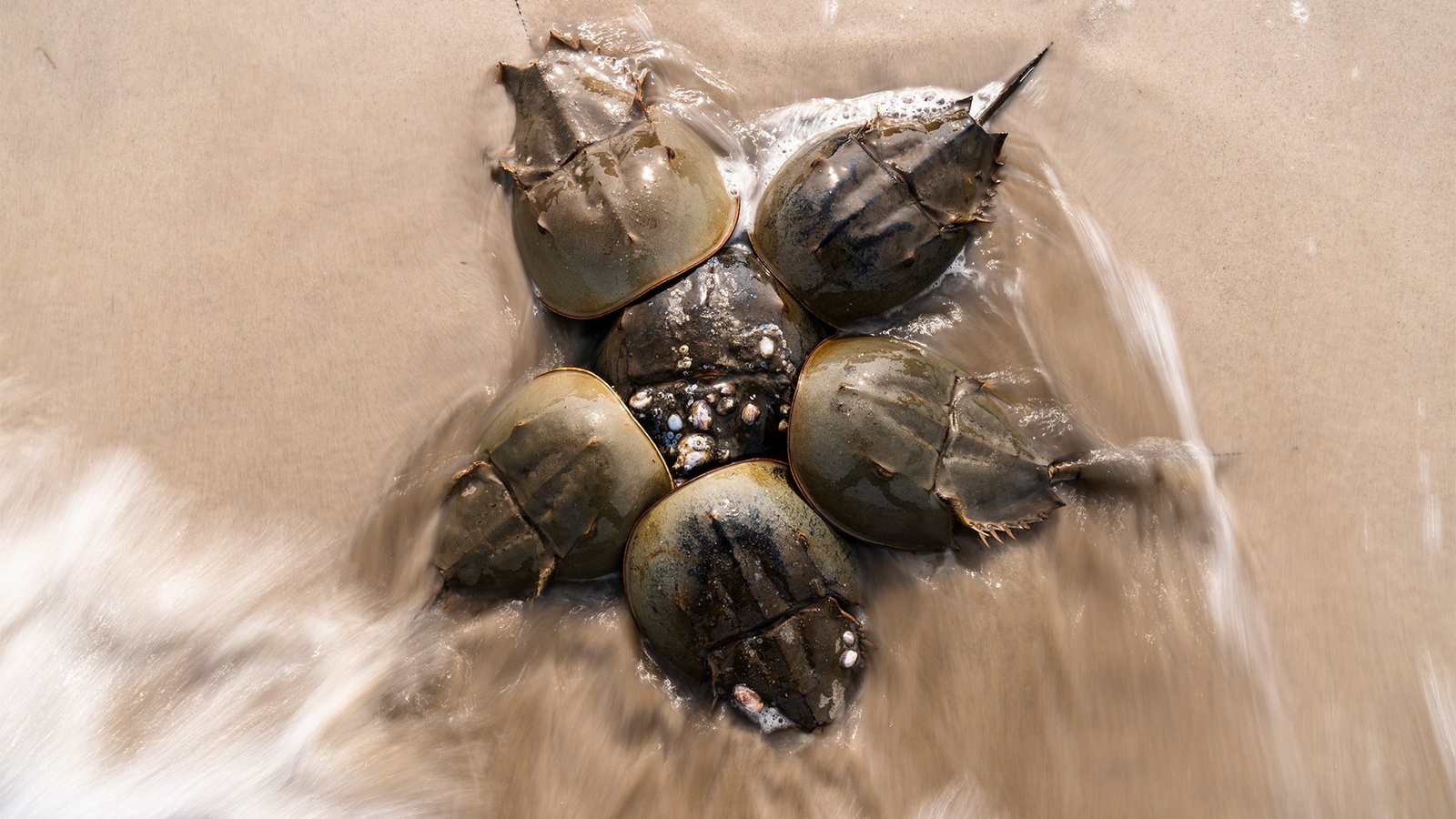
Each year in early summer, thousands of horseshoe crabs emerge from the Delaware Bay to spawn.
Their eggs are vital for shorebirds, in particular red knots, which stop along the New Jersey coast as they migrate to Canada from South America. Their blood is also valuable to biomedical companies, which use their blood to test vaccines, medicine and implants for safety.

Conservation groups and the federal government agencies disagree over how horseshoe crabs should be managed and protected.
In 2024, citing steep population decline, nearly two dozen organizations petitioned the National Marine Fisheries Service division of National Oceanic and Atmospheric Administration to add the American horseshoe crabs under the Endangered Species Act. In January, two groups, the Center of Biological Diversity and Friends of Animals, sued the fisheries service for failing to issue a finding by deadline.
“Horseshoe crabs have saved so many people, and now it’s up to us to pay back that debt and save them,” Will Harlan, a senior scientist for the Center for Biological Diversity, said in a statement. “We could lose these living fossils forever if they don’t get Endangered Species Act protections soon.”
In February, NOAA released a finding that said red knots, which depend on crab eggs, are a threatened species, though horseshoe crabs themselves are not.
“The petitions do not present substantial scientific or commercial information indicating that the petitioned actions may be warranted,” the agency concluded.
Older than dinosaurs
Horseshoe crabs are some of the oldest creatures on the planet, predating the dinosaurs. In New Jersey, Native populations reportedly used them for food and tools. Farmers turned them into livestock feed and fertilizer, and the commercial fishing industry has used them as bait.
Since the 1970s, biomedical companies have harvested horseshoe crabs for their blood, which contains a protein called limulus amebocyte lysate that can be used to detect bacteria and toxins. Any potential cause of infection introduced during a medical procedure – surgical devices, drugs and vaccines – has likely been tested using horseshoe crab components.
Because of human harvesting, as well as pollution and habitat loss, horseshoe crab populations have declined 90%, scientists say.
New Jersey adopted a moratorium on harvesting and possessing crabs in 2008. Biomeds, though, are allowed to bleed a portion of their supply and then must return the crabs to the wild. New Jersey laws also vary by bay and coast, with some permitting hundreds of thousands to be harvested each year.
Conservation groups and scientists argue the industry is not thoroughly regulated and laws are not enforced. They estimate that 15%-30% of harvested crabs die during or after the bleeding process.
Public process
In its response to calls to provide federal protection, NOAA cited statistics that found the horseshoe crab populations are generally stable along the Atlantic Coast from Maine to Florida – depending on the study and the location. It concluded that “sufficient information is not provided or otherwise available to indicate that the harvest and collection mechanisms identified by the petitions may cause the species to become endangered or threatened with extinction.”
Advocates argue the agency did not go through the standard scientific and public process.
“One of the biggest mistakes it made was to cherry-pick its own evidence and data to support its decision, without first allowing for public notice and public comment during its consideration of whether to list the species,” said Danny Waltz, senior attorney for the Center for Biological Diversity’s Southeast Program.
While conservation groups push to change laws and designations, the horseshoe crab’s future also hinges on emerging biomedical technology.
Manufactured alternatives to horseshoe crab blood have been in use in Europe since 2020. In May 2025, the U.S. Pharmacopeia, a compendium of drug information, approved synthetic alternatives and found them to be just as effective.
For now, the market for horseshoe crab blood remains lucrative – one crab can yield as much as $1,800 – and some in the industry have been reluctant to change. As a result, advocates argue, horseshoe crabs need federal protection.
“NOAA has an obligation to rely on the best available science in making listing decisions and should reconsider its decision not to list the Atlantic horseshoe crabs,” said Jennifer Best, director of the Friends of Animals Wildlife Law Program.



