
Few contemporary Korean filmmakers have made the zombie genre work as commercially and as globally, as Yeon Sang-ho. With “Train to Busan,” he turned a high-concept survival thriller into one of Korean cinema’s most exportable genre landmarks; with “Peninsula,” he expanded that world into a more overtly action-driven spectacle. “Colony” marks his return to the infected-body narrative, but it is not simply another exercise in mass panic. This time, Yeon uses the genre to stage a more contemporary anxiety: the fear that a society increasingly built on networks, data, shared signals and algorithmic consensus may have less and less room for individual difference.
“Colony” begins with a direct and effective provocation. Biotechnology researcher Seo Young-chul, played by Koo Kyo-hwan, calls the police to announce an act of terror, then declares that he himself is the only vaccine. In a single gesture, Yeon establishes the film’s central paradox: the source of the catastrophe and its possible cure are contained in the same body. Young-chul cannot simply be killed, but neither can he be allowed to remain free. That contradiction gives the film its initial engine of suspense.
The story unfolds inside “Dunguri,” a high-rise multipurpose building in downtown Seoul, where a biotechnology conference is taking place. Biology professor Kwon Se-jung, played by Gianna Jun, attends at the urging of her ex-husband Han Kyu-sung, played by Go Soo. Also trapped inside are Young-chul, Ji Chang-wook’s security worker Choi Hyun-seok, and Hyun-seok’s older sister Hyun-hee, a wheelchair-using computer whiz played by Kim Shin-rock. When an unexplained infection breaks out and the authorities seal the building, the survivors are forced into a familiar lockdown scenario. Yet “Colony” is less interested in the building as a simple trap than as a laboratory, a vertical maze in which human improvisation is tested against collective adaptation.
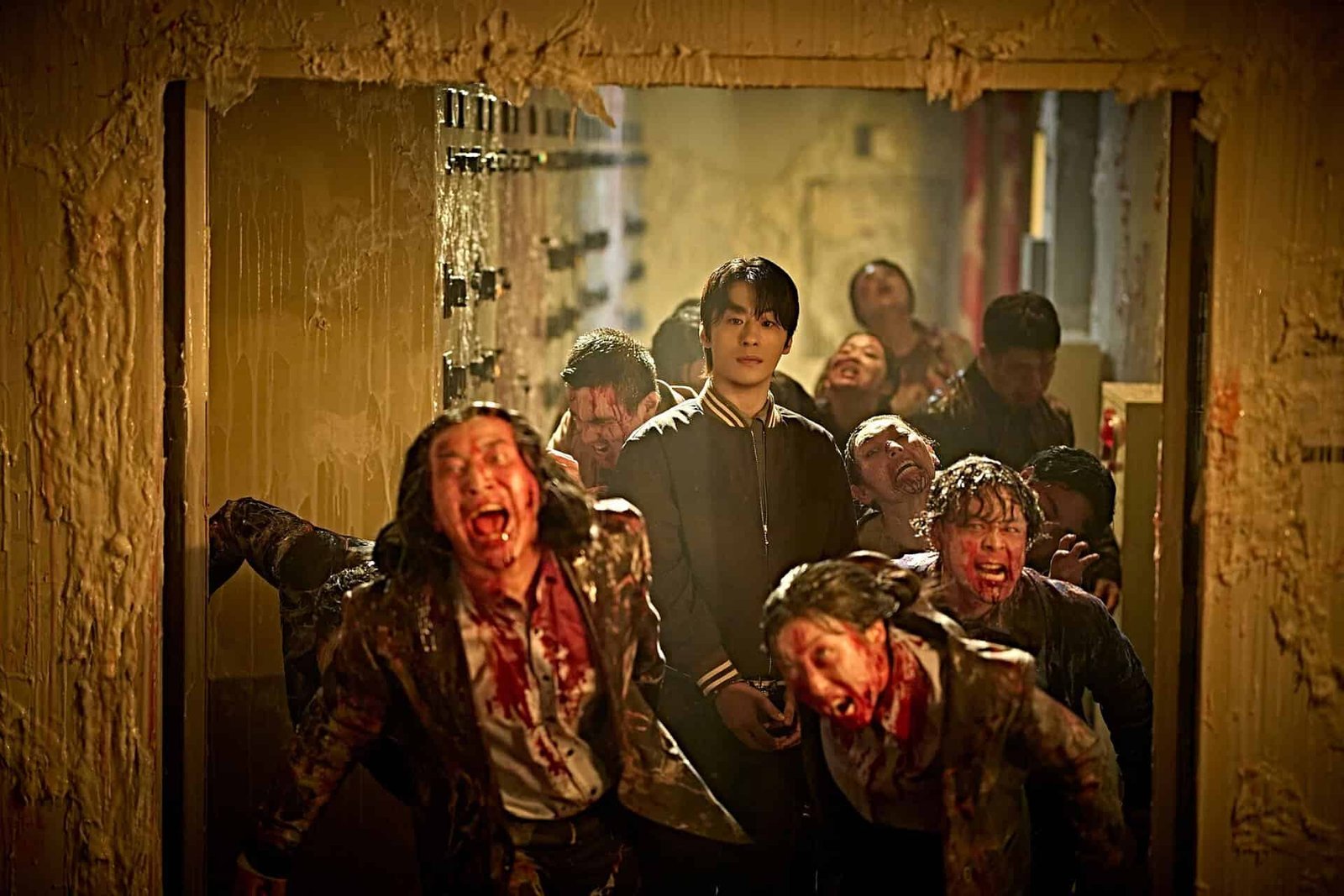
At first, the infected appear almost animalistic, scuttling on all fours and lunging at anything that resembles a human body. But their evolution is disturbingly swift. Soon, they stand upright, coordinate, move in groups, and eventually mimic human voices. Every tactical move the survivors make is met by a faster counter-move from the infected. Escape plans become obsolete almost as soon as they are formed.
This is what gives the zombies of “Colony” their particular menace. Their terror lies not simply in their physical strength, though they often overpower humans, but in their networked intelligence. The film’s mythology draws on yellow slime mold, a fungus-like organism capable of transmitting information across itself. Knowledge gained by one infected body circulates through the group by means that become increasingly fluid and mysterious. The zombies are no longer just a crowd. They are a system.
This is where Yeon’s directorial instincts are at their sharpest. He takes the familiar zombie swarm and turns it into an image of collective intelligence, algorithmic amplification and social conformity. The metaphor is not subtle, but it is compelling. The zombies evoke ant colonies and pheromone trails, but also social media, AI platforms and the terrifying velocity of contemporary information spread. “Colony” imagines a society in which connection no longer produces empathy, only synchronization.
Even the building’s Korean name, Dunguri, deepens the film’s ambivalence. The word suggests a shelter, even a cozy nest. But a nest can also be a lair, a breeding ground. Seoul’s sleek urban architecture is reimagined as both refuge and trap, a technologically advanced habitat that, under the pressure of infection, becomes something primitive and predatory.
The pace is brisk, especially once the infection begins to spread. Yeon keeps the narrative moving through pursuit, tactical reversals and changes in the infected’s behavior. The film is at its most exciting when the survivors and the infected seem to be thinking against each other in real time. Tension is often built through strategy: who learns faster, and how long a human plan can survive inside a system that keeps updating itself.
At the same time, the film’s great strength is also its limitation. Yeon is not a director who hides his themes in the margins. The dangers of collective intelligence, the fragility of individuality, the emptiness produced by perfect connectivity — these ideas are displayed clearly across the genre machinery. The infected evolve not only through accurate information but also through false signals. In the climactic “ant mill” sequence, the colony moves in a self-consuming circle, a collective intelligence collapsing into collective futility. Young-chul, who longs more desperately than anyone to be connected, emerges as the film’s loneliest figure.
All this is persuasive, perhaps too persuasive. “Colony” sometimes feels so efficient in communicating its ideas that it leaves little room for mystery. The infected are vividly imagined; the rules of their evolution are grippingly designed. But the human characters are not always explored with the same depth. Se-jung reads patterns. Young-chul manipulates the colony. Gong Seol-hee, played by Shin Hyun-bin, investigates the origin of the crisis from outside the building. The narrative functions are clean, almost diagrammatic. But characters do not always breathe inside those functions.
The performances help restore some of the that lost human texture. Gianna Jun, appearing in a film for the first time in eleven years since “Assassination,” gives Se-jung a cool, unsentimental clarity that suits a character defined by strategic intelligence and social distance. Se-jung is an outsider, someone whose refusal to smooth out her own edges becomes part of the film’s defense of individuality. Jun’s firm, unyielding presence makes that solitude feel like strength rather than emotional absence. Koo brings a more unstable energy to Seo Young-chul, avoiding the flatness of the conventional mad scientist. His Young-chul is grotesque not simply because he is dangerous, but because he is needy.
Yet the emotional surprise of the film comes from Ji Chang-wook and Kim Shin-rock as Hyun-seok and Hyun-hee. Kim brings sharpness and wounded dignity to Hyun-hee, while their relationship gives “Colony” its warmest and most vulnerable current. Ji’s late sequence, in which Hyun-seok pushes through the infected with a kitchen knife in hand, has the force of a simple genre image sharpened by desperation.
The infected’s movements were choreographed by Jeon Young, who also designed the zombie choreography and movement for “Train to Busan” and “Peninsula.” His work is crucial to the film’s uncanny physical language. Yeon has noted that the zombie ensemble included breakdancers and modern-dance troupes, and their physical discipline gives “Colony” much of its force. Their control and collective rhythm make the infected feel like a single thinking organism — jagged, animalistic, and eerily choreographed — giving visible form to the film’s central idea of individuality being absorbed into a terrifyingly coordinated whole. Nowhere is this clearer than in the ant mill sequence, where bodies move with frightening precision, trapped inside the very pattern that sustains and destroys them. The result is grotesque, beautiful and absurd: a perfect image of connectivity turned into annihilation.
Production designer Lee Mok-won, marking his ninth collaboration with Yeon, transforms Dunguri’s corporate surfaces, conference spaces, corridors and sealed-off interiors into a world of efficiency and control that becomes increasingly useless as the infection spreads. As cinematographer, Byun Bong-sun — in his sixth collaboration with Yeon — sharpens this instability through handheld camerawork, overhead shots and close-ups, making the building feel at once vast, sealed and increasingly unsafe. Song Hyun-seok’s lighting further pushes the space from institutional order toward biological chaos, allowing the clean surfaces of the conference venue to acquire a more anxious, contaminated atmosphere. Han Mi-yeon’s editing then gives the film its tactical rhythm, keeping the action legible even as the infected adapt, regroup and close in. The result is action built less around brute collision than pattern recognition.
“Colony” is at its strongest when it stops explaining its ideas and simply stages them. The ant mill lingers because it allows the image to carry the argument. Bodies move in a circle, bound by the logic of the group, unable to break from the pattern that sustains and destroys them: a perfect image of connectivity turned into annihilation.
It does not reinvent the genre. It does something more contemporary and, in some ways, more unsettling. It imagines the zombie not as an individual monster but as a social phenomenon: an intelligence without interiority, a network without conscience, a community without selfhood. Against that, Yeon sets the awkward, flawed, stubborn particularity of human beings — slower, less efficient, more divided, but still capable of moral choice. In a world where everything is connected, “Colony” finds its last trace of humanity in what refuses to be absorbed.



