
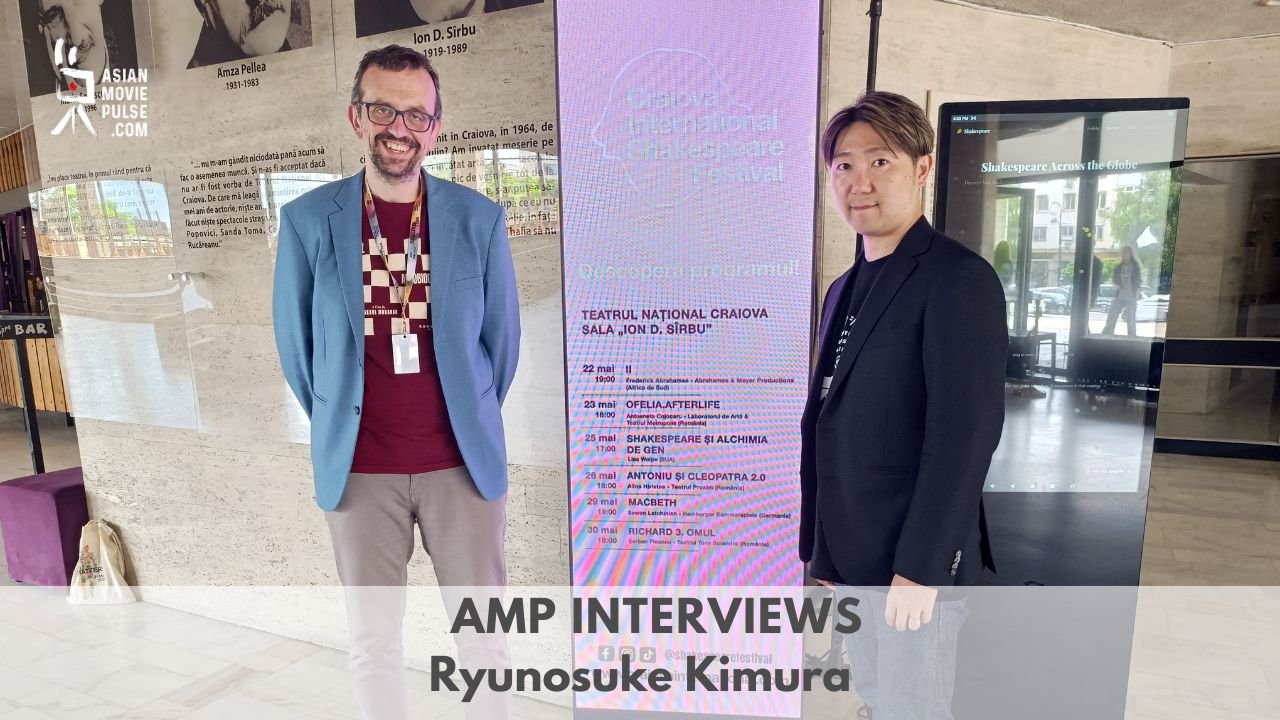
On the occasion of “Titus Andronicus: Reborn” being presented at the Craiova International Shakespeare Festival, Japanese director Ryunosuke Kimura spoke about Shakespeare, contemporary Japanese theatre, Noh, violence, and the long process that led the production to the Romanian stage. Created through his company Kakushinhan, the work has gone through several phases, cancellations, updates, and changes before reaching its current form, which combines Shakespeare, Noh theatre, Rakugo, physical performance, and a highly stylized approach to brutality.
Kimura’s presence in Craiova was part of the festival’s wider Japanese focus, which brought a number of Japanese stage productions, panels, and talks to the city. During a separate discussion with the audience, the director also spoke more broadly about his relationship with Shakespeare, the creation of “Titus Andronicus: Reborn”, and the ways in which contemporary Japanese society, global catastrophe, Noh theatre, and history inform his work.
Titus Andronicus is playing at the Craiova International Shakespeare Fesival
Kimura began that panel by asking the audience about their own reaction to “Titus Andronicus: Reborn”, turning the event into a dialogue rather than a conventional presentation. One spectator praised the atmosphere of the performance, the way history was brought into the production, and the idea that if people reconsidered things, perhaps they would not repeat the same mistakes. Kimura responded by saying that this is precisely how he thinks about Shakespeare: not as a dead literary monument, but as a living organism that must be adapted to the realities of the contemporary world.
For Kimura, his first meaningful encounter with Shakespeare did not come through childhood reading or academic admiration. Instead, it emerged from his own attempts to understand violence, catastrophe, and human cruelty. He mentioned several events that shaped his worldview, including the 1995 Aum Shinrikyo sarin gas attack in Japan, the September 11 attacks in the United States, and the Great East Japan Earthquake of March 11, 2011. As a young person, he struggled to understand why such tragedies and crimes happened and what could motivate people to commit them.
Although Kimura studied politics and religion through books, he said that this knowledge did not fully answer the questions he had “from the heart.” The turning point came when he encountered “Macbeth” in a library. Through the witches, the moving forest, and the image of blood that cannot be washed from one’s hands, he found a dramatic language that seemed to speak directly to the problems he was trying to understand.
This discovery led Kimura to “adopt Shakespeare” into himself, as he described it, and to cultivate Shakespeare within his own artistic life. He later became deeply interested in the work of Yukio Ninagawa, whose Shakespeare productions left a major mark on Japanese theatre and were also presented for many years at the Craiova festival. Kimura recalled that the first Ninagawa production he saw on screen was “Titus Andronicus”, an encounter that would become especially significant for his own career.
At the beginning of his work as a director, Kimura did not immediately adapt Shakespeare freely. Instead, he worked closely with the text itself. However, the events of March 11, 2011 convinced him that something had broken in Japanese society and that this rupture could also become the beginning of something new. It was in this context that he founded Kakushinhan Theatre Company, aiming to create a working company dedicated to Shakespeare and contemporary performance.
Kimura also described earlier projects in which actors worked with Shakespeare for long periods, including marathon-style performances that explored the plays over the course of an entire day. Through these experiences, he came to see history, politics, Japanese society, and culture through Shakespeare’s lens. For him, Shakespeare became a way of making sense of both personal and collective trauma.
This explains why “Titus Andronicus” became such an important work for him. Kimura described it as a Shakespeare play that he and other directors have to face now, precisely because of its violence, its grief, and its disturbing relevance to the present. Kakushinhan had previously staged versions connected to the work in 2016 and around 2019 or 2020, before developing the new “Titus” that first appeared in 2023.
The pandemic played a decisive role in the production’s path. Two attempts collapsed after cast members contracted Covid, while the cast and form of the work kept changing. Rather than simply stopping the project, however, the interruptions became part of its evolution. The production was continuously updated, including the major decision, around 2021, to incorporate elements of Noh through the participation of Yamai Tsunao.
This shift also changed the way Kimura approached the material. At the beginning, the pressure of the production was placed heavily on Shakespeare’s text, but gradually the emphasis moved toward the actors and their physicality. The final version, according to Kimura, became less about words alone and more about the bodies of the performers, with acting itself becoming the core of the production.
The creation of the work was also shaped by the spaces in which it was made. During the panel, Kimura said the company decided to work on “Titus Andronicus” around the time the pandemic closed theatres. Since conventional venues were unavailable, they rehearsed and staged the piece in a warehouse outside Tokyo, toward Saitama Prefecture. This space, he said, was not a theatre in the usual sense, but simply a space, something primitive that brought the work closer to theatre’s ritual roots.
One of the most important results of this process was the incorporation of Noh. For the role of Titus Andronicus, Kimura cast Noh actor Yamai Tsunao, a holder of Important Intangible Cultural Property status in Japan and a performer from the Konparu school. Kimura stressed the significance of this lineage, connecting it to the deep history of Noh and its foundations.
For Kimura, the discipline and continuity of Noh acting, preserved across centuries, represent a model of theatrical professionalism. Although Yamai would normally perform in Noh plays, Kimura wanted to persuade him to enter the world of Shakespeare because he believed the role of Titus had, in a sense, been written for him. The director saw in Yamai the capacity to carry the role’s weight, grief, violence, and sorrow.
In the interview, Kimura described Yamai’s presence as something extraordinary in the Japanese context, since a Noh performer appearing in a Shakespeare adaptation is far from common. However, he insisted that he did not want Yamai to appear as a “Noh performer” placed inside Shakespeare, but as a performer of Shakespeare himself.
The production is structured around what Kimura described as a kind of “Noh actor centralism”. Yamai stands at the centre of the stage world, while the other performers attack, pressure, and revolve around him. Yet rather than collapsing under this force, he transforms it into performance energy. Kimura connected this structure to Noh itself, where the relationship between the Waki and the Shite creates a central spiritual and dramatic axis. In “Titus Andronicus: Reborn”, Titus becomes that pivotal figure, the character around whom the whole stage universe turns.
At the same time, Kimura stressed that this centrality does not mean hierarchy in the rehearsal room. Even though Yamai is an important cultural figure, equality is one of the most important principles in his company. Everybody has a voice, and the director listens to all suggestions, while ultimately taking responsibility for the final direction of the piece.
Kimura also explained why Noh became so important to his interpretation of “Titus Andronicus”. In his view, Noh contains a strong element of warriorship, and a relationship between the killer and the killed. Rage and fury are present, but so are grief and sorrow, which can then be transformed and transmitted to the audience. This emotional structure allowed him to connect Shakespeare’s violent tragedy with Japanese theatrical tradition.
At the same time, Kimura does not see Noh as something that should remain confined to Japanese performers or Japanese ethnicity. He described it as a national heritage that he wants to share with the world. For him, artists from abroad can also learn to inhabit these forms, just as Japanese performers can inhabit Shakespeare. His mission as a director is to bring together Eastern and Western theatre theory and create a fusion that allows both traditions to speak to each other.
The question of violence was central to the conversation, as “Titus Andronicus” remains one of Shakespeare’s most brutal works. Kimura emphasized that the goal was not to be swallowed by violence, nor to eliminate it. Instead, the production had to deal with it properly. This meant maintaining a delicate balance between tragedy, comedy, surprise, and entertainment, allowing the actors to step out of the grip of violence without making it meaningless.
To achieve this, Kimura combines several forms, including Noh, Rakugo, stage props, and Shakespearean theatricality. He compared the treatment of violence to playing with a ball, with its force scattered across different genres and techniques. In this way, brutality is present, but it is not presented in a single, flat mode. Instead, it is refracted through form, rhythm, and theatrical distance.
Regarding one of the play’s most shocking moments, in which a mother eats her children, Kimura said that such violence is terrible and therefore cannot simply be shown realistically. It must be placed into form and metaphor. Because theatre is play, the horror should not be presented as direct violence alone, but transformed into an image that is still disturbing while also beautiful or symbolic enough to make the audience think.
The music of the production is another key element in handling this rhythm of violence and release. Kimura discussed the use of “hayashi”, a form of accompaniment rather than music in the conventional sense, and connected it to the idea of gradual escalation. This is also why Ravel’s “Boléro” appears in the production. The building tension of the music mirrors Titus’s rage, eventually turning into a crescendo that functions as part of the dramatization. As Kimura described it, the anger of Titus is placed into the structure of the bolero, creating a gradation of sounds that shapes the atmosphere of the work.
Kimura also spoke about how closely he thinks of the audience while directing. For him, every image and object must be considered in terms of how it will be received. He used the example of the silver sheet in the production, which he sees almost like a piece of modern art or a provocation. Throughout the process, he keeps an imagined audience in his mind, thinking scene by scene about how each visual and performative choice will be perceived.
The omnipresence of red in the production is similarly intentional. Kimura explained that his approach to blood looks back to theatrical masters such as Peter Brook and Yukio Ninagawa, with Brook using cloth and Ninagawa using red ropes in earlier approaches to “Titus Andronicus”. Kimura wanted to acknowledge these precedents while making the image his own. In his version, red is connected not only to blood, but also to the grief of the heart.
The mask worn by Yamai was created specifically for this production. Kimura explained that it is not simply a demon mask, but a “Titus” mask, designed especially for the character. Made by Noh mask designer Hisahito Iwasaki, it combines the face of a demon with that of a grieving person. Depending on the angle from which it is seen, the audience can perceive either sorrow or monstrosity. Kimura hopes the mask will endure for centuries, like traditional Noh masks, becoming a kind of memento through which future viewers might also read Japanese grief after the Second World War and the act of returning home.
The conversation also touched on the question of adapting Shakespeare for Japanese audiences. Kimura noted that many young people in Japan know Shakespeare’s name but have not read the plays and may not understand references such as Elsinore Castle or the basic world of “Hamlet”. This is why he often places Shakespeare in contemporary Japanese settings, allowing younger audiences to grasp the meaning behind the drama more directly.
One example he gave was his version of “Hamlet” set in Shibuya, with Hamlet sitting in a lotus position at the famous Shibuya Crossing, surrounded by crowds moving in every direction while he remains still. For Kimura, this becomes a contemporary equivalent of Hamlet’s castle. Beneath the crossing, he imagines the buried dead of Japanese history, while the blowing sakura petals recall the famous literary idea that corpses are buried beneath cherry blossoms.
This method, Kimura explained, is like assembling a puzzle. His task is to connect Shakespeare to history, contemporary Japan, memory, violence, and place. Whether dealing with “Macbeth”, “Hamlet”, or “Titus Andronicus”, he searches for the links that make the plays speak to the present.
Speaking about the Japanese reception of “Titus Andronicus: Reborn”, Kimura noted that audiences in Japan often tend to value a production more strongly once it has received attention abroad. Since it was announced that the work would travel to Romania, reactions became more ardent, even though “Titus Andronicus” remains a relatively minor Shakespeare work for many viewers. At the same time, Kakushinhan has its own loyal supporters, while some spectators were also drawn by the presence of well-known figures in the cast.
Kimura also described his position within Japanese theatre as unusual. He does not claim to be a specialist in the whole contemporary Japanese scene, since there are thousands of groups and non-professional companies across the country. Instead, he sees himself as working in his own lane, focused specifically on Shakespeare, which is itself rare for a Japanese theatre company.
Looking ahead, Kimura said he is restaging “A Midsummer Night’s Dream” with robots on stage and hopes within the next four or five years to create his own new version of “Hamlet”. His interest lies in finding a contemporary “Hamlet Reborn”, exploring how language can be transformed into the physicality of the actor and how humans can face language in an age increasingly shaped by AI.
Finally, Kimura discussed the financing of his work, noting the importance of crowdfunding, supporters, sponsors, and people in Japan who are interested in Shakespeare not as directors, but as backers of the project. He also stressed the value of working outside Tokyo, connecting with other prefectures, municipalities, and regional supporters in order to create a better environment for theatre.
Ultimately, Kimura presented “Titus Andronicus: Reborn” not simply as a Japanese version of Shakespeare, but as an evolving theatrical organism shaped by pandemic disruption, Noh tradition, physical performance, and a deep concern with how violence can be transformed into form. Through Kakushinhan Theatre Company, he continues to treat Shakespeare not as a fixed Western monument, but as a living structure through which Japan, history, grief, catastrophe, and contemporary theatre can meet.



