
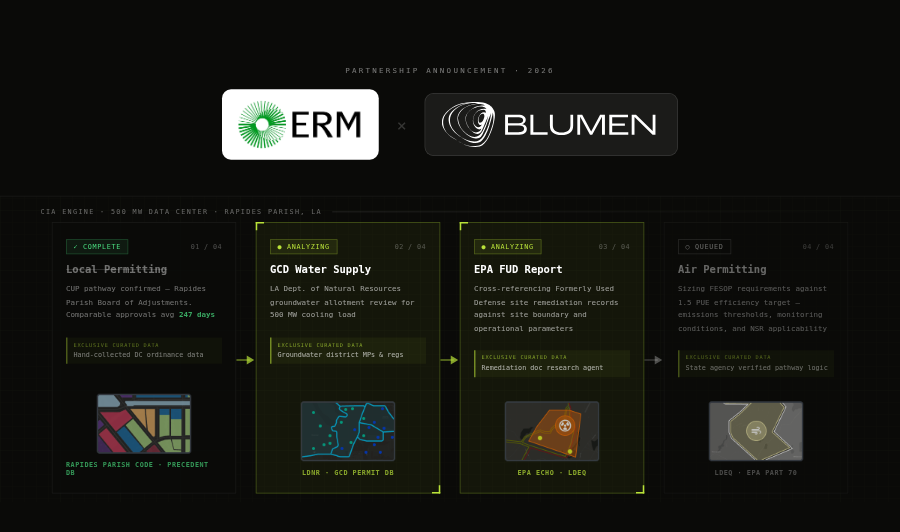
Aiming to tackle permitting challenges of the data center building boom, ERM, which says it is the world’s largest consultant focused solely on environmental, social and corporate governance and sustainability services, is partnering with AI and data infrastructure firm Blumen Systems to clear these hurdles.
The consultant and tech firm announced the partnership on May 26, and say it will help clients navigate complex permitting pathways, reduce site‑related risks and accelerate development of critical and increasingly complex capital projects.
“Permitting has always been complex, and now we’re seeing a change in scale and urgency of these projects,” says Neeraj Nandurdikar, partner and co-global lead for capital project delivery at ERM. “Our clients are navigating thousands of local jurisdictions with increasingly tight timelines.”
London-based ERM, which has 160 offices in more than 40 countries, ranks at No. 24 on ENR’s 2025 Top 200 Environmental Firms list, reporting $1.4-billion in 2024 global environmental revenue.
Hannes Boehning, Blumen CEO, began developing that firm’s renewable energy and infrastructure software tools as a graduate student at Stanford University, and founded the company in 2023. “We produced a huge amount of geographic data, but [at first] it didn’t talk to regulatory agencies,” he notes. “The advent of large language models allowed us to build on the technology, creating maps that ‘talk’ to regulations.”
A press release from Blumen stated: “For companies managing power, energy, manufacturing and data center developments, permitting and local regulatory requirements are often a source of cost, delay and execution risk. Companies face a convergence of challenges, including permitting uncertainty across thousands of local jurisdictions; compressed development timelines driven by urgent electrification and data center demands; and intensifying local and political scrutiny. Together, these factors mean more capital is at risk earlier in the development cycle due to increased regulatory, stakeholder and investment requirements.”
The firms conducted a couple of pilot projects before entering into the formal partnership, notes Boehning. “In both cases, we were able to mine entire past sets of projects and permits and public hearings.”
Looking for quick answers on construction and engineering topics?
Try Ask ENR, our new smart AI search tool.
Ask ENR →
Nandurdikar adds: “In those pilot projects, we saw early indications of value and a strong interest from clients in having this joint offering. What used to take multiple experts, and days and weeks from multiple sources, now can be done within a matter of days.” That includes obtaining zoning information, identifying geospatial constraints, codes and jurisdictions ,and detecting potential issues early on.
The release states that Blumen’s proprietary foundation of regulatory and geospatial intelligence “includes a comprehensive, continuously maintained dataset of local zoning and permitting regimes across the U.S. that is integrated with more than 2,000 geospatial layers and a growing database of historic permitting outcomes.”
The company adds that Its “rapid generation of permitting and site risk intelligence is validated through expert quality assurance, ensuring reliable analysis in high‑stakes regulatory environments where errors can have material financial and schedule impacts. The collaboration enhances ERM’s existing ecosystem of partnerships by providing clients with a clear understanding of permitting pathways, constraints and risks, informed by local political and community dynamics, sector‑specific design and operational considerations.”
In a typical scenario, “clients bring in a project folder and answer some questions,” says Boehning. “We then run through thousands of geodata sets and come back a few days later with the first draft of analysis.” The Blumen team will work with ERM experts to provide clients with better certainty regarding the permitting process.
The firms will initially focus on North America and on data centers, but “really, the need is cross-sector,” says Nandurdikar.
“We are living through an unprecedented infrastructure supercycle,” Boehning stated in the release. “The environmental and civil firms that integrate AI-powered regulatory and geospatial intelligence into their workflows will identify risks earlier, move faster with greater clarity, and deliver projects with a level of quality and consistency that has historically not been possible.”
Source: www.enr.com



