
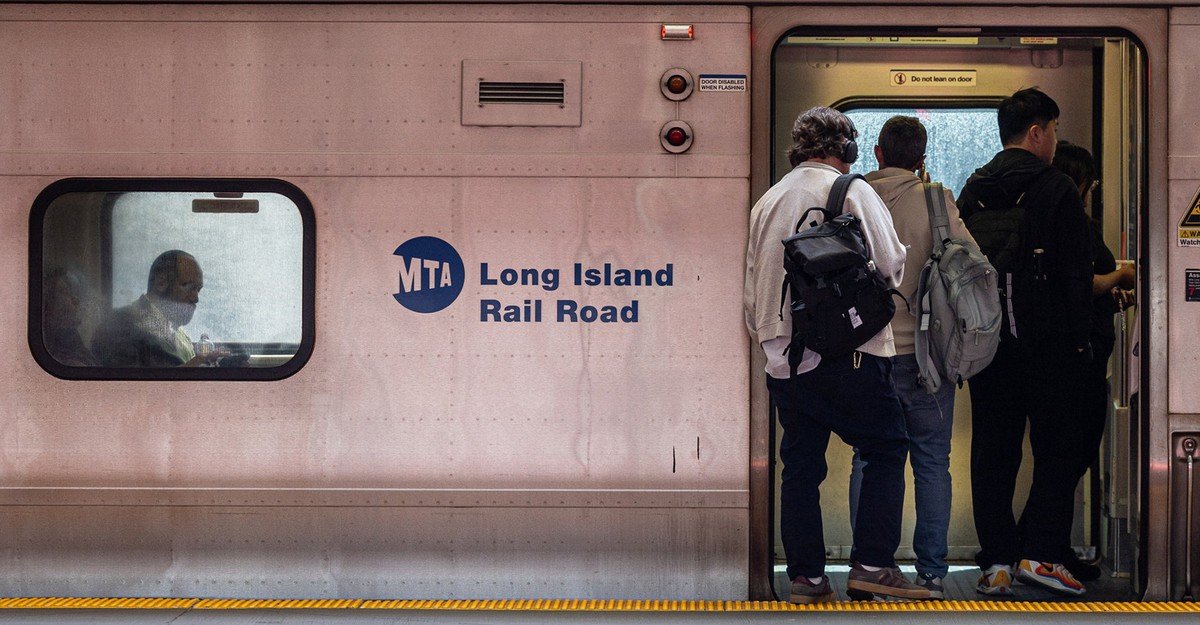
What are public-sector unions for, exactly? What problem are they supposed to solve? That’s the question I found myself asking earlier this month, when the best-paid railroad workers in America went on strike for three days.
To be clear, I get what the unions understand their purpose to be. It’s to get the best deal for their members. That’s what they’re designed to do, and they do it well.
Salaries at the Long Island Rail Road—a commuter-train system that connects suburban residents to New York City—now average $121,646, which is 50 percent more than the median household income in New York City ($80,483). Work rules entitle engineers to double or even triple pay when they drive different types of trains on the same day or when they deliver a train to the maintenance yard after driving passengers. Last year, more than 300 LIRR workers each earned $100,000 in overtime—in addition to their base pay. Those extra wages in turn inflate their pensions, which they can take at the age of 55 after 30 years of service.
All of this is as good for union members as it is unimaginable for most American workers. But taxpayers and commuters are the ones who pay for those generous compensation packages, and it’s reasonable to wonder whether they are getting a fair deal.
To her credit, Governor Kathy Hochul pushed back on the LIRR unions. But she quickly settled the strike on still-to-be-disclosed terms that will keep in place massive overtime payments, expensive work rules, and bloated pensions. That’s business as usual in blue states and blue cities, where public-sector unions wield fearsome political power.
None of this is inevitable. Strong unions persist because roughly 30 states have passed laws requiring collective bargaining with public workers. If this process advanced the common good, all would be well. But the available research suggests that it doesn’t. To the contrary, unions routinely insist on pay packages and work rules that degrade the efficiency and effectiveness of the public sector.
Our laws aren’t doing a good job, in short, of aligning union incentives with the public interest. That’s a big problem, especially as our most vibrant cities struggle to provide good schools, effective policing, and high-quality transit. Reform is long overdue. Thankfully, it’s also achievable.
For many union members, it’s completely obvious why we have collective-bargaining laws. “The training process for this job is over a year long,” explained one LIRR engineer on the picket line. “It consists of multiple examinations. Some of the written ones are incredibly difficult. We are very qualified. And, you know, frankly we deserve this money.”
We deserve this money. What should the public make of this argument?
In a market economy, compensation isn’t normally keyed to what a worker deserves in the abstract. It’s linked, instead, to what an employer has to pay to attract high-quality workers. An employer that pays too little will find itself with too few workers or workers who are bad at their jobs. An employer that pays too much risks being driven out of business by more cost-conscious rivals.
There’s nothing intrinsically fair about the resulting wage distribution. Because, from an employer’s perspective, the goal isn’t fairness. It’s running a successful business.
In the private sector, unions temper that unfairness by pushing corporate owners to split profits with workers. But private-sector unions can push only so hard: If they insist on compensation packages and work rules that make the business go bust, they could find themselves out of a job.
Matters are different in the public sector. The Long Island Rail Road, for example, is owned and operated by the government, much like public schools and police departments. As a result, the unions representing public workers aren’t constrained by the possibility of corporate bankruptcy. They’re constrained instead by politics.
Which means that politicians have to decide how to compensate government workers. One approach, favored by unions, is to depart from the baseline set by the market and pay workers what they deserve. It’s an appealing idea. Public workers do crucial work and ought to be compensated fairly for it.
The trouble, of course, is that there’s no end to claims about deservingness. Pretty much everyone thinks they’re underpaid and underappreciated. Sometimes they’re right; sometimes they’re not. But I don’t know what a teacher or a cop or a railroad engineer “deserves,” nor does anyone else.
Giving public-sector workers what they think they deserve, moreover, clashes with how everyone else in the economy gets paid. Is it fair for one group to get special consideration just because they happen to work for the government? Especially when taxpayers—working people themselves—are picking up the tab?
During negotiations with the railroad union, Hochul suggested that the answer is no: “Workers deserve to be paid fairly for their work,” she said. “But at the same time, we must be responsible with public funds and the fares paid by Long Island residents.”
That’s the right approach. When the government supplies public services, its goal should be to supply those public services as efficiently as possible—not run a tax-and-transfer system to aid the relatively small number of people lucky enough to be union members.
There is a better argument for public-sector unions, which is that unions have the leverage to demand compensation packages and work rules that are necessary to attract excellent public workers. Here’s Randi Weingarten, the long-standing head of the American Federation of Teachers: “If we want to recruit and retain high-quality teachers, it starts with a fair wage, adequate working conditions, and the resources and support to succeed.”
There’s a lot to this. The public sector, like the private sector, is only as good as its workforce. If unions help attract better teachers and cops, collective bargaining might improve the quality of public services. We should be happy, on this view, that unions are fighting for government workers. We’re all better off as a result.
Except that’s not what the research shows.
Start with schools. Two comprehensive reviews of the available evidence, one from 2025 and one from 2015, find that teachers’ unions reliably increase school spending, especially on salaries for veteran teachers. In general, however, they do not appear to help kids. “Most often,” the 2025 review says, “teachers’ unions have no impact or a slight negative impact on performance.”
Recent experience in Wisconsin is revealing. In 2011, Republicans passed a law, Act 10, that curtailed collective-bargaining rights for teachers. In the immediate aftermath, student outcomes suffered, mainly because of a sharp increase in teacher turnover. But that dip was short-lived.
Since then, a series of studies have suggested that Act 10 has improved student performance. Barbara Biasi, an economics professor at Yale, found that test scores rose when districts ditched seniority-based pay in favor of a more flexible approach. Morgan Foy of the University of Illinois found similar gains in test scores and attendance even in districts that didn’t adopt a flexible pay scale—because, he suspects, teachers worked harder when unions couldn’t protect them from discipline. And E. Jason Baron at Duke has shown that the promise of higher entry-level wages enticed more young Wisconsinites to get a teaching degree, which has improved the talent pool.
Now consider policing. In 2003, sheriffs’ deputies in Florida secured collective-bargaining rights because of an unanticipated court decision. Researchers at the University of Chicago Law School took advantage of that natural experiment by comparing sheriffs’ offices with municipal police departments that were unaffected by the court decision. Collective bargaining, they found, caused a roughly 40 percent increase in violent misconduct in sheriffs’ offices relative to police departments.
That’s the opposite of what you’d expect to see if public-sector unions made public services better. But it’s consistent with the general run of the evidence about policing. One forthcoming study, for example, finds that the extension of collective-bargaining rights significantly increased the number of civilians killed by police, especially nonwhite civilians, and “can explain 14 percent of all non-white civilian deaths by legal intervention between 1959 and 1988.”
To put it mildly, these results are hard to square with the claim that public-sector unions improve the public sector. At least three factors seem to be driving those results.
First, unions often push for job protections that frustrate workplace accountability. In the study of Florida sheriffs’ deputies, for example, collective bargaining appeared to cause a rise in violent misconduct, because of “a reduction in expected sanctions.” In other words, sheriffs’ deputies knew they could get away with it.
Second, unions push to equalize pay among their members based on seniority and credentials, not on quality of performance. That makes recruiting talented young people difficult, and rewarding good workers impossible. The Wisconsin reforms, for example, “led younger and less credentialed teachers to earn more on average, and older, more experienced teachers to earn less.” That’s bad for aging union members, but good for students.
Third, public-sector unions avidly negotiate for compensation in the form of pensions, not wages. But pensions are a poor recruitment tool: Starting wages matter much more to young people than pensions that will be paid out decades down the line. When unions use their power to boost pension payments, they aren’t working to attract talented young people. They’re working to reward their members.
If we want unions that actually improve the quality of public services, we’re going to have to reform our collective-bargaining laws.
As matters stand, those laws require state and local governments to negotiate with unions. But they also establish what those unions are entitled to negotiate over—what is “bargainable.” And a very wide range of terms and conditions of employment are typically bargainable. That’s how you get demands for job protections, pay equalization, and hefty pensions.
None of that is graven in stone. The laws could be amended to limit the scope of what’s bargainable. Overtime, pensions, work rules, salary schedules—all of those would be off-limits. Unions would be left to negotiate over the one thing that is most likely to attract high-quality workers: base wages.
In that world, unions would still be powerful. They would still serve as a counterweight to local governments that might try to balance their budgets on the backs of middle-class workers. Their members would still receive job protections under civil-service laws. The unions just wouldn’t be allowed to make demands that frustrate the delivery of high-quality, cost-effective public services.
Reformed collective-bargaining laws would bring what unions want into better alignment with the public interest. Otherwise, we’re left with the LIRR engineer’s argument about what the unions are for: We deserve this money. The engineer may be right about what he deserves. Surely we all deserve better in this fallen world. But it’s no way to run a railroad.



