
Published May 28, 2026 06:00AM
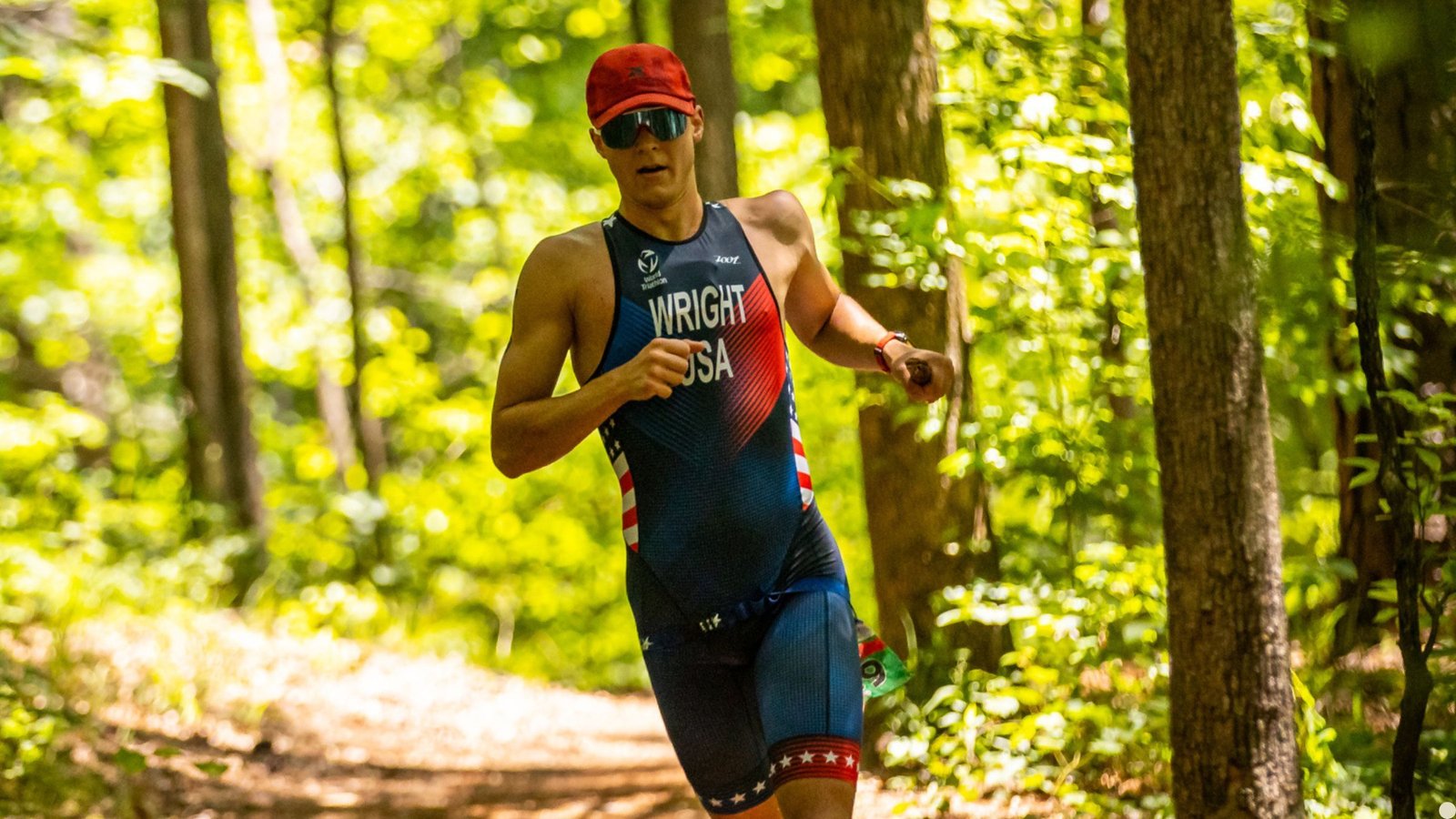
After winning the USA Triathlon Junior Cross National Championship at Oak Mountain State Park in Alabama and defending his XTERRA North American Junior Championship title on May 18, Lucas Wright had somewhere else to be.
There was no extended celebration or slow ride home. He boarded a flight to Allentown, Pennsylvania, to be there for his sister Zoe’s graduation from Muhlenberg College.
The race weekends are getting bigger, and more opportunities are beginning to form, but his family, including parents Michael and Mary, have remained the constant presence beside him. They have been there through mountain biking, road races, draft-legal qualifiers, college competitions, and now a season in which XTERRA, USA Triathlon and Wingate University are all beginning to come together.
“My dad did Ironmans back in his day, or at least half Ironmans,” Wright says. “He did a couple triathlons and some of the local triathlons around here. The Columbia Triathlon was big for a while. He stopped doing those when I was really young, probably when I was four or five, but when I started, I knew he had done them, so he helped me along as I got into them.”
Before Wright had a racing calendar built across three parts of the sport, swimming had taken over his younger years. Baseball remained alongside it for a while, but year-round swimming eventually demanded too much time for both to continue.
How Lucas Wright found off-road triathlon success
“I just want to enjoy what I do. I didn’t stop swimming yet, but I started biking and running a little bit, having a little fun,” Wright says. “Then I did my first triathlon, which was EX2, my local XTERRA in Maryland, between ninth and tenth grade.
Growing up in Ellicott City, Maryland, with the mountain bike trails of Patapsco Valley State Park close to home, entering an off-road triathlon on the same bike he had already been riding for fun felt like a natural first step.
“The first sign that this could be something bigger was my second year at EX2. I won it outright as a kid, and I was like, wow, this is pretty crazy. I didn’t really expect to do that.”
“Then 2025 was the year I really knew I was on to something. I went to XTERRA Puerto Rico, and I think I beat the entire pro field there. That was where I thought, okay, I really think this is something I want to do. This is something I can compete at.”
Mastering the draft: Lucas Wright’s entry into USA Triathlon and junior draft-legal racing
As Wright was beginning to build off-road momentum, an Olympic-distance triathlon on Maryland’s Eastern Shore qualified him for USA Triathlon Nationals the following year, placing him at a championship weekend in Milwaukee where age group racing, draft-legal competition and the PTO US Open were all taking place together.
His first draft-legal race came later that fall. Wright entered as a junior athlete without much experience in the format, racing among college athletes in a collegiate conference event. Coach Rad [Nicholas Radkewich], now his coach at Wingate University, noticed him there before either could know where that introduction would lead.
“I did a random draft-legal race that fall, and that is actually where I met my college coach now, Coach Rad. The following year, I joined the team with the coaches from that summer camp, MC Elite. I did three races that year, two qualifiers and nationals. This year, I’m planning to do four qualifying races and nationals. I really just want to end my last junior season having fun with that circuit.”
“Draft-legal is very fast-paced racing. You are definitely at threshold the entire time. There are a lot of fast boys, and it’s all juniors, pretty much the fastest juniors in the country at every single race. After the first race I did, I noticed it was a lot of fun because you are always around people. There are always people around you in the draft packs and on the run, and it pushes you really, really hard.”
The two styles of racing have not developed separately for him. “I think there is a back and forth between draft-legal and XTERRA, both ways. Good training in draft-legal is actually pretty similar to XTERRA. You are in packs, coming in and out of corners, and chasing the front down. It’s repetitive, high-intensity intervals, so the training goes together really well.”
Balancing academics and athletics
Years after that first draft-legal race, the coach who had noticed Wright among college athletes came back into the picture when he began looking at universities.
“Coach Rad first found me at that first draft -legal race I ever did. It was a collegiate conference race that year, and I was just a random kid who had never done a draft legal race, racing with all these college kids,” he says. “I guess he had approached my mom at that race. Years went by between that and when I actually committed, but when I started looking at colleges again, my mom reminded me that he had emailed her all those years ago. I submitted my application, I was accepted, and it kind of just fell into place.”
At Wingate, where he is double-majoring in finance and exercise science. It’s the triple crossover: learning to develop in a collegiate racing environment while keeping the off-road calendar and junior draft-legal schedule active alongside it.
“All the XTERRA experience counts toward USAT acknowledgements if it is in the U.S. They compile all of those into their ranking database. I think I’ve been an All-American every year since I started, and last year I was nominated for the U20 Off-Road Athlete of the Year from USAT.”
Following his successful title defense at the XTERRA North American Championship, two more qualifiers and nationals remain on his junior circuit schedule, with another opportunity potentially following the summer championship.
“Based on this year, I’m first from Collegiate Nationals, Texas, and Claremont. Texas was a draft-legal qualifier, and Claremont was a draft-legal race earlier in the season. I have two more qualification races and then nationals this summer. There is also potentially an opportunity for me to go to a USAT camp just after nationals, based on my rankings in the middle of June. They are taking the top three junior athletes and flying them out to Utah to train with Project Podium, the Mallow team, and their high-performance team. Basically, all the big guns in the USAT organization are going to be there training.”
A double victory at the 2026 Oak Mountain championships
The 2026 Oak Mountain weekend brought two championship routes into the same race for Wright. The previous year, he had won the XTERRA North American Junior Championship while the USA Triathlon Cross Triathlon National Championship took place in Oregon, creating a conflict with his draft-legal racing schedule. This time, both titles were decided on the trails in Alabama. Wright finished 11 minutes, 18 seconds ahead of fellow Junior athlete Jacob Hamblin, gaining 1:32 in the swim, 4:36 on the bike and 4:32 on the run.
“XTERRA puts on a really great race, a really professional race,” he says. “To bring the national cross championships to XTERRA was a really good step. Defending a title felt different. There was definitely some pressure.”
But pressure is where he thrives: “I am very used to – at least in the draft-legal races – being the hunter and trying to catch up to people, because there are a lot of fast people in those races. It’s definitely different being hunted.”
Bike setup and gear secrets: the technical adjustments for XTERRA racing
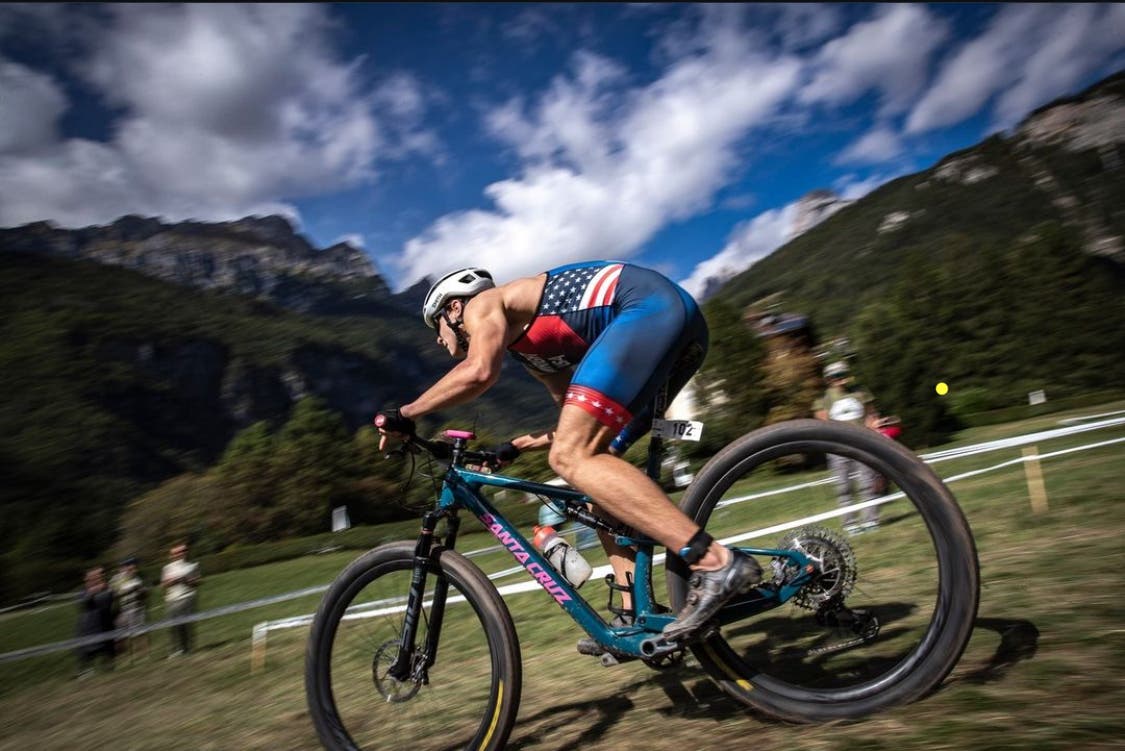
The time spent preparing for collegiate racing had also left him away from his mountain bike. Returning to his Santa Cruz Blur XC meant moving back from the road and TT position into the technical decisions and physical adjustments demanded by the off-road.
“That is my baby,” he says of his bike. “I’ll be honest, at college it was a lot of road and TT preparing for the collegiate races, and I got back on my mountain bike and it felt foreign for the first couple miles. But once I started getting into it, going downhill, having fun, I got used to it again.”
The equipment choices for an off-road race are part of what Wright now has to read each time he returns to XTERRA. Surface and weather determine the tyres, pressure, tread and suspension. Conditions also change what he can carry and where he can place it on the bike.
“When I’m choosing my bike setup for different XTERRAs, the biggest thing is tires. Depending on dry or wet conditions, I think about pressure, different types of tires, and different tread patterns. I’ll worry a little bit about shocks too, whether I want them a little firmer or a little looser depending on the terrain.
“The other big thing is nutrition, whether I want it in bottles or whether I stick chews to my top tube. If it is rainy, obviously you cannot really stick stuff to the top tube because it will wash off. Those are the three big things for me right now.”
Switching from road and time-trial preparation back to the mountain bike changes his position over the bike and the way his body has to work through the course.
“The biggest adjustment from draft-legal road triathlon to XTERRA is the seat position over the bottom bracket. When I’m doing TTs, my seat is closer to the handlebars and more over the bottom bracket. In mountain biking, the seat is so much farther behind the bottom bracket. That is a brutal adjustment to make, and it changes some of the muscles you use around your hips and upper leg.
“Everything else is fine. The handlebars are a little bit wider, but that actually helps in the woods with turning and stuff. Really, the biggest thing is just that seat position.”
The training focus: Prioritizing run and bike volume while maintaining a champion’s swim base
The swim background that first brought Wright close to burnout has become the part of his triathlon that needs the least rebuilding. With that base still available to him, he can direct more training toward the run and bike while maintaining the discipline that first introduced him to competitive sport.
“Running is still the one I’m working on, but maintenance is definitely a lot easier than building. I have that base of swimming. I swam so many yards for so many years, and I got really, really fast. My form is very diligent, and I try not to stray from that,” he says. “Even though I’m doing less yards now, I keep some high intensity in there, and that is the maintenance part.”
With the reduction in swimming volume, and by alternating bike and run volume, Wright says he can put more effort into the run and the bike while still maintaining the swim.
Oak Mountain placed two championship titles beside Wright’s name, but the next part of his year was already waiting: his sister’s graduation, his remaining junior draft-legal qualifiers, nationals, Wingate, and the possibility of training in Utah through USA Triathlon. The mountain bike, the road bike, and the TT bike are all part of the same season now, just as XTERRA, USAT and collegiate racing each hold a place in where his career may go.
His triple crossover is underway, and at 19, he’s finding out where all three roads can take him.



