
Published May 27, 2026 06:00AM
Chances are you’ve found yourself halfway through the swim leg of a race, shoulders fatigued and hyperventilating. You made it to dry land, but you were already feeling depleted – all before you even touched your bike.
For many triathletes, targeted shoulder work is a missing piece of training that reveals itself on race day. The good news? You don’t need much of it to become a stronger swimmer.
“Getting your body strong and primed for three different sports can be a demanding affair,” says Dede Griesbauer, a former Ironman champion and Stanford swimmer who now works as a strength and triathlon coach.
“A lot of triathletes tend to see the swim as an inconvenience to an otherwise wonderful triathlon event, so carving time for specific shoulder strength can be difficult in the face of other demands. As with most strength work, a little bit can go an awfully long way, and something is better than nothing!”
Signs you need more shoulder training
Griesbauer says swimmer’s shoulder is a common overuse issue for triathletes, and can be compounded in triathletes with a predominantly “forward” posture from time spent hunched over the aero bars and then working at a desk for hours afterward.
“Pinching, weakness, or stiffness in the shoulder joint is a sure sign that an athlete should dedicate some attention to shoulder stability exercises, and on activating and strengthening the lower trapezius and rhomboids,” she says. “Also, addressing the forward posture will allow the shoulder to hang more properly in the joint and alleviate some of the relative strength imbalances within the shoulder stabilizers.”
Why your shoulders are the key to a better swim
The exercises below are designed to activate and strengthen your lats (latissimus dorsi, the large muscles in your back) and your triceps, two muscle groups central to an efficient stroke.
“For swimmers, your lats are the primary powerhouse muscles that provide propulsion through the water,” Griesbauer says. “The triceps offer the finishing touch at the back end of your stroke, so any upper body exercise that creates strength and power in the lats and triceps will be beneficial.”
The other key piece is shoulder stability to create the essential “catch” position at the start of the stroke and maintain an early vertical forearm position.
“Having the shoulder strength and stability to hold that catch position as the lat activates and propels you through the water is mission-critical to an efficient and powerful swim stroke,” she says.
George Vafiades, a New York-based strength and conditioning coach who has completed six Ironmans and countless other tris, echoes the functional focus. “This strength work is not about getting a burn or getting the heart rate up; it’s more about functionality,” he says.
Workout overview
This routine shouldn’t feel like a traditional workout; remember, the goal is control and functionality, not fatigue. Vafiades recommends 7-12 reps per exercise, giving yourself a minute to complete each movement before taking a minute of rest. While the upper body is the focus, he incorporates the whole system.
For an optional finisher, add on 15 minutes of a compound movement (a dumbbell, kettlebell, or barbell deadlift, one minute on and one minute off) to continue working the upper back, lower back, and hamstrings together.
How often: In the base and build phases of the season, Griesbauer recommends two to three strength sessions per week if possible. During race season, once weekly is enough for time-starved athletes. “If you’re able to do this set once a week in season, that’s great,” adds Vafiades.
For additional swim efficiency, Griesbauer recommends supplementing with lat pulldowns, rows (cable, plank, or bird dog), and core work. And for a quick pre-swim hit, stretch cord exercises and band work can be done in five to 10 minutes on the pool deck before you get in the water.
4 shoulder exercises for swimmers
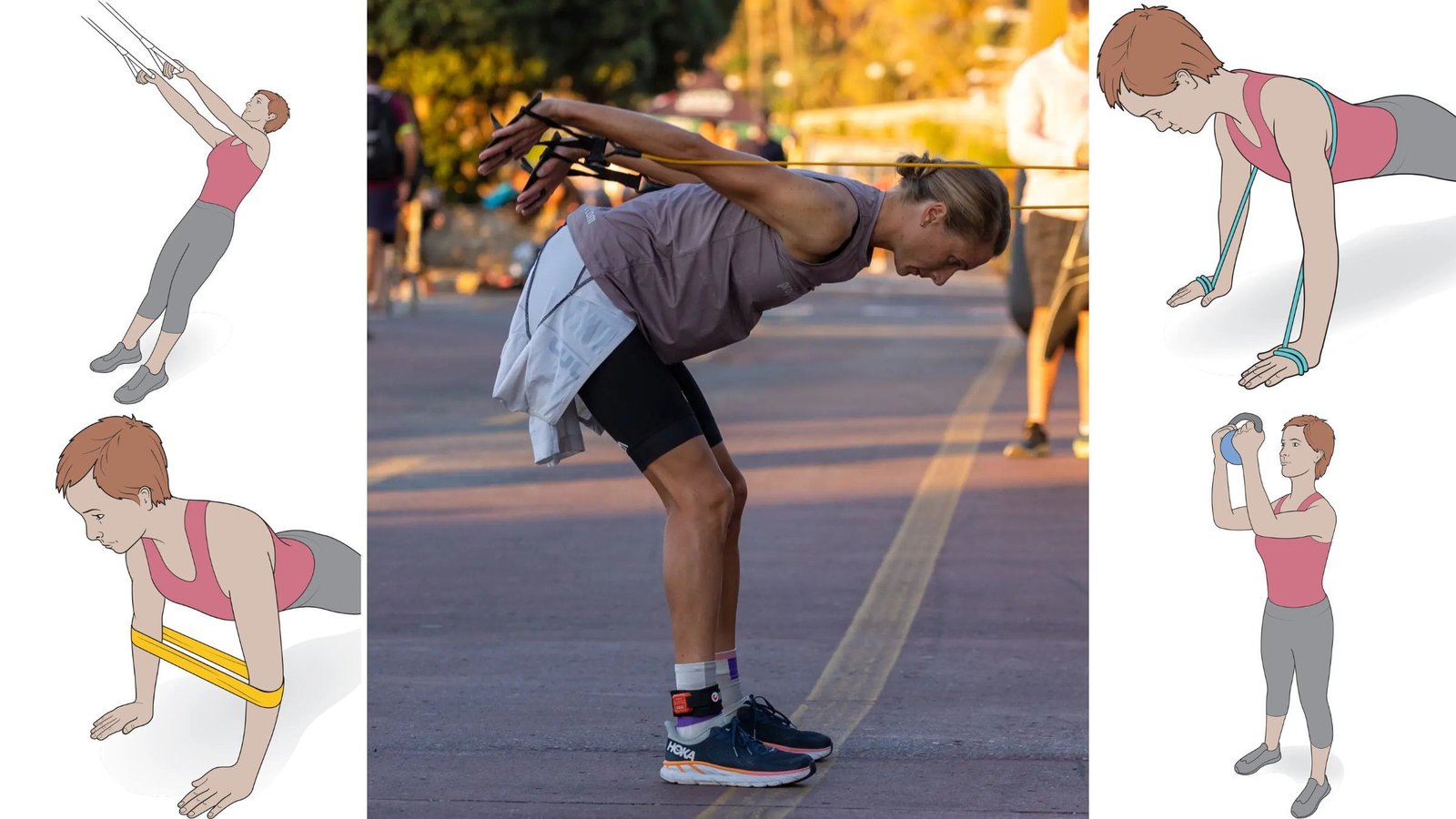
TRX isometric hold row
Take the straps in your hands and lower to a diagonal position with your feet placed firmly on the floor, and your arms outstretched. When you get to that low point, hold for one second and squeeze your shoulder blades together before “rowing” yourself up — elbows close to your rib-cage. For a more advanced challenge, perform with one leg raised.
Step-back lunge with kettlebell

Take a light kettlebell and hold it around eye level with your arm outstretched and bent at a 90-degree angle. Step back to lunge, lowering your knee toward the floor; prevent the kettlebell from swaying by engaging your bicep, tricep, and upper-back muscles.
Banded plank

Place a resistance band around either your palms or your elbows and remain in a plank position with your hands shoulder-width apart. Aim to hold for 60 seconds.
Pushup with resistance band

Place a resistance band around your palms, and place both hands on the floor, shoulder-width apart. Lower slowly into a push-up, keeping your elbows tight to your ribs. The resistance band helps stop elbows from flaring out and pulls the shoulder blades down the back. Keeping shoulders engaged will help with shoulder stability.
Bonus poolside shoulder exercises
These are Griesbauer’s favorite poolside shoulder exercises — easy to work in during the five to 10 minutes before a swim session:
Pre-swim stretch cords

Stretch cords are one of the most swim-specific exercises you can do because they pretty identically mimics your swim stroke, with the added benefit of being on dry land, so the swimmer can visualize that high, early vertical forearm and get the shoulder stability and lat strength all in one.
From a comfortable standing position, hinge at the waist to form a 90-degree angle. Then use the stretch cords to simulate your swim stroke as you focus on fundamentals and warm up the shoulders.
Internal/external rotation exercises
Pack a smaller band in your swim bag for some internal and external shoulder rotation exercises. These are a great way to warm up the shoulders and to activate and strengthen all of the tiny shoulder stabilizer muscles in the rotator cuff (supraspinatus, infraspinatus, teres minor, and subscapularis).
Set up your stretch cord so that it’s hip height. Stand with your left arm down, reach your right arm across your body, pick up the stretch cord. While holding your right elbow close your side, pull the cord until your right arm is rotated all the way out to your side. Slowly return your right hand back to your left hip (without moving your right elbow). Rotate to the other side of the band and repeat with your left arm.
Stability ball thoracic archer
“This is a great one because the hand stabilizing the ball gets a hit of isometric strength for the shoulder stabilizers while the thoracic rotation offers that dose of lat activation and upper mobility that most triathletes desperately need,” says Griesbauer. These combination exercises have multiple benefits rolled into one exercise, offering great bang for the buck.
Start on your knees on the floor next to a wall, facing so that your right shoulder is about a foot from the wall. Place your left foot up so it is firmly planted on the floor. Take a stability ball and use your left hand to stabilize it against the wall. Place your right hand behind your head and rotate your trunk until you are facing the wall. Rotate back to your starting position, bracing the stability ball with your left hand the whole time. View a video demonstration of the exercise.



