
Updated July 13, 2026 10:54AM
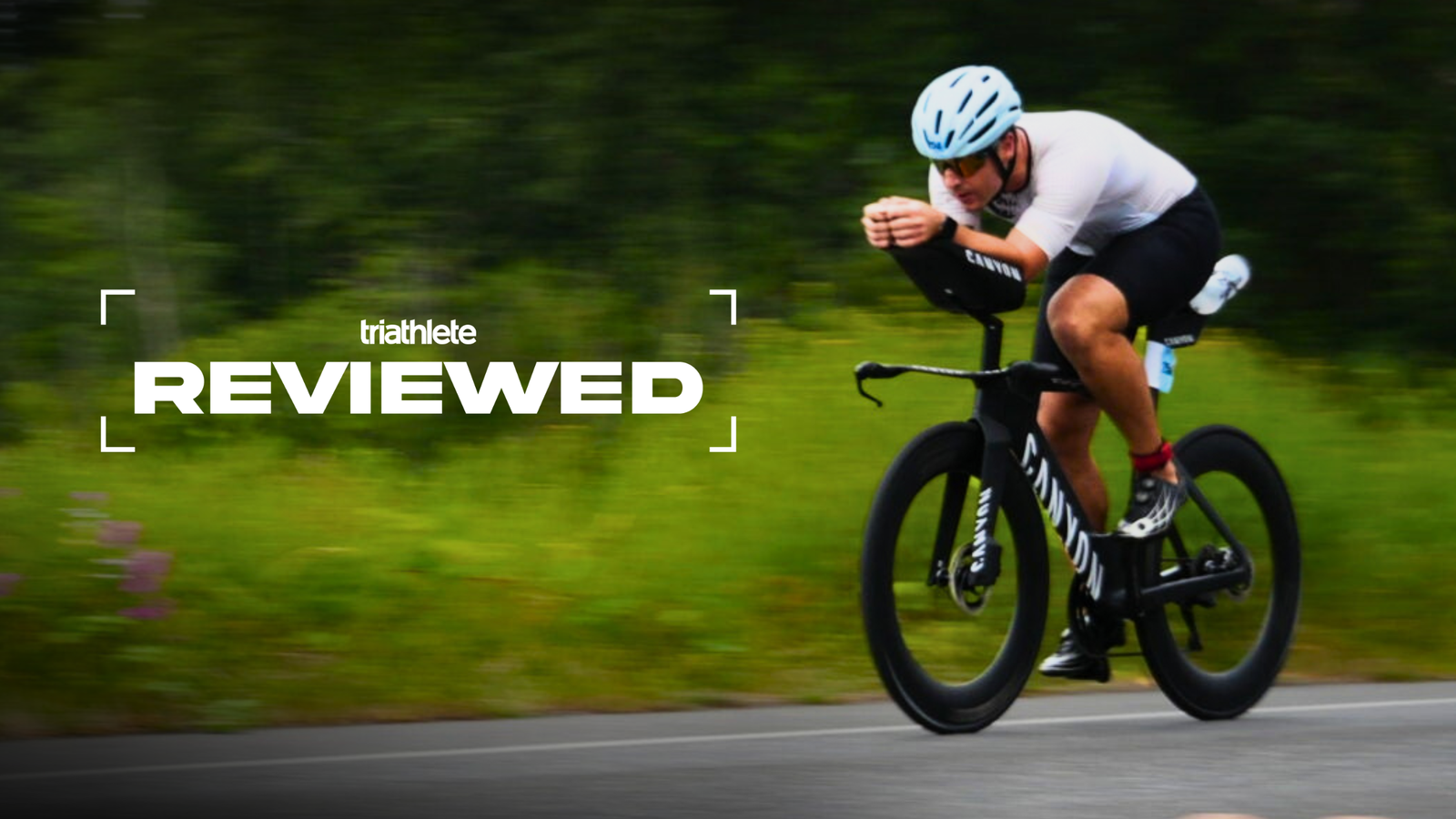
Challenge Roth couldn’t have been a more dramatic unveiling for what Canyon calls the fastest triathlon bike in the world, with two of its athletes, including champion Sam Laidlow, producing sub-3:55 180 km bike splits and averaging more than 28.56 mph on the new Speedmax CFR Gen 6.
Reading numbers like that in the past would typically leave any amateur believing that, even if you possessed their power, those speeds and splits were impossible to achieve without the custom setups and pro-level support that are out of reach for almost every age-grouper.
But this is exactly what Canyon aimed to solve with the latest Speedmax CFR—a three-year project we first learned about just before Oceanside 70.3 in March. We had to sit on the news for three agonizing months, plus one extra week spent actually sitting on the bike itself. But that wasn’t enough. Like any everyday triathlete, we wanted to answer: Yeah, but how does it race?
That took another weekend, but the extra time was worth it, as we can give our unbiased, race-tested impressions below.

But first, let’s address the elephant in the room: With an already tight lineup of superbikes, why would Canyon make yet another not-really-cheap bike in a crowded market? According to Canyon, the goal with this bike was not just to create a faster frame. (In fact, that was something Canyon said they found almost impossible to do compared to its 2021 model.) Instead, the aim was to take the type of aerodynamic, highly customized fit once possible only for professionals with access to wind-tunnel testing or custom engineering and make it available to age-group athletes out of the box.
The TL;DR is that their engineers believe that the rider who holds the fastest position comfortably for the longest time is ultimately the quickest over just fast materials. This is a logic that top-level bike fitters have echoed for ages.
But is it really exactly like what the pros are riding? As I watched Challenge Roth unfold live while riding indoors on the new $13,100 (as tested) fully specced CFR bike – adjusting my own setup as Laidlow and Bogen were rewriting the record book – I was preparing to take the CFR to my local race, where I would put the bike to its first full test: 24 miles of an Olympic-distance triathlon. And already, I knew this was a one-of-a-kind ride.

Canyon Speedmax CFR at a glance
The new version of the Canyon Speedmax comes in two models – the top-end CFR and the CF SLX – with various configurations in between, prices ranging from $7,500 to $13,000-plus, and four sizes from Small to XL with 31mm tire clearance and supports SRAM and Shimano drivetrains.
The bikes are built around Canyon’s AeroID system, which allows customers to receive a personalized fit (PPS – perfect positioning system) by entering their sizing and preferences or bike-fit data at purchase to determine their best fit. The assembly team then pre-configures the bike before shipping.
All versions use the new Speedmax frame, which has changed little from the previous model. Despite Canyon developing 12 prototypes, they claim only one turned out faster – just 0.5 to 1 watt faster, but it was too heavy.
Instead, Canyon said they ended up with a very similar frame featuring “new, progressive geometry,” while reducing the frame weight by up to 250 grams and the full build weight by up to 547 grams. Notably, the top-tube storage box from the previous model is now gone, with storage options moved to the BTA (between-the-arms) system. The medium CFR version we tested weighed in at just over 19 pounds.

However, the cockpit is the standout feature of the bike.
First, there are two closed-structure, raised-side-wall cockpit options. The regular AeroShield offers adjustability in width, length, and grip angle. The AeroShield Pro we tested is the more advanced monocoque setup. It is 300 grams lighter and offers three width and length options built around an athlete’s forearm length and circumference.
Both setups use Canyon’s AeroModule Hydration and Storage system, which allows athletes to choose from various options depending on their needs, whether that means a storage box, a hydration setup, or an additional combination of both using the optional “BTC Beam,” which features a standard-size water bottle cage and gel compartment.

The bike also features renewed in-frame hydration, developed in collaboration with HydraPak, with capacities ranging from 650 ml to 850 ml depending on frame size, with quick access for race refueling.
The cockpit uses a new monopost system that allows users to rapidly adjust stack height with two bolts, as the post slides into the head tube like a seatpost. Three stack options are then added to set the height incrementally with a range of 105 mm. Furthermore, during checkout, athletes are asked to choose their cockpit post variation, specifically for their reach, stack, and angle adjustment ranges.

The final standout feature is the seatpost, with the winged fin splitter plate pro option coming standard on the CFR and optional on the SLX 8 model. It offers several hydration mount positions, allowing athletes to place bottles farther in and lower, or farther out and higher, and adds 76 grams to the build.

Build and first impressions
Upon opening the box, there is a very clear, very German attention to detail, with every small moment of the experience carefully thought through. From the packaging to the detailed instructions, the nerves of unboxing something this valuable quickly give way to confidence.
One exception to that was the extra manuals and spare parts, which weren’t well addressed and could quickly be overwhelming to a first-time buyer if you’re not sure what their significance was. There was also no tool I could find to tighten the bar-end shifters, which were loose on arrival.

With that aside, the build experience was one of the easiest I have had on a bike at this level, and it quickly highlighted the bike’s fit features. Every bolt and part displays the correct torque setting, while subtle markings make it easy to track your exact sizing measurements.
After installing the seatpost and wheels, I was anxious to move on to the cockpit. To my amazement, it slotted in just like the seatpost after housing the Di2 or SRAM wires internally in under a minute. Within a few more minutes, I had successfully installed the entire cockpit and was already playing with stack, reach, and angle adjustments to begin dialing in my fit toward race day.
The cockpit is everything
Immediately, the adjustability and flexibility of the bike are apparent. The seatpost range and angle options are comparable to other bikes at this level, but the cockpit is where the bike truly stood out.
Two screws at the front hold the stack in place, while two screws around the cockpit fuel storage area allow for quick adjustment of reach and tilt angle.
Let me tell you – this is a dream for an average rider like myself who is constantly tinkering with position, and I imagine bike fitters will feel the same way. The fact that I could carry the included lightweight torque wrench on a ride and dial in my fit with ease was one of the biggest real-world wins. Stack height could be changed in less than a minute, while reach and angle adjustments took less than two.
The Aeroshield Pro monocoque cockpit I tested felt more stable than expected, even at higher stack heights. Because it spreads weight over a wider surface than a traditional two-pad setup, it felt supportive despite placing me in a narrower, more aggressive position than I am used to. The pre-determined fit also seems spot on, with Canyon saying the development process included 183 forearm scans to create the multiple width and length options designed to better match different riders.

Even getting in and out of the extensions, or riding with one arm in the extension and one hand on the base bar, was better than expected. That is likely because the cockpit angles slightly outward rather than straight up, so your arms do not feel completely locked into place. It is certainly snug, especially with the storage module in place, but it feels secure rather than trapped.
Real on-road testing and racing of the Canyon Speedmax CFR
To give the bike a proper real-world test outside of about a week’s worth of training rides, I took it to our local Lake Whatcom Triathlon – a race I had done twice before on two different time-trial bikes. That gave me two imperfect-but-useful benchmarks: a 1:15:45 bike split over the 24.9-mile Olympic-distance course on an older, ill-fitting Jamis TT bike, and a 1:12:16 split on what I would call a current-generation A2 that I believed was one of my best-fitting, most dialed bikes.

This was by no means a scientific experiment. Conditions were very different, and there are, of course, too many variables to control. But in terms of general fitness, I was lining up in a very similar place to those previous years – now a couple of years older, maybe with a little less sharpness, but evened out with a little more experience.
So the question was simple: Would this expensive, out-of-the-box “superbike” actually make a noticeable difference – first and foremost in how it felt, and secondly in my time on a familiar course?
Even with wind and rain affecting much of the ride and producing notably slower times than in previous years – something several regular competitors I spoke with also noticed – I felt fast on the Speedmax.
More than anything, I found myself thoroughly enjoying the ride. I was as comfortable as I could be in the snug cockpit, even in an aggressive new position that I had only ridden for a week leading into the race. I specifically remember thinking how easy it was to stay in the aero position for longer, thanks to the way the cockpit distributed my weight across my forearms.

One of the biggest concerns in designing such a versatile cockpit, Canyon shared, was stability. They wanted the widest possible cockpit adjustment range, but that range had to be built into the frame reach and overall geometry rather than simply added on top. The entire system was carefully designed around the rider’s elbow point. That is the anchor for the fit, and you can feel it on the road.
The one-piece cockpit also feels fast in a way that is hard to ignore, even without access to a wind tunnel. You can feel how little air seems to pass between the arms, across the chest, or around the midsection. It is no wind-tunnel test, but it is one of the first things you notice once you settle into position.
The CFR also includes small fingertip stays on the hand grips that keep your fingers locked onto the extensions. It is such a small detail, but after racing with it, it will be hard to go back to a cockpit without one.
For me, it was one of the first times I noticed my heart rate drop in a race when I settled into the aerobars rather than riding on the base bars, and the Ergon armrests are subtle yet comfortable; you almost don’t notice they’re there.
That collaboration with Ergon continues with the base bar grips, which are among the best we have tested. Despite the wet conditions in the second half of the ride, those grips also give real confidence when nervously cornering. Climbing and descending on the base bars also felt more pleasant than expected, with the narrow width really letting you tuck in on descents.
You can see how this bike was designed with courses like the 2023 and 2024 Nice World Championships in mind, where Sam Laidlow and Laura Philipp both won on the technical bike leg.
However, in training, I found that the cockpit’s snugness comes with one obvious trade-off: airflow. There is very little air moving between the arms or around the chest.
Great for aerodynamics; however, it gets warm and sweaty quickly, often within 30 minutes. After one hour-long 70-80-degree weather ride, sweat was dripping from the bottom of my cockpit, as there is almost no wiggle room when the hydration or fuel module is attached between the arms.
That makes it easy to understand why Sam Laidlow’s and Patrick Lange’s cockpits in 2024 featured cooling armpad technology, and why athletes like Lucy Charles-Barclay have also been working with new cockpit cooling solutions. For a cockpit this closed off, it feels like a no-brainer.

So for this race, I appreciated the cool, wet temperatures so it wasn’t warm in the cockpit, and I was channeling my inner Laidlow to keep my head tucked and take advantage of the bike’s aerodynamics.
Since it was only an Olympic-distance bike, I didn’t need the full 3500ml of liquid capacity this bike can hold when including the in-frame hydration bladder. I just used two small bottles on the rear and the front hydration system, which was more than enough – easily utilizing the magnetic straw to rehydrate.
Despite the impressive functionality of the AeroFuel hydration module, which works much like an XLAB Torpedo, I would likely ride without it for everyday training and instead use the dual rear bottle cages or a hydration bladder to keep my forearms cooler, as we have seen Tour de France riders prioritize this year.
An optional second bottle and nutrition box can additionally be added under the chest, as we saw the pros use at Roth, further filling that space while staying within the 300 mm x 300 mm rule.
In the lead-up to testing this bike, I was comparing multiple offerings from brands like Factor, A2, Cervelo, and Ventum – and the Canyon shares some of the best qualities of each. It has the stable, non-twitchy feel of the Ventum, which I find invaluable on longer rides (or even in this 24-mile race), while still feeling snappy and quick to accelerate on climbs like the Cervelo, likely attributed to its lightweight, stiff nature.
The custom winged seatpost – fin, mast, splitter, or whatever we are calling it – first seen on Patrick Lange’s 2024 Kona bike, is also more functional than it may first appear. With six mounting screws, you can position the rear bottles farther back for more room to scoot rearward on descents, or keep them closer for a more aerodynamic setup.
In the end, that thoroughly enjoyable ride translated into a 1:13:21 bike split. Yes, that was one minute slower than my best on the course, but it came on a much tougher day and in a relatively unfamiliar setup. I also averaged five fewer beats per minute heart rate, which may have helped set me up for what became a great run afterward. For those interested, I averaged 224 watts at 20.3 mph with a height and weight of 6’1″ and 192 lbs.

At the same time, a bike like this will clearly shine more over longer distances, where there is more time to take advantage of the marginal gains, added comfort, and advantageous hydration and fueling details.
Perhaps the best part of the entire experience was the constant oohing and aahing around the bike. People stared at it in awe, asked countless questions about the “fin” on the back, and repeatedly offered some version of, “Now that looks expensive.”
Additional details and caveats
One of the more notable changes is that Canyon is no longer continuing with 650b wheels, citing a lack of industry support. As a result, there is no longer an XS size in the range.
The new adjustability allows the bike to cover a similar fit range to the previous model, with the new size small losing only 9 mm compared to the old XS. Across the four sizes, the fit range is 630 mm to 900 mm in saddle height.
The tool storage is now integrated from the top of the bottom bracket area, and the bike now offers UDH-compatible derailleur hangers.
Across almost the entire lineup, from the CF SLX 8 to the CFR, users can choose between cockpit, seatpost, crank length, saddle, and other options. Every model includes at least a set of DT Swiss ARC 1600 carbon wheels, with a Continental Aero 111 26 mm tire up front and a Continental Grand Prix 5000 TT TR 28 mm tire in the rear.
The CFR is offered in two standard colors, white and black, with four additional colors available at an extra cost. The SLX version offers six standard color options. Shipping estimates are currently listed for mid-September to early October for U.S. customers.
It is also interesting to note that one of the few remaining advantages pros have is access to dedicated elbow-stop rests on the cockpit. Age-groupers do not get that same option due to sizing limitations, as they are designed to be adjustable for a much broader range of riders.
As Canyon is trying to bring pro-level customization to everyone, it still has to work across real-world body shapes, fit ranges, and production constraints.
Quick history of the Speedmax
The Speedmax has come a long way from its humble beginnings 17 years ago.
2009-2013: The earliest Speedmax models were designed without CFD analysis and before the bike became a true wind-tunnel-focused triathlon platform.

2013-2016: Canyon moved deeper into wind-tunnel testing, with a focus on UCI legality, integration, storage, and performance. Began working closely with athletes like Jan Frodeno to fine-tune performance details and popularity rose, with Frodeno taking two world titles on the bike.
2017-2020: The platform shifted more completely toward triathlon, with athlete input becoming more central. Jan Frodeno’s 2019 setup helped influence the first fully enclosed cockpit direction, with a position tailored closely to the forearm and BTA channeling through the arms

2020-2025: Canyon made major advances in frame design, disc brakes, deeper integration, and the mono-post cockpit direction that would influence the current generation. Canyon’s work with its top pros helped shape the new Speedmax cockpit and storage system. Sam Laidlow’s stretched Nice 2023 position pushed Canyon to expand cockpit range and rethink nutrition placement, while Laura Philipp’s 2024 setup influenced the lighter closed cockpit design. Patrick Lange’s configuration showed how much hydration could be carried through the straw system, and Kat Matthews’ Kona setup helped prove how elevated bottles could improve the rider’s front profile.

2026: The Gen 6 Speedmax CFR arrives as the culmination of work over the last generations and iterations with pro riders like Frodeno, Philipp, Lange, and Laidlow. Benchmarking the bike against major rivals including Scott, Cube, Trek, Factor, and the previous-generation Speedmax CFR, they focused less on reinventing the frame and more on refining the rider fit and feel around it.
Canyon Speedmax CFR: Final verdict
At $13,100 as tested, and lower models easily jumping into the $10,000+ range, this is clearly one of the highest-end triathlon bikes on the market. The real question is what that price gets you and whether it’s worth it for you.
In this case, it gets you a bike that is light, stable, highly integrated, and incredibly adjustable. At the same time, as for me in my race, it will not turn an age-grouper into Sam Laidlow or Kat Matthews overnight. But it does remove the question mark around whether your equipment can give you a fast position – and help you stay there.
Even for everyday triathletes who aren’t chasing those results, have nowhere near this budget, or don’t care for every optimization, the Speedmax CFR is worth paying attention to. Much of what Canyon has built here will likely influence the triathlon bike industry and eventually trickle down into lower-cost options. It also offers a blueprint for riders looking to make their current setup faster, cleaner, and more integrated.
It is certainly one of the most unique bikes we have tested in recent years, with no bolt left untouched. Challenge Roth-level technology that can be built at home in about 30 minutes, adjusted and fit in 10 more minutes, and ridden hard without a mechanic nearby. Given where triathlon bike prices are today, the performance matches the price tag – especially for long-distance races and if PB results or Kona qualification are the goal.
There are few major brands driving triathlon bike development at this level, working alongside regulators, and doing it with this level of resources. It may not be the bike of the future for everyone as it was for us. But it is one of the clearest looks yet at where the fastest triathlon bikes are headed.



