
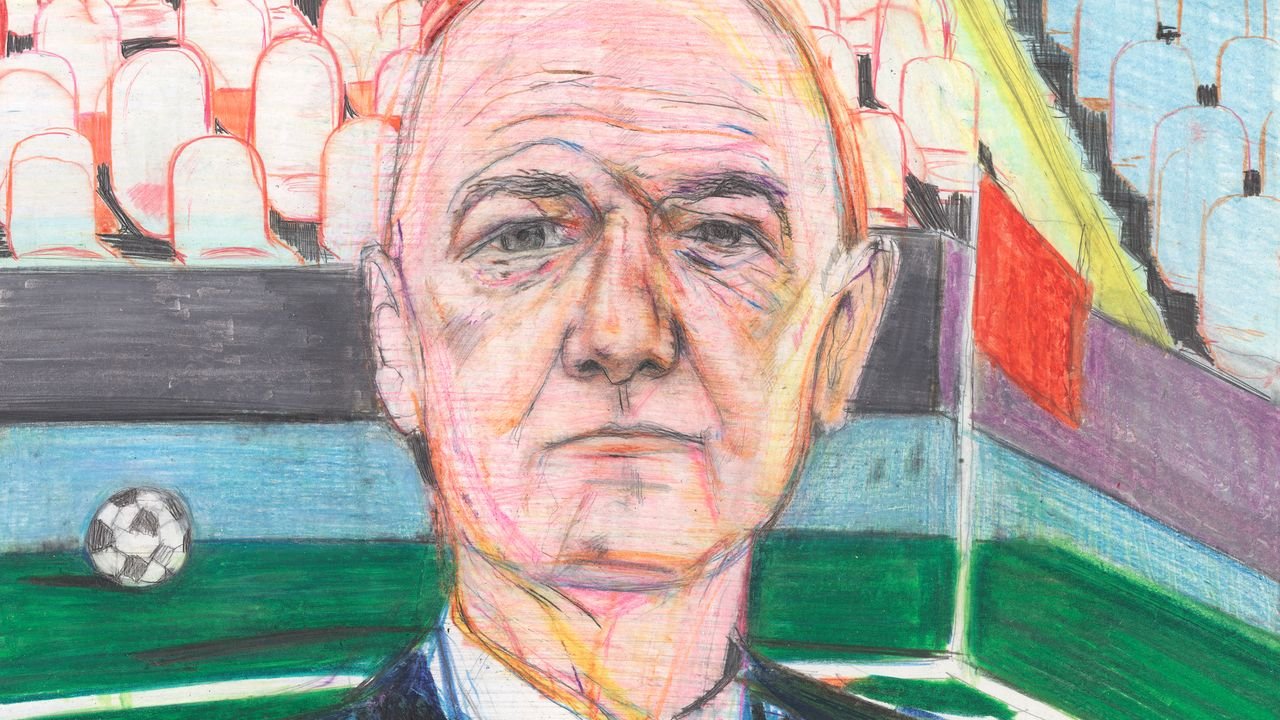
Infantino likes to remind people that FIFA has more members than the United Nations. Earlier this year, the organization announced a partnership with Trump’s Board of Peace at its launch, in Washington, D.C. Infantino presented what appeared to be an A.I.-generated video of a new seventy-five-million-dollar “football ecosystem” that would rebuild “people, emotion, hope, and trust” in Gaza, and rocked out while Javier Milei, the President of Argentina, sang along to an Elvis song. Then, in March, Infantino was among a handful of spectators at the Mardan Sports Complex, in southern Turkey, to watch the Iranian men’s team play a friendly match and to insist on the team’s appearance at the World Cup this summer. “We have to bring people together. It is my responsibility,” he said recently. “It is our responsibility.”
It is a form of politics in which choices—even Infantino’s—do not really exist. Last year, he delayed the start of the FIFA Congress, in Paraguay, by three hours because he was tied up with Trump and Mohammed bin Salman, the Saudi crown prince, in Doha. A group of UEFA delegates walked out in protest, accusing Infantino of putting his political ambitions ahead of soccer’s. Infantino can’t stand that kind of dissent. He does not believe in boycotts or what he refers to, disapprovingly, as “pressure” on FIFA’s members or corporate sponsors. At the America Business Forum, he said that he is surprised whenever he reads negative coverage about Trump: “He’s just implementing what he said he would do. So I think we should all support what he’s doing, because I think he’s doing pretty good, right?”
A month later, at the ceremony for the World Cup draw, in Washington, D.C., Infantino awarded Trump FIFA’s inaugural Peace Prize. “This is what we want from a leader,” Infantino said, as he bestowed a miniature version of “Thoughts and Desires,” a statue that stands outside the U.N.’s offices in Geneva, upon the President. Only one FIFA member, Lise Klaveness, the president of the Norwegian Football Federation, has had the temerity to speak out against Infantino’s political freelancing. “I sat in Washington, in a room full of football presidents, and felt the painful feeling of being hostage to something that is clearly wrong,” she said in a speech, two months later. “The feeling that the emperor is not only walking without clothes—but that he is leading us in a dangerous direction, and that, at the same time, I can’t stop it.”
Everyone else, for the most part, takes the magic ball and smiles. After the prize ceremony, Trump and Infantino returned to the stage with the leaders of the other host countries for this summer’s World Cup—Claudia Sheinbaum, the President of Mexico, and Mark Carney, the Prime Minister of Canada—to begin the draw for the tournament. Carney pulled out the first ball, which he unscrewed to reveal the first team assigned to the group stages. “Uh-oh!” he said, chuckling. It was Canada. Sheinbaum pulled out the next. “Viva Mexico!” she whooped. Trump, at least, had the naturalness, or the insouciance, to show that he knew the thing was rigged. “This is shocking,” he deadpanned, after taking out a ball for the U.S.A. But Infantino didn’t mind. He had his own podium, for FIFA, alongside the host nations. He marshalled the politicians like a concierge you might easily mistake for a guest. Then he took out his phone for a group selfie.



