
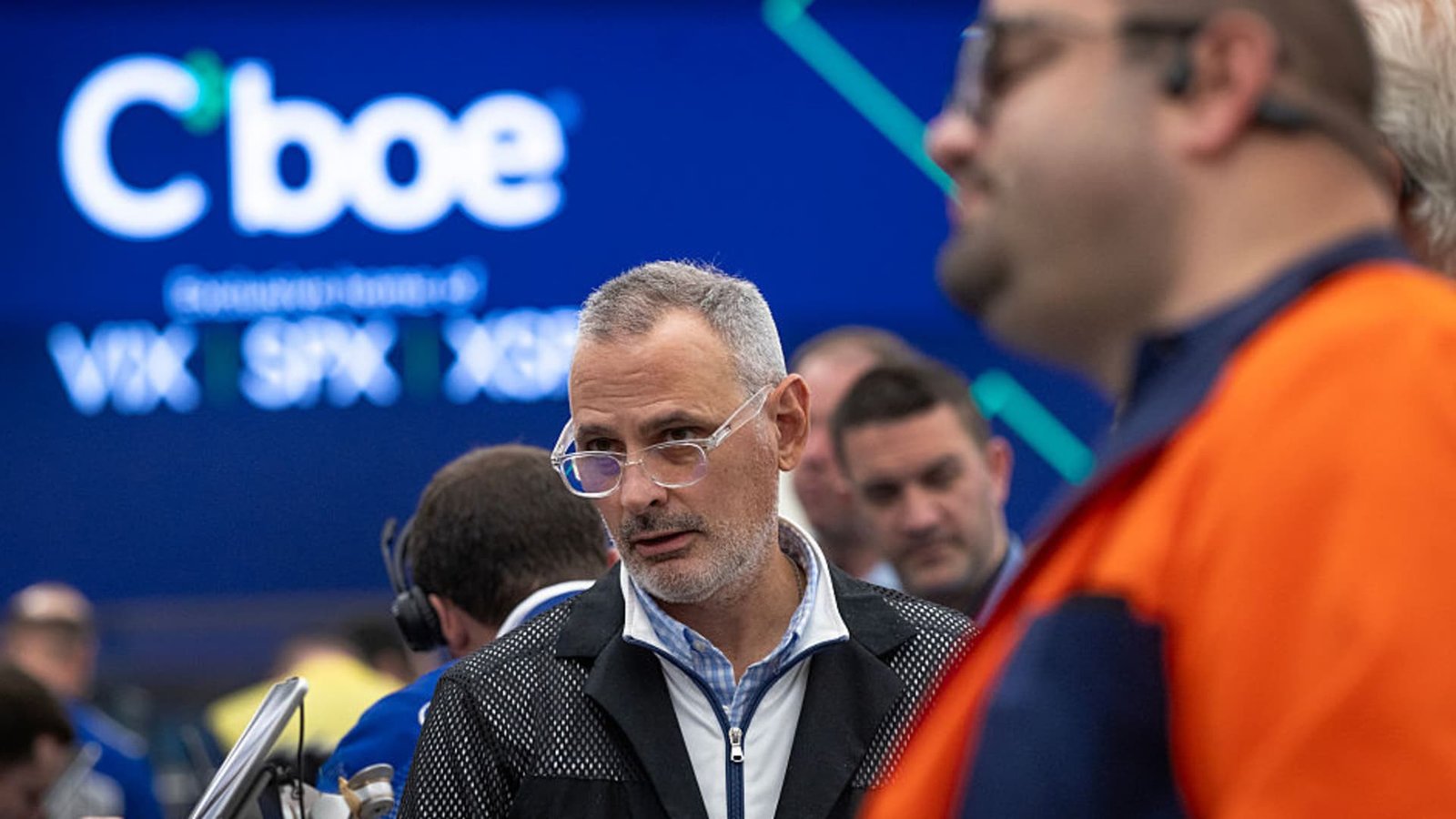
Traders work in the S&P options trading pit at the Cboe Global Markets exchange on March 31, 2026 in Chicago, Illinois.
Scott Olson | Getty Images
Shares of exchange stocks are tumbling after the regulatory approval of perpetual futures for bitcoin ignited concerns that a new wave of trading products could pose an existential threat for Wall Street.
CME Group, known for its derivatives and futures trading platforms, dropped more than 2% in Tuesday’s session. The stock is down more than 8% over the last two days and is poised to record its biggest weekly drop since 2020.
Cboe Global Markets, an exchange and derivatives network, plunged more than 8% in Tuesday trading. That brought its losses for this week to more than 17%, also pacing for its largest weekly decline going back to 2020.
CME Group, 5 days
New York Stock Exchange parent Intercontinental Exchange slid more than 1% on Tuesday and is down more than 3% for the week. Nasdaq shares tumbled more than 5% in the session, dragging the stock into the red week to date.
The Commodity Futures Trading Commission last week approved perpetual futures — a type of future-style contract with no expiration date — for bitcoin trading on Kalshi. This tool, known in short as “perps,” is popular among retail traders abroad.
Investors are worried that the CFTC could give the green light to other asset classes to trade via perpetual futures next. That could increase competition for the traditional exchanges that have long dominated on Wall Street.

Cboe, 5 days
The “concern is that perps could come to equity products, and potentially displace CME/CBOE S&P products,” Barclays analyst Ben Budish told clients in a Tuesday note.
‘Shooting first’
Budish said perpetual futures could provide a competitive challenge to certain products that target retail investors. But the analyst said there’s already comparable offerings in the U.S. that haven’t meaningfully changed how retail investors trade so far.
Despite the recent pullback, RBC analyst Ashish Sabadra said the competitive risk can be managed because there are “fundamental” differences between perpetual future mechanisms and those offered by exchanges. Sabadra said perpetual futures may face leverage limits from clearing houses as a way to mitigate risk and that there’s limited institutional interest.
In other words: Investors are “shooting first and asking questions later,” said Jay Woods, chief market strategist at Freedom Capital Markets.
“There [may be] merit on the news for a minor setback,” Woods said. “But this seems like a major overreaction to me.”
Perpetual futures aren’t the only challenge facing exchange providers in the eyes of traders, according to David Krakauer, vice president of portfolio management at Mercer Advisors.
Investors are worried that financial technology companies and other platforms could begin offering products that rival those from traditional exchanges, Krakauer said. What’s more, he said stakeholders in these stocks are wondering if the rise of prediction markets will draw attention away from conventional asset classes.
Growing interest
“Kalshi is starting with perpetual futures on bitcoin, and then we’re going to expand from there,” Mansour said Monday on CNBC’s “Squawk on the Street.”
Perps see more than $90 trillion in volume annually, making it “one of the largest asset classes on the planet today,” Mansour said. That’s without participation from U.S. investors due to regulatory roadblocks, despite interest in the products, he added.
“The demand has been very clear for a few years in America,” Mansour said. “People want it here. Institutions want it here.”
To be sure, Piper Sandler analyst Patrick Moley told clients in a note last month that Hyperliquid’s perpetual futures platform Trade[XYZ] isn’t yet taking significant market share from legacy operators. For instance, Trade[XYZ]’s volume equates to less than 1% of what’s seen in products tied to the S&P 500 and oil from the Intercontinental Exchange and CME, the bank found.
Robinhood CEO Vlad Tenev said the potential to bring perps to the U.S. is “very attractive” in an interview with CNBC’s “Squawk on the Street” on Tuesday.
Tenev said American traders should be able to use perpetual futures without going through unregulated platforms that are accessed by virtual private networks, also known as VPNs. U.S. crypto investors have been known for years to trade perpetual futures for bitcoin through offshore accounts.
— CNBC’s Davis Giangiulio, Sean Conlon and Tanaya Macheel contributed to this report.



