
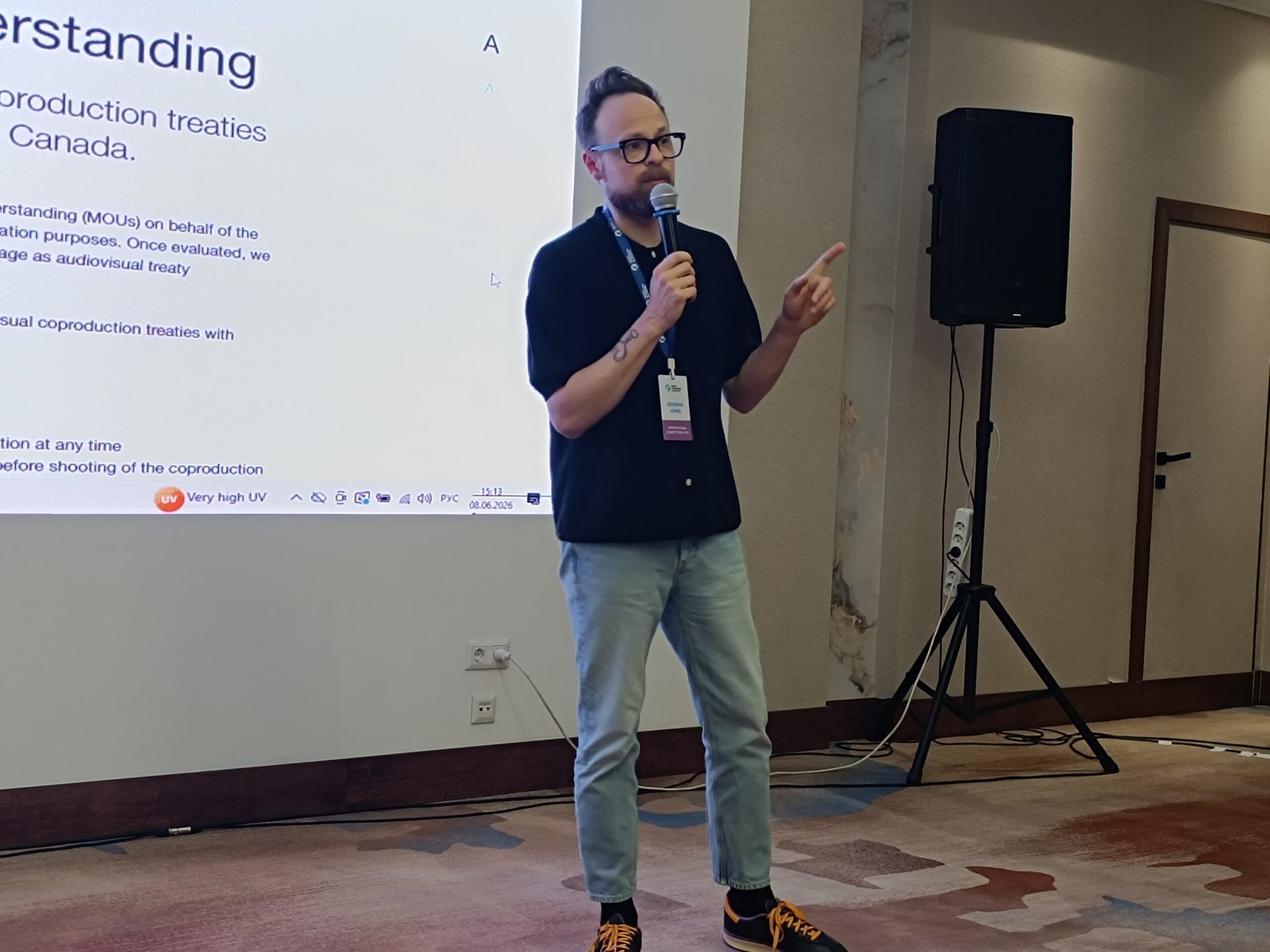
Canadian producer Jefferson Moneo, whose work focuses on international co-productions and genre cinema, spoke at a panel about the possibilities of partnering with Canada, offering a detailed explanation of how the country’s co-production system works and how it could potentially apply to Central Asian producers.
Moneo began by stressing that Canada has co-production treaties with a large number of countries, most of them in Europe, including all EU member states, but also with several countries in Asia and other regions. In most cases, he explained, a co-production partner must contribute at least 20 percent of the global budget. In practical terms, for a movie with a budget of one million dollars, this would mean a minimum contribution of 200,000 dollars from the co-producing partner.
He also noted that Canada’s system is not only about financing, but also about creative participation. The percentage of money brought by each country is connected to a creative evaluation grid, which calculates the involvement of writers, directors, composers, actors, cinematographers, editors, designers, shooting locations, and post-production. According to Moneo, this grid can become a crucial tool for producers, since it determines whether a project can qualify as an official Canadian co-production.
Using a hypothetical example involving Kyrgyzstan, Moneo showed how a project could be structured with Canadian and local creative elements. He explained that if Canada contributes a certain percentage of the budget, the production must also include a significant Canadian creative contribution. This could come through a Canadian screenwriter, cinematographer, composer, editor, post-production team, or other key crew members. At the same time, the local side could retain actors, locations, production design, and other essential elements, depending on how the project is structured.
Moneo emphasized that this system offers flexibility, but also creates restrictions. Directors often have specific collaborators they want to work with, particularly cinematographers, editors, actors, and composers. However, in a treaty co-production, those choices can affect the financing structure. As a result, producers often need to balance the creative desires of the director with the financial and treaty requirements of the project.
He added that the easiest projects to structure are what he called “natural co-productions,” meaning stories where the cultural exchange is already built into the narrative. As an example, he mentioned a recent co-production he worked on in Italy, involving Canadian characters traveling to visit a brother living there. In such cases, the presence of Canadian actors or story elements makes the co-production feel organic, while also helping the project meet the necessary requirements.
Moneo also spoke about the role of Telefilm Canada, explaining that it can fund up to 49 percent of the Canadian side of a budget. The rest is usually assembled through provincial tax rebates, private equity, pre-sales, minimum guarantees from distributors, producer investment, in-kind services, or deferrals. He described Canadian soft money as rebates producers receive after spending in a province, adding that these can usually reach around 30 to 35 percent, with further bonuses for visual effects or post-production-heavy projects.
Post-production, in particular, can be a major incentive. Moneo noted that if a project completes most of its post-production in Canada, the rebate can climb significantly, sometimes approaching 50 percent. For larger budgets, even an additional five percent can make a major difference, potentially translating into one or two extra shooting days.
The panel also addressed the fact that Kyrgyzstan and Canada currently do not have a direct co-production treaty. Moneo suggested that one way forward would be to introduce Central Asian officials and producers to representatives from Canada’s Co-production Office. He added that existing Canadian treaties can be studied as templates, since many of them follow a similar structure.
When asked whether Central Asian producers could work with Canada through a third country, such as France or Germany, Moneo explained that Canada is stricter than many European countries. While European partners may allow more flexible arrangements, Canada still requires a significant Canadian creative contribution. In practice, this could mean working with a Canadian cinematographer, composer, post-production facility, or other key creative personnel, even if the project is primarily set and shot in Central Asia.
The conversation also turned to Asian co-productions. Moneo mentioned Singapore as a particularly effective partner for Canada, while also noting that the recently expanded relationship with Korea could become important in the coming years, especially given the popularity of Korean cinema in Canada. He also referred to China and the Philippines as active and successful co-production partners, partly due to the large Chinese and Filipino communities in Canada. At the same time, he described Japan as more difficult to work with, mentioning the limitations of its memorandum of understanding and the challenges of qualifying non-Japanese citizens under that framework.
Moneo underlined that Canada is open to stories from around the world, including national stories from Kazakhstan, Kyrgyzstan, and the wider region. According to him, the key issue is not whether the project remains culturally rooted in its country of origin, but whether Canadian talent makes a clear creative contribution. In many cases, he suggested, bringing in a limited number of Canadian key crew members could be enough for a project to qualify.
Beyond financing, Moneo also pointed out the promotional strength of Telefilm Canada. He explained that the institution invests heavily in promoting Canadian projects and talent internationally, supporting producers at major markets and festivals. As an example, he mentioned his own experience as a Telefilm Canada delegate in Busan, where the organization arranged meetings and promoted participating producers in the market.
Overall, the panel offered a practical and unusually detailed look at the opportunities and complexities of working with Canada. For Central Asian producers, the system may seem complicated, especially when national cinema rules and local funding requirements are added to the equation. Nevertheless, Moneo made clear that Canada remains interested in international stories, provided that the partnership is creatively meaningful and not merely a financial arrangement.



