
Overview
This study was conducted at the University of Maryland School of Medicine’s Center for Vaccine Development and Global Health. We enrolled healthy, nonpregnant, nonlactating adults aged 18–50 years. Participants were identified through the site’s volunteer database and by advertising in the Baltimore/Washington DC area.
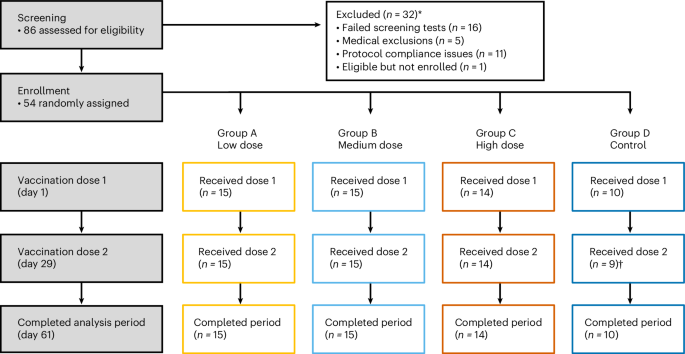
There were four study groups (Table 1). LASSARAB + aPHAD-SE was administered in three dose groups: group A received 700 rU of antigen with 5 µg of adjuvant in 1 ml; group B received 1,400 rU of antigen with 5 µg of adjuvant in 1 ml; and group C received two concurrent injections of the medium-dose preparation for a total of 2,800 rU of antigen and 10 µg of adjuvant. Group D, the control group, received the licensed inactivated rabies vaccine (Imovax Rabies; Sanofi Pasteur) in its commercial presentation. LASSARAB antigen content was measured by ELISA using a LASV-GPC recombinant protein as a reference and expressed as relative units, where 700 rU of LASV-GPC ELISA value is equivalent to approximately 50 µg of total virion protein.
The LASSARAB-containing vaccines were prepared by the investigational pharmacy before administration. The final preparation appeared cloudy white. By contrast, the rabies vaccine comparator required reconstitution immediately before vaccination and appeared reddish-pink. To preserve blinding, unblinded vaccinators reconstituted the control human diploid cell vaccine (HDCV) and drew it into the same type of needle and syringe used for the LASSARAB-containing vaccines, after which all syringes were masked with blue tape to obscure the product color. Unblinded staff were responsible for vaccine accountability, storage, preparation and administration, but were not involved in subsequent safety or immunogenicity assessments. Participants and all other study personnel were blinded to treatment allocation until study completion and database lock. Personnel assessing clinical and safety endpoints were aware of the cohort in which each participant was vaccinated and whether they received one or two injections at a given visit but remained blinded to specific vaccine assignment.
Eligible participants were enrolled and randomized to study groups using block randomization generated by the study statistician. The study protocol stated that up to 55 participants would be randomized to one of the four study groups with an assignment ratio depending on the escalation stage (Extended Data Table 1). With full enrollment (n = 55), the planned overall allocation ratio was 3:3:3:2 to group A, B, C and D, respectively. Randomization by cohort was prespecified in the protocol as follows: cohort 1 used a 4:1 allocation to groups A and D; cohort 2 used an 11:4:3 allocation to groups A, B and D; cohort 3 used an 11:2:4:1 allocation to groups B, D (HDCV only), C and D (HDCV plus saline); and cohort 4 used an 11:3 allocation to groups C and D. Vaccinations were administered on days 1 and 29. Follow-up included scheduled safety and immunogenicity assessments. The final study visit is planned for day 394.
The primary objective of the trial was to assess the safety and reactogenicity of LASSARAB + aPHAD-SE administered in a two-dose primary series. The primary end points included the number and percentage of participants with (1) solicited local and systemic reactogenicity AEs through 7 days after each vaccination; (2) unsolicited AEs from day 1 through day 61; (3) serious AEs and other AEs of special interest (medically attended AEs, NOCMCs, PIMMCs and sensorineural hearing loss) from day 1 through day 394; and (4) clinical laboratory AEs through day 61. The secondary objectives were to evaluate LASV and RABV antibody responses following the LASSARAB + aPHAD-SE series. Secondary end points included geometric mean IgG titers and seroconversion rates for LASV-GPC and RABV glycoprotein by ELISA, as well as rabies neutralizing antibody titers by RFFIT, assessed at days 1, 8, 29, 36 and 61. The study protocol prespecified an interim analysis of primary and secondary end points through day 61.
Participant eligibility
To be eligible to participate in the trial, an individual must have met all of the following inclusion criteria:
-
1.
Provides written informed consent before the initiation of any trial procedures.
-
2.
Able to understand and agrees to comply with all planned trial procedures and be available for all study visits.
-
3.
Age ≥18 and ≤50 years at time of enrollment.
-
4.
In good general health and without clinically significant medical, psychiatric, chronic or intermittent health conditions.
-
5.
Participants of childbearing potential must have a negative serum human chorionic gonadotropin (HCG) pregnancy test at screening and a negative urine HCG pregnancy test within 24 h before the study vaccination.
-
6.
Participants of childbearing potential in a heterosexual relationship agree to use of highly effective contraception beginning at the time of the screening visit through day 61.
-
7.
Vital signs and BMI are within the following ranges: oral temperature less than 38.0 °C; pulse 47–100 beats per minute, inclusive; systolic blood pressure 85–140 mm Hg, inclusive; diastolic blood pressure 55–90 mm Hg, inclusive; and BMI 18 to <35 kg m−2.
-
8.
Has a negative test result for hepatitis B virus surface antigen, hepatitis C virus antibody and human immunodeficiency virus types 1 or 2 antibodies at screening.
-
9.
Has a negative rabies neutralizing antibody test at screening (<0.5 IU ml−1 in RFFIT assay).
-
10.
Screening hematology tests (white blood cells, hemoglobin and platelets) and screening chemistry tests (alanine transaminase, creatinine and total bilirubin) are within acceptable parameters.
-
11.
Must agree to the collection and storage of residual biological specimens and additional clinical specimens for secondary research use.
-
12.
Participants must agree to adhere to the following lifestyle considerations: if of childbearing potential in a heterosexual relationship must use highly effective contraception from screening through day 61; refrain from donating blood through day 61; refrain from enrolling in any other study involving blood draws, experimental agents, or other interventions through the end of the study; refrain from receiving any other vaccine through day 61; refrain from receiving any live vaccine through day 61; refrain from participating in or planning to enroll in another clinical trial during the study period; and agree to inform the investigators of any potential rabies exposures or changes in rabies risk for counseling regarding possible withdrawal for licensed rabies vaccination.
Individuals who met any of the following exclusion criteria were excluded from participation in the trial:
-
1.
A history of anaphylaxis, serum sickness, meningitis; neuroparalytic events such as encephalitis, transient paralysis; Guillain–Barré syndrome; myelitis; retrobulbar neuritis; history of previous or current hearing loss as assessed by quantitative audiometry; or multiple sclerosis.
-
2.
Current use of any medications that may be associated with impaired immune responsiveness.
-
3.
Allergy treatment with antigen injections within 60 days before first vaccination or that are planned through the end of the study.
-
4.
Receipt of immunoglobulins and/or any blood products within the 60 days before first vaccination or that are planned through the end of the study.
-
5.
Current pregnancy or lactation.
-
6.
Known allergic reactions to (1) any rabies vaccine; (2) any components of HDCV (human albumin, neomycin sulfate, phenol red, β-propiolactone); or (3) any components of LASSARAB + aPHAD-SE (LASSARAB, Tris-HCl, l-arginine, (3D-(6-acyl) PHAD, squalene redistilled, DMPC and vitamin E dry powder).
-
7.
History of severe local or systemic reactions to any vaccination or a history of severe allergic reactions to drug or vaccine products.
-
8.
Has a clinically significant acute illness (with or without fever), as determined by the site principal investigator or appropriate sub-investigator, within 72 h before enrollment.
-
9.
Receipt of a rabies vaccine or an antibody therapeutic product for treating rabies or a Lassa fever vaccine any time before the first planned study vaccination.
-
10.
Receipt of another experimental agent or intervention within 60 days before first vaccination or plans to do so before the end of the study.
-
11.
Received or plans to receive any other vaccine in the 2 weeks before the first vaccination through day 61 (32 days after the last study treatment).
-
12.
Received or plans to receive any live vaccine in the 4 weeks before first vaccination through day 61 (32 days after the last study treatment).
-
13.
Self-reported or known history of alcoholism within the last 2 years.
-
14.
Any condition that, in the judgment of the investigator, precludes participation because it could affect participant safety or end-point assessment.
-
15.
Has tattoos, scars or other marks which would, in the opinion of the investigator, interfere with assessment of the vaccination site.
Investigational vaccines
The study vaccine was a rabies-vectored, monovalent LASV vaccine (LASSARAB) formulated with a synthetic 3D-(6-acyl) PHAD-based stable squalene oil-in-water nanoemulsion adjuvant. LASSARAB was manufactured by IDT Biologika (Dessau-Rosslau, lot CTM0041222). The antigen consists of a chemically inactivated, genetically-modified RABV vector engineered to express both the RABV glycoprotein and the full LASV-GPC. LASSARAB has previously been used in mice, guinea pigs and NHPs21,22,26. The product used in this trial is identical, with the exception that the clinical material was produced and released under good manufacturing practice conditions. MH778559 is the GenBank accession number for the codon-optimized gene sequence of the LASV-GPC from the Josiah strain.
The parental RABV backbone (BNSP) is a recombinant version of the SAD B19 strain, which has been widely used as a live oral rabies vaccine for wildlife in Europe50. The relative rabies antigen content of LASSARAB compared to HDCV is not known. LASSARAB incorporates an arginine-to-glutamate substitution at amino acid position 333 of the rabies glycoprotein, a modification known to reduce viral neurotropism51. Following replication, viral particles are chemically inactivated with β-propiolactone.
The adjuvant (aPHAD-SE) was produced by Curia (lot P07223/1). It is composed of a fully synthetic monophosphoryl lipid A (MPLA) analog, 3D-(6-acyl)-PHAD, combined with a stabilized squalene oil-in-water nanoemulsion (final squalene concentration 2% v/v). For administration, LASSARAB and aPHAD-SE were mixed immediately before use to yield a single 1-ml intramuscular dose, given as a two-dose series 28 days apart.
Control vaccine
The control vaccine was the licensed HDCV, sold as Imovax Rabies and produced by Sanofi Pasteur. HDCV is a sterile, stable, freeze-dried suspension of RABV (strain PM-1503-3M, derived from the Pitman-Moore lineage) grown in MRC-5 human diploid cells, concentrated by ultrafiltration and inactivated with β-propiolactone52. The vaccine is provided in single-dose vials without preservatives. Each 1-ml dose contains ≥2.5 IU of rabies antigen52. HDCV is indicated for pre- and post-exposure prophylaxis and approved for use in all age groups52. HDCV is licensed for pre-exposure prophylaxis as either a two-dose regimen, administered on days 0 and 7, or a three-dose regimen with a third dose on day 21 or 28 (ref. 52). A RFFIT titer ≥0.5 IU ml−1 is considered seroprotective53.
Normal saline placebo
Sterile 0.9% sodium chloride for injection (USP) was administered concurrent with HDCV in cohorts that included group C. This maintained blinding, as group C received two concurrent injections.
Trial procedures
Participants gave written informed consent before any data were collected or study procedures were initiated. Eligible participants were enrolled and assigned to study groups using block randomization prepared by the study statistician. Participants were enrolled and randomized sequentially in a stepwise, dose-escalation process using four vaccination cohorts (Extended Data Table 1). Participants were blinded to treatment allocation, as were study staff and investigators involved in subsequent assessments of trial end points. Only trial personnel involved in receipt, storage, preparation and administration of the study product were unblinded.
Participants were enrolled under the prespecified cohort-based randomization and allocation scheme described above. Vaccinations were administered by intramuscular injection in the preferred deltoid muscle. For participants receiving two concurrent injections, bilateral deltoids were used. Participants were observed for 30 min after each vaccination. Participants had vital signs recorded, were examined by a study clinician (if indicated), completed an immediate reactogenicity assessment, received paper symptom diary training and were discharged.
Two days after each vaccination, participants received a follow-up phone call to evaluate AEs, review diary instructions and confirm their next appointment. They returned to the clinic on days 8 and 36 for safety evaluations, during which a study investigator reviewed the paper diaries, assessed vaccine reactogenicity and documented any other safety issues. Venous blood samples were collected at these visits for hematology and chemistry testing. Hearing thresholds to evaluate for new-onset sensorineural hearing loss were assessed by a validated tablet-based audiometer at screening, after the first vaccine dose at day 22, after the second vaccine dose at day 61, and will be assessed upon completion of the study at day 394, at any time if the participant reported a change in hearing or if deemed necessary by study investigators. Additional safety and immunogenicity assessments were conducted on days 36 and 61. Serum samples (15 ml) for vaccine immune response measurements were collected on days 1, 8, 29, 36 and 61.
After 7 days of safety data had been collected for each of the first three cohorts, the SRC met to evaluate the findings. Following predefined criteria, the committee determined whether to continue vaccinating the remaining participants at the current dose level and to initiate enrollment of additional participants at the next higher dose.
Study data were collected and managed using REDCap (Research Electronic Data Capture) tools hosted at the Univ. of Maryland School of Medicine54,55. REDCap is a secure, web-based software platform designed to support data capture for research studies, providing (1) an intuitive interface for validated data capture; (2) audit trails for tracking data manipulation and export procedures; (3) automated export procedures for seamless data downloads to common statistical packages; and (4) procedures for data integration and interoperability with external sources.
A total of eight protocol deviations occurred during the study that included: two instances of unapproved electronic consent versions being signed due to administrative oversight; one incorrect laboratory test order (HCG); one incomplete blood draw due to participant difficulty with phlebotomy; one missed clinic visit due to participant scheduling conflict; one excess blood draw (20 ml over protocol requirements); one clotted hematology sample preventing laboratory analysis; and one missed participant temperature recording for days 2–7 post-vaccination. All protocol deviations were minor and had no impact on the safety of study participants or integrity of study results.
Safety oversight
For safety oversight, we used the SRC and an ISM. The SRC provides ongoing oversight to ensure participant safety throughout the clinical trial. The SRC consisted of the principal investigator, a representative of the funder (US National Institute of Allergy and Infectious Diseases; NIAID) and a representative of the regulatory sponsor (UMB). The SRC reviews blinded safety data at scheduled intervals and ad hoc as needed. A key responsibility is evaluating safety outcomes from sentinel subgroup participants in cohorts 1–3 using predefined dose-escalation criteria and protocol-specified halting rules. After each sentinel review, the SRC provided the ISM with relevant safety data for concurrence and notified the Investigational New Drug (IND) sponsor if no sentinel subgroup halting criteria had been met. The SRC may recommend continuation, modification or temporary pause of dosing, and may request ISM review at any time.
The ISM is an independent, medically qualified physician scientist who has no role in conducting the trial. The ISM’s primary responsibility is to monitor participant safety through impartial evaluation of blinded or, when necessary, unblinded study data. The ISM considers both trial-specific findings and relevant background information on the disease, investigational product and population. During sentinel reviews and whenever the SRC identifies a potential safety concern, the ISM assesses whether dosing should proceed. The ISM may consult an unblinded statistician, request additional information, recommend protocol changes or halt the study if needed. The SRC and ISM functions are detailed in a charter approved by all SRC members at the start of the trial.
Safety assessments
Vaccine reactogenicity was evaluated by monitoring solicited local and systemic reactions from the time of each vaccination through 7 days post-vaccination. Local reactions included warmth, tenderness, itching, pain, redness and swelling, while systemic reactions included feverishness, arthralgia, myalgia, malaise, nausea and headache.
Unsolicited AEs, serious AEs, medically attended AEs, NOCMCs, PIMMCs and sensorineural hearing loss are being monitored from enrollment through day 394 per protocol. Clinical laboratory abnormalities were assessed through day 61. Given theoretical risks of sensorineural hearing loss after LASV vaccination48, this outcome was prespecified as an AE of special interest and defined as a hearing level in any ear of 30 dB or greater at three consecutive frequencies or a change of ≥10 dB at a single frequency as measured by tablet-based audiometry and consistent with Brighton Collaboration guidance48. During eligibility assessment, individuals with a baseline hearing level >15 dB at three consecutive frequencies or ≥20 dB at any single frequency by tablet audiometry, confirmed on clinical evaluation, were excluded.
In-clinic audiometric testing was performed using the SHOEBOX PureTest system (SHOEBOX), a tablet-based, automated pure tone audiometer implemented on an iPad platform and paired with calibrated RadioEar DD450 headphones, consistent with audiometry methods used in other Lassa fever vaccine trials28. Participants underwent scheduled evaluations for sensorineural hearing loss at eligibility assessment, at three scheduled time points after vaccination, and at unscheduled assessments if a change in hearing was reported or at the investigator’s discretion. To follow up on abnormal in-clinic audiology tests after enrollment, participants were referred for formal diagnostic sound booth audiometry performed by a licensed audiologist and evaluation by an otologist for confirmation.
Planned assessments after this interim analysis
The study protocol provides for participant safety monitoring through study day 394 (approximately 1 year after the second study vaccination). Additional safety and immunogenicity visits are scheduled for days 121 and 394. A safety phone call is scheduled for day 210. Audiometry is scheduled for day 394. Serious AEs, medically attended AEs, NOCMCs, PIMMCs and sensorineural hearing loss will be monitored through day 394.
Further exploratory immunogenicity analyses may be conducted post-trial using clinical specimens collected for future use.
Immunogenicity assessments
We assessed immune responses to Lassa and rabies viruses using multiple assays at various time points:
LASV-GPC antibodies by ELISA at days 1, 8, 29, 36 and 61
RABV glycoprotein antibodies by ELISA at days 1, 8, 29, 36 and 61
RABV neutralization by RFFIT at days 1, 8, 29, 36 and 61.
LASV-GPC antibodies and RABV glycoprotein antibodies
ELISAs developed for nonhuman primates were adapted and qualified to quantify LASV- and RABV-specific human IgG26. The qualified assays incorporated the use of the First WHO International Standard for anti-LASV antibodies (National Institute for Biological Standards and Control (NIBSC) code 20/202) and an in-house standard calibrated against the Third WHO International Standard for Anti-rabies Immunoglobulin (SRIG; NIBSC code 19/244).
Immulon 2HB 96-well microplates were coated with recombinant LASV-GPC or RABV glycoprotein produced at Thomas Jefferson University at 0.5 μg ml−1 in bicarbonate buffer and incubated for 16 to 18 h at 4 °C. Plates were washed using a BioTek 405 TS microplate washer (BioTek) and blocked with 5% nonfat dry milk in phosphate-buffered saline (PBS) containing 0.05% Tween-20 (PBS-TM) for 1 h at room temperature (22 °C).
Following blocking, serum samples and controls diluted in PBS-TM were added in duplicate and incubated for 2 h at room temperature. After washing, bound antibodies were detected using HRP-conjugated goat anti-human IgG (Jackson ImmunoResearch), followed by TMB substrate. The reaction was stopped after 15 min with 1 M phosphoric acid, and absorbance at 450 nm was measured using an AccuSkan FC microplate photometer with SkanIt Software (Thermo Fisher Scientific).
Each assay included an eight-point calibration curve of the corresponding standard. Antibody concentrations (IU ml−1) were determined by interpolation from the calibration curve using GraphPad Prism v.10 (GraphPad) and adjusted for sample dilution.
RABV antibodies by RFFIT
The RFFIT was conducted as previously described56. Human serum samples were serially diluted twofold in 96-well plates using Opti-MEM medium (Invitrogen), starting at a 1:4 dilution for baseline screening samples and a 1:5 dilution post-vaccination. Each plate included a serial dilution of the Third WHO International SRIG (NIBSC code 19/244), in duplicates, beginning at 0.5 IU ml−1, to create a calibration curve.
A volume of RABV strain CVS-11, previously determined to infect 90% of confluent cells, was added to each well containing the diluted sera/SRIG and incubated for 1 h at 34 °C. Subsequently, BSR cells (a clone of baby hamster kidney cells; 6 × 10⁴ per well) were added to the serum/virus mixture, and plates were incubated at 34 °C for an additional 23 h. Cells were then fixed with 80% acetone and stained with FITC-conjugated anti-RABV nucleoprotein antibody.
The percentage of infection was evaluated using fluorescence microscopy and a Cytation 5 reader (Agilent BioTek). The 50% end-point titers were calculated by the Reed–Muench method and converted to IU ml−1 by comparison with the SRIG calibration curve. Samples that did not reach a 50% end point were reanalyzed at a higher starting dilution57.
Statistical analysis
This was an exploratory trial; no confirmatory hypothesis testing was prespecified. Inferential analyses, whether prespecified or conducted post hoc, were interpreted as exploratory and nonconfirmatory. The planned sample size (n = 55, 15 per experimental study group and 10 HDCV controls) was selected to characterize safety and immunogenicity rather than to power between-group comparisons, consistent with US Food and Drug Administration (FDA) guidance58. Accordingly, all reported statistical inferences, including 95% CIs and statements of statistical significance for group comparisons, are exploratory and hypothesis-generating.
All participants who were randomized and received at least an initial dose of study vaccine were included in the safety analysis. For the immunogenicity analysis, all participants who received at least an initial dose of study vaccine and for whom data were available at a particular time point were included. Outcomes were analyzed by study group. Baseline demographics were summarized descriptively. Sex was determined by self-report of sex assigned at birth. Safety end points were tabulated by severity grade and relationship to vaccination.
Serum antibodies were described in ELISA units or RFFIT titers. Seroconversion for ELISA assays was defined as a ≥fourfold rise from the baseline (day 1) titer. Seroprotection for RFFIT was defined as titers ≥0.5 IU ml−1, consistent with WHO guidance1. ELISA and RFFIT data were summarized by GMTs and geometric mean fold-rise (GMFR) from day 1, and the proportion of participants achieving seroconversion for ELISA data and seroprotection for RFFIT data. When computing GMTs, values that were lower than the lower limit of detection were replaced by one half the limit of detection (0.35 IU ml−1 for LASV-GPC, 0.002 IU ml−1 for RABV-G and 0.25 IU ml−1 for RABV-neutralizing antibodies). Missing data were not imputed for safety or immunogenicity analyses.
For binary outcomes such as ELISA seroconversion (yes/no) or RFFIT seroprotection (yes/no), proportions were calculated for each study group with 95% CIs using the Clopper–Pearson exact method. Differences in continuous outcomes between the four study groups were assessed using the Kruskal–Wallis H-test, with pairwise comparisons conducted. Within-group changes in antibody titers across time points were evaluated using the Wilcoxon signed-rank test. No adjustments were made for multiple comparisons. All statistical tests were two-sided. Analyses were performed using SAS v.9.4 (SAS Institute). Figures were generated using GraphPad Prism v.10 (GraphPad Software).
In addition to prespecified safety and immunogenicity analyses, we conducted four post hoc exploratory analyses: (1) pairwise comparisons of the proportion of participants with ≥2 moderate (grade 2) solicited symptoms across study groups, conducted separately for doses 1 and 2 using Fisher’s exact test; (2) dose–response comparisons of GMTs across LASSARAB-containing groups at days 29 and 61 for each serologic assay; (3) recalculation of dose–response comparisons for LASV-GPC IgG ELISA after excluding one participant with elevated baseline titer; and (4) evaluation of the association between RABV glycoprotein ELISA titers and RFFIT neutralization titers using Spearman’s rank correlation coefficient with 95% CIs. These analyses were not prespecified in the study protocol or statistical analysis plan and were conducted for exploratory purposes. Sex-based subgroup analyses were also not prespecified.
Regulatory and ethics
The protocol and informed consent forms were approved by the UMB, Institutional Review Board (IRB) (HP-00110576). There have been six versions of the study protocol. Version 1 was submitted to the US FDA but was not submitted to the IRB. Versions 2, 3 and 4 addressed FDA and UMB IRB feedback, with Version 4 receiving initial UMB IRB approval on 4 December 2024. Version 5 corrected the rabies neutralizing antibody eligibility threshold (<0.5 IU ml−1), clarified rescreening windows and aligned laboratory grading with FDA toxicity scales. Version 6, approved on 13 June 2025, clarified the plan for database freeze before interim analysis and aligned the protocol text to consistently specify that vaccine administrators were unblinded to study group. The trial was registered at ClinicalTrials.gov (NCT06546709) on 4 December 2024. The trial protocol and statistical analysis plan are available in Clinicaltrials.gov.
Reporting summary
Further information on research design is available in the Nature Portfolio Reporting Summary linked to this article.



