
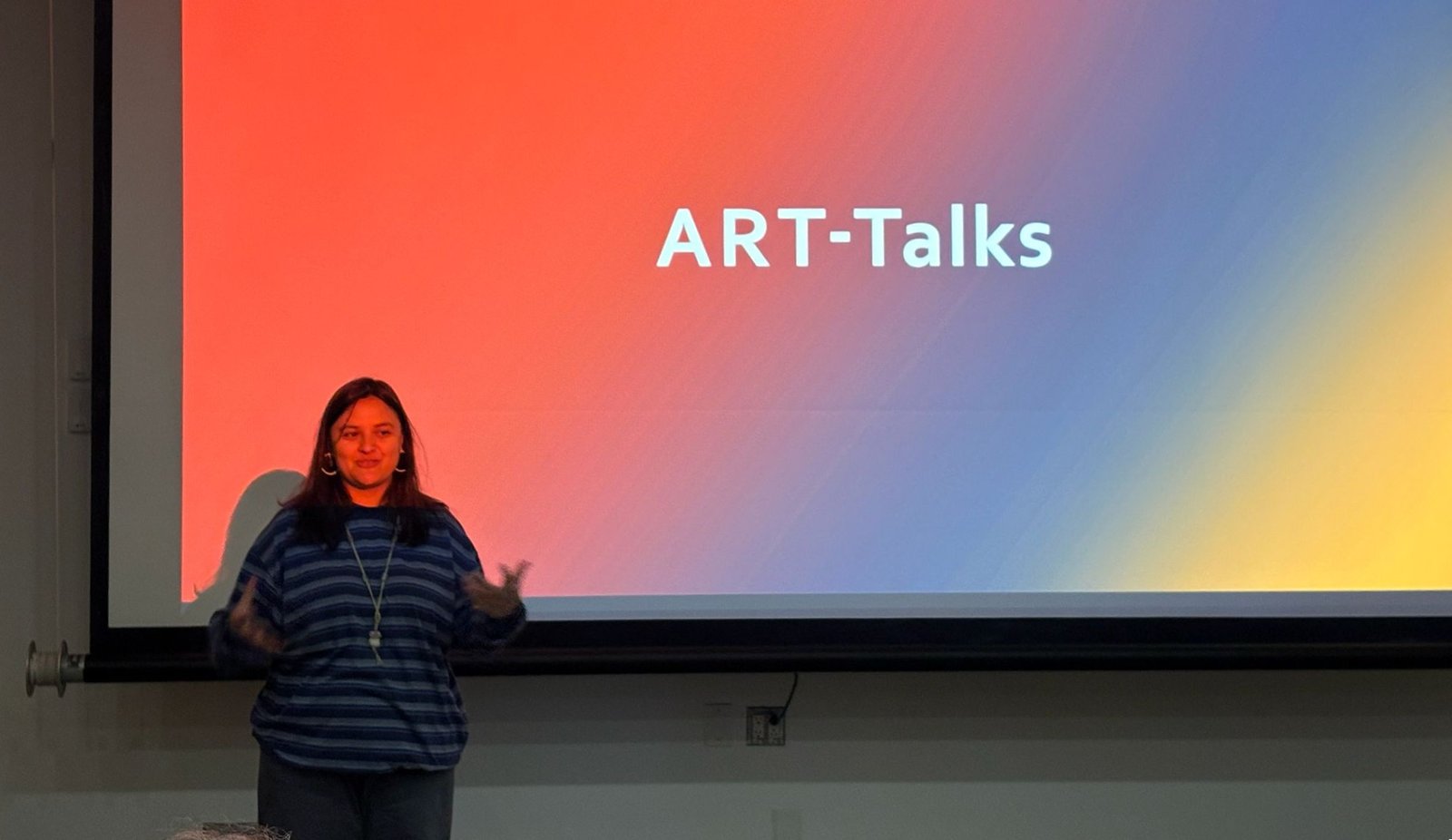
Claudia Tuyet Scheffel is a writer and a filmmaker known for “Amputierte Arschbacken” (2020) and “Lonig & Havendel” (2025). She is the daughter of a Vietnamese contract worker and an East German father, grew up in the Erz Mountains, and studied film at the University of Fine Arts Hamburg.
On the occasion of the screening of “Loney & Havender” at the Montreal Asian International Film Festival, she talks about her family, technology, and the reception of her film.
How the idea for “Loney & Havender” first came to you?
The film began as my graduation project at the University of Fine Arts Hamburg. Interestingly, the first thing that came to me was the title. At the time, I was allergic to both honey and lavender. I liked how romantic the words sounded together, but “Honey and Lavender” felt too conventional. So I swapped a few letters and created “Lonig & Havendel.” That small change introduced the idea of duality that runs throughout the film. The story constantly moves between different worlds, perspectives, and realities. I started developing the project during my bachelor’s studies and completed it during my master’s degree. It was always in the back of my mind. Making it within the university system gave me a kind of safety net, as it allowed me to experiment with a feature film without much pressure.
How personal is the story?
It is very personal. I grew up in the Erz Mountains, where the film takes place, as the daughter of a Vietnamese mother and a German father. My mother came to East Germany as a contract worker, which is an important part of the region’s history. At the same time, I wanted the film to go beyond autobiography and address larger social and political questions. The different characters represent different migration experiences. Duc, for example, grew up in Germany like I did and feels deeply attached to the region, even as many of his friends leave. Truc Lam represents a type of migrants who are still finding their place. What’s more, many members of my own family appear in the film. My aunt plays Duc’s mother, my mother voices Truc Lam’s mother on the phone, and my father appears as the guide in the mine.
There is a scene when Truc Lam talks on the phone with her mother, and says that her experience is impossible to describe. What experiences you think people have for themselves – the kind that can’t be put into words?
The region where we filmed is often portrayed in the media through stories about right-wing politics and extremism. But when you grow up there, your relationship to the place is much more complicated. I moved to Hamburg to study, and I often felt that people in Western Germany had a very limited view of Eastern Germany. There are many stereotypes. I wanted to show a migrant perspective from eastern Germany and present a more nuanced picture. A place can be flawed, but still feel like home. You can criticize your own home, but when people with no connection to it do the same, it can feel as if they are insulting your family. So you can say, that you need to experience living there.
The presentation of Duc’s family seems to be rather negative. How close is this portrayal to reality?
It’s interesting that you consider it to be negative, because reactions in the audience vary a lot. In some screenings people see those scenes as tense, while in others they laugh because they recognize them from their own families. For me, these scenes are not meant to be negative. They show different generations expressing care in different ways. Everyone wants what they believe is best for the family, even if they disagree on how to achieve it. My own parents have always been very supportive of my work. They never discouraged me from becoming a filmmaker, and they continue to support me today.
One detail I found interesting is that the adults seem far more attached to their phones than Duc, who doesn’t even have one. This feels like a reversal of the stereotype that young people are always online. How do you view our relationship with smartphones and digital technology today?
Yeah, that comes directly from my own observations. Honestly, I often see people over fifty using their phones more intensely than younger people. Somehow, every adult is addicted to Candy Crush! Of course, technology makes it easy to stay connected with family and friends, especially across countries. My mother, for example, is often on the phone with people in Vietnam. Sometimes, when we sit down to eat, and we talk, she is so focused on those conversations and says to us: “Could you lower your voice?” I think media often presents smartphone addiction as a problem mainly affecting young people, but in my experience it’s quite different.
The cinematography is very colourful and reminds of a fairy tale. Can you tell me about the process of working on visuals with the cinematographer, Yunus Koylu?
Yunus and I have known each other since we started film school. We share a similar taste, which made collaboration easy. Colour was very important from the beginning. Certain characters were assigned specific colours that connected them emotionally, even when they rarely shared scenes together. We also drew inspiration from the dark romance genre; that’s why the film includes forests, mirrors, mysterious figures, recurring images of death, and so on. These elements were already present in the screenplay, and we worked together to translate them into visual form. Also, we even chose the unusual aspect ratio of 14:9 because it resembled the framing of older landscape paintings.
Besides Dark Romance, what artistic influences inspired the film?
Literature has probably influenced me more than cinema. I often describe the film as magical realism: something magical happening within an otherwise realistic world. Many viewers compare the film to the works of Haruki Murakami or by Studio Ghibli, like “Spirited Away“, because it also has two worlds. I admire the work of Yoko Tawada, a Japanese writer who writes in German and often explores questions of language and identity. I also enjoy Georgian literature and writers such as Hiroko Oyamada, the author of “The Hole”, and Elisa Shua Dusapin, especially her “Winter in Sokcho”. Their work creates strange, mysterious atmospheres without relying on obvious fantasy elements. I also wrote a novel myself for my bachelor studies and for my graduation project.
Wolves appear as an important symbol in the film and seem to function as protectors. What drew you to this image, and what do wolves represent for you personally?
For me, the wolf is both a political and a mythical symbol. In Germany, debates about wolves often become symbolic discussions about migration. Some people want to protect them, while others want them removed. I was interested in using the wolf as a metaphor for those social tensions. At the same time, wolves appear throughout fairy tales. They can be frightening, but they can also act as guides. In earlier versions of the screenplay, it was the wolf that actually leads Truc Lam at the end. However, that scene had to be removed for practical reasons.
What do you hope audiences take away from “Lonig & Havendel” after watching it?
More than anything, I hope people leave the film with a strong feeling or atmosphere. The film is quite polarising. People either like it very much or not at all. But when it works, viewers often tell me they continue thinking about its mood and imagery long after the screening. The film is not directly trying to create political change. However, I do believe it can encourage people to see the region and its communities in a more nuanced way. After the shoot, we organised a series of intercultural workshops in the region where we filmed. We held sound design workshops, graphic design workshops, and even karaoke events that brought German and Vietnamese participants together. One of my favourite moments was seeing strangers standing side by side, singing German and Vietnamese songs together. In a way, that spirit of connection is what I hope people take away from the film as well.



