
There’s an art to programming films, and Flickers’ Rhode Island International Film Festival demonstrtaed a mastery of it with the festival’s opening block.
Nine disparate but lovely films opened the fest, and all embraced big, difficult questions and bold declarations of love. The programmers linked them through themes like grief and the need to be understood, but also everyday objects — like stairs — that can take on profound meanings.
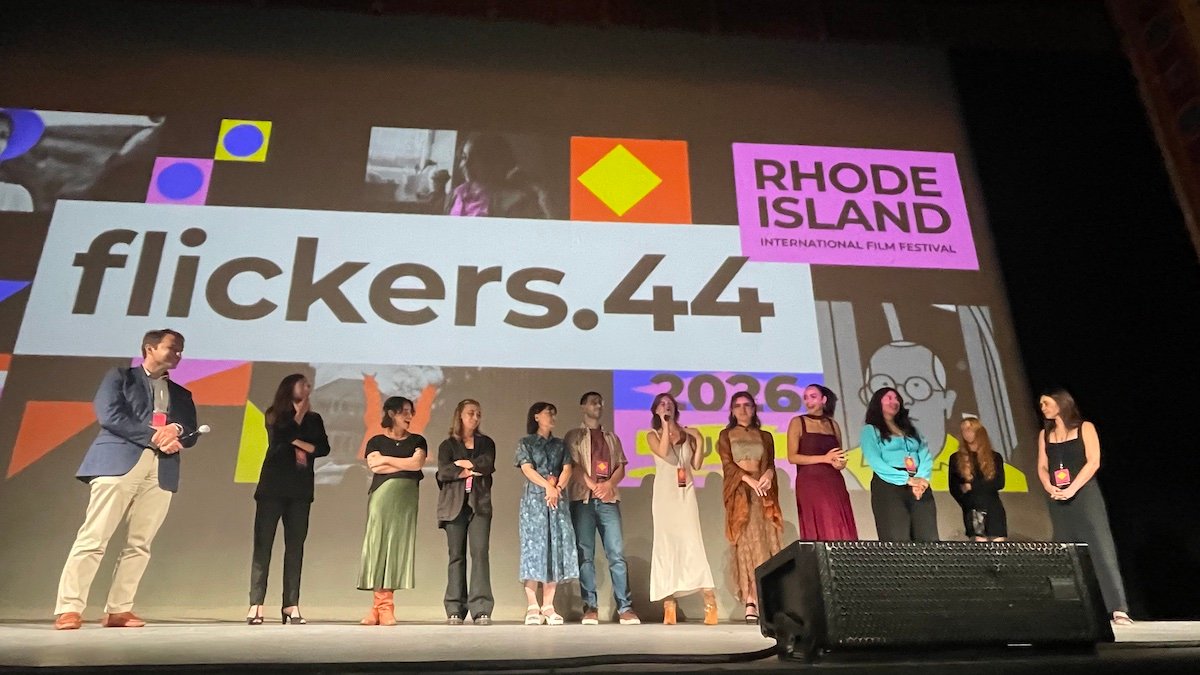
After the block, festival executive director Shawn Quirk invited the filmmakers in attendance onstage at the Providence Performing Arts Center to talk about their ideas, inspirations, and occasionally funny challenges.
Here’s what they shared.
Pénélope Rose on “7h53”
Writer-director Pénélope Rose flew from Paris to share her devastating drama “7h53,” in which an estranged couple are reunited for one night with their dead daughter. She returns to them to slide down the stairs, eat fries, and explain matters of life and death.
Rose told the audience that the film came from her own dreams, as she coped with the death of her father at a very young age. Seeing him in her sleep brought a swell of changing and conflicting feelings.
“I understood, thanks to my dream, that letting go isn’t about forgetting. It’s about allowing life to to continue and allowing ourselves to to enter into this life again,” she said.
Losing a loved one, she noted, can feel “like an apocalypse.” But by having the young girl in her film play with her parents, and enjoy mischief, Rose was able to explore deep, contradictory emotions.
The spirit of play, and living while you’re alive, caught on with her crew. They designed a safe setup for the daughter to slide down her stairs.
“The slide, the stairs, became like a toboggan, ” she said. “Everybody on the team wanted to do it,”
Jessica Aquila Cymerman on “The Stairs”

The next film in the block also involved play on the stairs — again with dark undercurrents.
Jessica Aquila Cymerman based her magnificent, wincingly intense film on the experiences of her mother, Deborah Aquila, as she grew up in Brooklyn in the 1960s. The film was shot in San Pedro, California, in a building that passes astonishingly for a New York tenement apartment.
Rose, the young lead character, wants to join her brother and another boy in a horrific game in which they sit in a chair at the top of a staircase and tip it back as far as they can without falling. Soon a church deacon begins to prey on her, and to exploit the trust of her immigrant parents.
Though the game becomes symbolic, it didn’t start that way.
“This was a real game that my mom and her brother and their friends would play when it was too hot to play outside,” Aquila Cymerman said. “There were a lot of really dangerous games in tenement buildings when kids were bored. They would also jump from rooftop to rooftop — that’s how close together the buildings were.”
When Rose becomes physically ill because of the deacon’s predation, her mother turns to a healer – a woman who encapsulates love and faith far better than the deacon does.
That was also real, the director said.
“There really was a woman down the hallway who would do magic,” she explained.
Alissa Fagin on “Sound & Color”

“Sound & Color” follows Sarah Kraning, an artist with synesthesia — a condition that causes her to see sounds. She translates them to her paintings, and in the film, a team of animators work with her to bring her sound-inspired visions to life.
Director Alissa Fagin provide a portrait of Kraning while allowing people who don’t have synesthesia to better understand what it’s like. Kraning notes in the film that at one point, people who reported visions like hers would have been institutionalized, instead of given a means of expression.
“I first learned about synesthesia when I was a kid, when I read a book called A Mango-Shaped Space, which is a great young adult novel that I highly recommend,” Fagin told the Flickers audience. “And I think what really drew me to it at that time was it just seemed so incredible that somebody could experience the world in that way. And that really got me thinking about all the different ways people people could be experiencing the world, and how perception allows people to have very different experiences of this world that we share.
“I just feel like if we have more awareness about that, it’s just easier for us to empathize as people,” she continued. “So I sought out Sarah, and we made this film together, and she was very much on the same page about wanting to share that message.”
Ru Kuwahata and Max Porter on “Cartoon Physics”

In the beautifully animated “Cartoon Physics,” a mother confronts her child’s first encounter with death by embracing the logic of old cartoons: In cartoon reality, for example, someone who runs off a cliff doesn’t fall until she looks down and realizes she’s run off a cliff.
Married co-directors Ru Kuwahata and Max Porter, who previously earned as Oscar nomination for their short film “Negative Space,” were inspired by their child.
“We had our daughter six years ago, and kept talking about, ‘Let’s make a film about what it’s like to be parents,’ and then fast forward to when she was two, she saw a dead baby bird, and she asked all these questions, and then we didn’t really know how to answer such a big topic,” Kuwahata explained.
“And then around the same time, we also encountered a poem written by Nick Flynn called ‘Cartoon Physics’ that talked about how children should live in a cartoon world where disasters happen and heroes come at the right time to save you —you don’t get injured, you don’t die. And we thought, ‘OK, these two can have perfect marriage as a film,’ and that’s how we made it.”
Kuwahata and their daughter provide the voices of the mother and daughter in the film. Porter noted that the directors initially planned for the girl to speak English. But over years of animating and recording, she became more proficient in Japanese, like her mother. So they decided to do the film almost completely in Japanese.
Emeline Easton and Manya Glassman on “Against The Gates”

“Against the Gates” is a music video in which Emeline falls in love with a woman for the first time, and is embraced — in a church — by a queer community that seems to have been waiting for her for her whole life.
“I grew up in Providence, so it was incredibly fun to come back and return home to make this film about my experience having my first time falling in love with a woman, and I was just thinking about how falling in love — and specifically with someone of the same gender — is one of the most holy feelings I’ve ever felt,” Emeline said.
She noted that many people “use religion to manipulate and and hate.” But that wasn’t the case at the church where they filmed, which is just down the street from the Providence Performing Arts Center.
Manya Glassman, who went to high school with Emeline and watched her grow and evolve as a musician, said the Grace Church “was just arms wide open and wanting to do this.” Churchgoers who came in to pray during the shoot were more than happy to share their space with a queer cast, dancing and kissing up and down the pews.
“The experience was holy, and I think incredibly healing for for a lot of people,” Glassman said. “So it was an honor.”
K. Elisa Garcia and Lia Lockhart on “Extraño”

In “Extraño” a young girl plays with her mother in a cemetery where things are not as they seem. Lía Lockhart, who stars and co-directed with K. Elisa Garcia, was inspired by the strangeness of the English language. A native Spanish speaker, she was sometimes baffled by the number of English words with multiple meanings.
She noted that there are very few Spanish words like that — but one of them is “extraño.”
“Extraño can mean three different things: a stranger, something weird happening, and I miss you,” she explained. And that’s what what inspired the whole film.”
The film is just two minutes long, and packs in an incredible amount of emotion in that time. Co-director K. Elisa Garcia noted that the film was shot in just three hours, with a child in the lead role and almost no budget.
“This was purely out of passion,” she said. “Trying to work with the sun and no money and kids. Yeah, but I am proud to say we shot it in three hours, not including prep and loadout. So yeah, the challenges of no money.”
Sara Crow on “Howl”

Sara Crow’s “Howl” is about a girl, played by Zoe Ziegler, who moves into a tent in the backyard. Her father, played by Saturday Night Live veteran Alex Moffat, is trying to get her to move back into the house, but doesn’t know what to do. Her mother — who would know what to do — is gone. The girl, meanwhile, has a curious fascination with wolves, and a neighbor’s dog who looks quite wolf-like.
“I had been thinking about a film where a girl has moved into her backyard and there’s sort of standoff between her and her parent, and it kept changing — she was older, and then she was younger, and I couldn’t quite figure it out,” Howl explained.
She had a breakthrough when she saw the film Janet Planet at the New York Film Festival, and spotted Ziegler. She knew she would be perfect as the girl.
“She just had such a magnetic and real quality and sensitivity that I like looked her up and found her Backstage profile and sent a message to her mom,” Crow said.
When her mom mentioned how much Ziegler loves animals, Crow started reworking the script to fit her.
The showbiz adage warning against children and animals proved only partly true. Ziegler, who attended Tuesday’s screening, was fantastic to work with.
The animals, not so much.
“I used two untrained dogs in my movie, so that was really hard,” Crow said. “And the wolf jumped in the pool.”
You can learn more about the Flickers Rhode Island Film Festival here and read more of our festival coverage here.
Main image: (L-R) Flickers executive director Shawn Quirk with panelists Pénélope Rose, Jessica Aquila Cymerman, Alissa Fagin, Ru Kuwahata, Max Porter, Emeline Easton, Manya Glassman, Lia Lockhart, K. Elisa Garcia and Sara Crow.



