
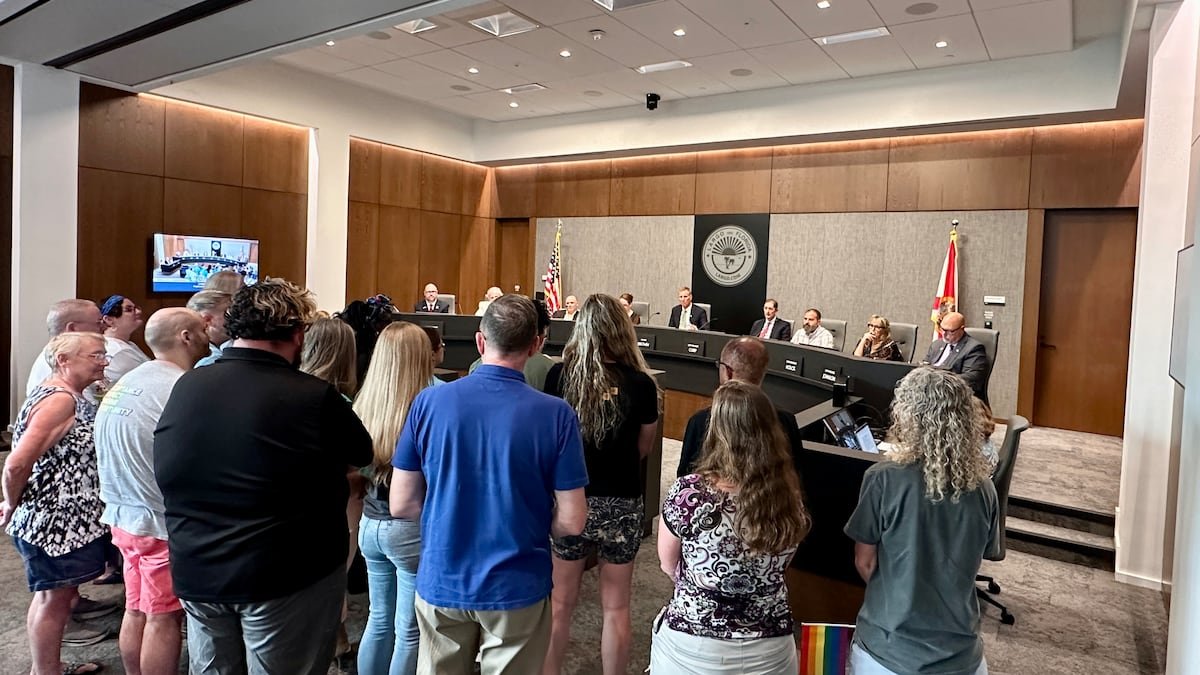
Largo Mayor Woody Brown read a Pride Month proclamation to open Largo’s June 2 commission meeting, but the gesture came only after word that the city had planned to drop it from the agenda, drawing dozens of residents to the new City Hall auditorium in protest.
Many of the speakers had come from the ribbon-cutting earlier that evening for Horizon West Bay, the $85 million mixed-use complex anchored by the new City Hall. One after another, they used the public comment period to voice their disappointment over the proclamation’s near-removal and to press leaders to keep standing with the LGBTQ+ community.
Reading from a prepared statement, former Commissioner Jamie Robinson said he spoke “as an ally and as a resident who cares deeply about the kind of community we try to be,” and he expressed disappointment that Largo was not recognizing Pride Month as it had in past years.
Since the city first raised a Pride flag in 2019, he said, Largo had shown that it “values and respects the diversity of the people who live, work, and raise families here,” sending a “simple but meaningful message: Everyone belongs.”
Matthew Faustini, the planning board chairperson and a commission candidate in the November election, said the city charter “explicitly mandates that in June for LGBTQ+ Pride Month, the city recognition must include a proclamation, a flag-raising and information.” He charged that “city staff just decided not to follow that legislative policy on their own because they are afraid of (state politicians in) Tallahassee.”
Faustini said Brown had acknowledged during his weekly online chat that leaders were “afraid you will lose money from the state, afraid you will lose money from the county” for backing LGBTQ+ programs — which, Faustini said, meant “you’re not willing to stand up for the residents of this city.”
Brown had addressed the issue a day earlier. During his June 1 Mayor’s Coffee Chat, he said Largo “doesn’t have any officially city-sanctioned Pride events because the state has essentially told us that we shouldn’t be spending money, not just on Pride events, but any events that aren’t (an) official federal government-recognized holiday” — a reference to Florida House Bill 1001, which bars municipalities and counties from spending on DEI-related events and initiatives.
“So, it puts us in a tough position,” Brown said.
The mayor added that Largo “is very welcoming to everybody, and we certainly think it’s important to celebrate our differences, and we always have. But we’re trying to keep a relatively good relationship with our state folks, and they’ve made some rules around that.”
While the legislation targeting such spending “doesn’t go into effect until July 1,” Brown noted, “we also have people who are in Tallahassee that were part of that legislation that we’re depending on for a lot of things, including some money to pay for stormwater projects, et cetera.”
At the June 2 meeting, Wendy Vernon, president and founder of the PFLAG Safety Harbor/Greater Pinellas LGBTQ+ support organization, asked whether she could bring her allies to the podium. Told she could, she turned to the audience: “Would anybody like to stand with me?” More than a dozen people rose, walked to the front and gathered around the dais.
“Mayor and commissioners, many in our community were discouraged by the earlier decision to discontinue Pride recognition,” Vernon said, noting that community organizations “have worked alongside city event planners for almost four years and they were just as excited for this event as the rest of us.”
Vernon called the cancellation of the city’s fourth annual Pride Month event “a gut punch that rippled through the community” and said Pride Month “is both a celebration and a reminder about the ongoing work to build communities where everyone can safely belong.” At a time when conversations around diversity, equity and inclusion “are becoming more difficult in government spaces,” she said, “it is important for our community to know they are not alone” and that “even as policies change, support still exists here.”
She urged leaders to keep talking with LGBTQ+ residents and to “work together on initiatives to strengthen inclusion and belonging throughout Largo” in the months ahead.
“We know that it’s coming to a time when you will not have that choice,” Vernon said. “But right now, you do. And we ask that we can continue these conversations and build this bridge before it’s completely destroyed.”
Jon Harris Maurer, public policy director for Equality Florida, followed Vernon to the podium and thanked Largo’s leaders for recognizing Pride Month despite the obstacles they faced.
“We have 14,000 members in Pinellas County and 1,142 members in the city of Largo,” Maurer said. “And you can see from the turnout tonight that that really does matter to us.”
Marking the 10th anniversary of the Pulse nightclub shooting, Maurer said many local governments were “beginning to wrestle with implementation of a law signed by Gov. DeSantis,” but added that he was thankful “there are numerous exceptions and exemptions in that law that do still let city and local governments show up for their communities and support their communities.”
During his closing comments, Commissioner Michael Smith, who is gay, spoke about the importance of Largo’s continued support for the LGBTQ+ community.
“I am very appreciative of this commission, of the support you have provided over the years,” a visibly emotional Smith said.
Smith called the proclamation’s near-removal “a real slap in the face.” He said he “gets kind of emotional about this because it took 28 years of my life to stay in the closet and pray to who I truly am.”
“There are people growing up that feel they are chained with a stigma,” Smith said. “But I was a believer that God loves me and I’m only answerable to him.”
Humans “need to show kindness to each other and understand their difficulties in life,” he said. To those “who say keep your private life to yourself,” he added: “You can walk and sit with your wife at a restaurant, and I can’t hold my partner’s hand” without being “called names and picked on or possibly killed.”
Pointing to the proclamation, Smith said, “This here is showing faith to our citizens who are out there.” He spoke of having considered taking his own life when he was younger because he felt different. “But I will say ever since I came out, I have been loved by many people and I appreciate it.”
“The words here tonight were great,” Smith said, but they came from “a small portion of our population. … There are many that are still afraid to come out and speak, and many that are being shamed back into the closet. And that’s just wrong. We should show kindness and love.”
He closed: “I think this city and this commission have all shown me kindness, and I believe you would show kindness to all our citizens. And I really appreciate it. Thank you very much.”



