
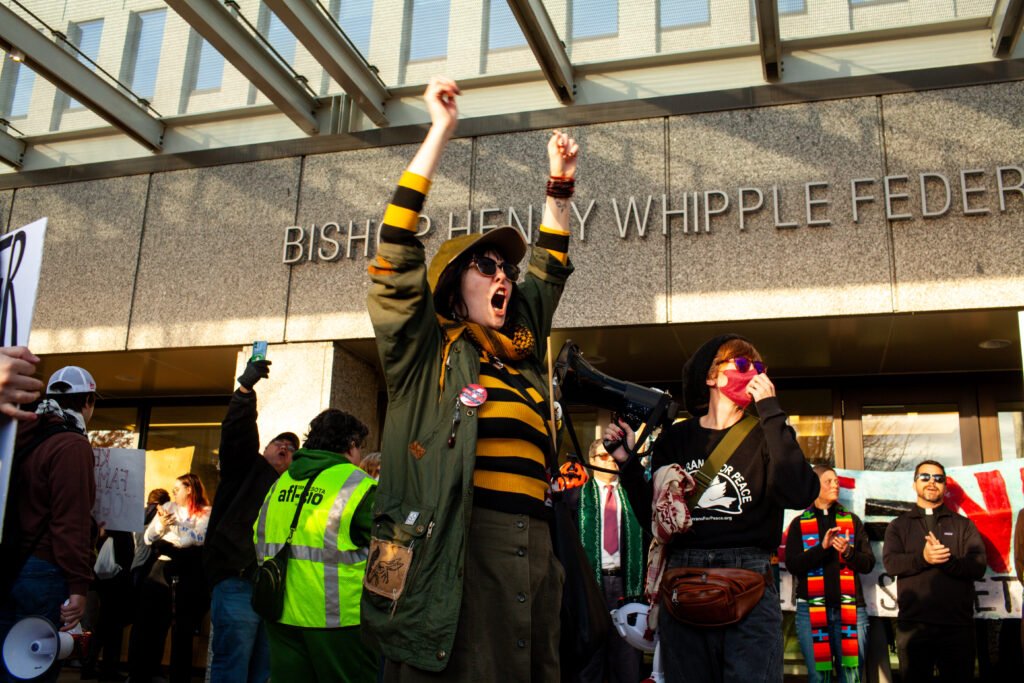
A recent judicial ruling nullifying U.S. Department of Justice subpoenas served on the offices of Gov. Tim Walz, Minneapolis Mayor Jacob Frey and other state and city officials during the heat of Operation Metro Surge isn’t your typical dry recitation of legal argument.
Instead, a federal judge gave the president’s men a public shaming.
A little background: Amid Minnesota’s resistance to the strongman tactics of the Trump administration’s immigration crackdown, someone leaked details of subpoenas that were served on state and local officials.
We can now add Frey, Walz, Attorney General Keith Ellison and a host of local officials to the long and growing list of Trump political opponents on the receiving end of legal harassment: former Federal Reserve Chair Jerome Powell; New York Attorney General Letitia James; former FBI Director James Comey; and U.S. Sen. Mark Kelly, to name just a few.
We’ve become frighteningly inured to a practice that we once associated with authoritarian regimes like Iran and Russia.
The order quashing the subpoenas, written by Minnesota district’s chief judge Patrick Schiltz, says: “Initiating a criminal investigation in order to harass political opponents or to coerce them into taking official action — particularly official action that the federal government cannot directly require those political opponents to take — is a blatantly unlawful and unethical use of the grand-jury process.”
He immediately raises the prospect that the subpoenas were issued to force Minnesota to carry out the administration’s immigration crackdown, which is a federal, not state responsibility. And/or used to harass the administration’s political opponents.
By the way, Schiltz isn’t some radical lefty judge, as at least one state legislator insinuated. He was appointed by President George W. Bush and clerked for conservative icon Antonin Scalia.
He goes on: “The only question, then, is whether the challenged subpoenas were issued for one of these forbidden purposes.”
And then the hammer: “The court has no doubt that they were.”
The next part drips with barely-concealed contempt for what’s become of the DOJ around these parts:
“On the one hand, the evidence that the challenged subpoenas were issued for unlawful reasons is overwhelming. On the other hand, the (Department of Justice) has struggled — without success — to identify a single plausible justification for the subpoenas.”
Instead, Schiltz writes, the feds “seek materials that largely if not entirely relate to constitutionally protected conduct.”
This is not the first time the Minnesota department of the federal judiciary has slapped down the Trump administration.
During Operation Metro Surge, Schiltz wrote, “Increasingly, this court has had to resort to using the threat of civil contempt to force ICE to comply with orders. This court is not aware of another occasion in the history of the United States in which a federal court has had to threaten contempt — again and again and again — to force the United States government to comply with court orders.”
Jason Marisam, a constitutional law professor at Mitchell Hamline School of Law, told me that he was struck by Schiltz’s decision to unseal the ruling.
“He wanted the public to see what he believed was a clear and egregious unconstitutional abuse of power from the executive,” Marisam said.
Unlike his fellow elites at American corporations, media companies, universities and law firms, Schiltz apparently feels no compunction to bend the knee to Trump or his men.
Which speaks to Schiltz’s character.
But his evident independence is also in the Constitution’s design. Alexander Hamilton writes in Federalist No. 78 that he agrees with Montesquieu that “there is no liberty, if the power of judging be not separated from the legislative and executive powers.”
He also writes that the “independence of the courts of justice is peculiarly essential in a limited Constitution.”
The court must be able to nullify actions of the other branches to protect the Constitution from their encroachments.
“Without this,” Hamilton writes, “all the reservations of particular rights or privileges would amount to nothing.”
Indeed, given the pliant Republican Congress, the judiciary stands as the sole bulwark against the Trump administration’s strategy of employing the legal system to crush dissent — and, if they get their way, the opposition altogether.
(As with all authoritarians, there’s an element of absurdity, i.e., arrests of people throwing sandwiches; merely touching Trump’s glamorous algae pool; or in the case of recent Minnesota indictments, scheduling meetings.)
On the other side of the ledger, the administration will stand by its friends, like the men who killed Renee Good and Alex Pretti, who as far as anyone knows, have faced no consequences for their lethal decisions.
Although we should celebrate Schiltz’s ruling, let’s remember that Walz, Frey and the other elected officials benefit from effective lawyers and have resources to fight back.
But consider the 15 people the DOJ indicted recently for conspiracy to impede or injure a federal agent. I can’t speak to their guilt or innocence, but as my colleague Madison McVan noted, prosecutors have dropped multiple similar cases for lack of evidence and prosecutorial misconduct.
All over the country, dissent and political opposition are being criminalized, often with terrible consequences for the regular people opposing the Trump administration, which is using blatantly unconstitutional tactics in its campaign to destroy any resistance.
Will the judiciary protect them?
This story was originally produced by Minnesota Reformer, which is part of States Newsroom, a nonprofit news network which includes Florida Phoenix, and is supported by grants and a coalition of donors as a 501c(3) public charity.



