
Oil prices inch back up amid attacks on ships in Strait of Hormuz
The price of Brent crude oil, the international standard, rose about 2.5% on Tuesday to trade at $73.83 a barrel as Iran launched attacks on several vessels in the Strait of Hormuz. U.S. staple West Texas Intermediate crude was up a similar amount on the day, trading at about $70 a barrel.
The strikes on ships, reported by the U.K. navy, upset hopes that the war in Iran could be winding down and the strait could fully reopen to oil tankers bringing crude to customers worldwide from the Persian Gulf.
Higher oil prices put upward pressure on inflation, and U.S. Treasury yields climbed higher in the bond market. The yield on the 10-year Treasury rose to 4.51% from 4.48%
High yields worldwide have been rattling investors after oil prices burst above $100 per barrel earlier in the summer because of the war.
The worry is that high inflation may force the Federal Reserve and other central banks to hike interest rates. High rates can keep a lid on inflation, but they also slow the economy and hurt prices for all kinds of investments.
CBS/AFP
Gulf Cooperation Council leader condemns “brutal Iranian attack on the Qatari tanker”
The head of the Gulf Cooperation Council, a regional bloc made up of six Persian Gulf states, condemned the “brutal Iranian attack on the Qatari tanker ‘Al-Rukayyat,'” which he said had endangered the ship’s crew.
GCC Secretary-General Jassim Mohammed Al-Budaiwi called the strike on the liquid natural gas (LNG) tanker off Oman’s coast “a dangerous escalation that threatens the security and stability of the region.”
In his statement, Al-Budaiwi called on the international community to adopt a “firm and deterrent stance against these repeated Iranian attacks in order to safeguard regional and international peace and security and prevent the recurrence of such hostile acts that threaten the stability of the region.”
He added that the GCC stood “united with the State of Qatar and expressed its full solidarity with all measures” taken in response by Doha.
Report of possible third ship coming under attack in Strait of Hormuz
The U.K. navy’s Maritime Trade Operations center said it received “a report of a further incident involving a tanker transiting the Strait of Hormuz,” in what appeared to be a possible third attack on a commercial vessel by Iran Tuesday.
UKMTO said the tanker, which it did not identify, was hit by a drone “and has sustained minor structural damage,” though it had reported no casualties or environmental impact and said it was continuing to its next port of call.
The agency earlier reported a projectile impacting a Qatari liquid natural gas tanker, identified as the Al-Rekayat, as it transited the Strait of Hormuz along a southern route close to Oman’s coast that Iranian authorities have warned vessels not to use. Qatar’s government condemned the attack and accused Iran of carrying it out.
The Reuters news agency, meanwhile, said the Saudi-flagged crude oil supertanker Wedyan was damaged in or near the Strait of Hormuz, also close to Oman’s coast, by an Iranian fired missile on Tuesday.
Reuters said the attack on the Al-Rekayat caused a fire in the ship’s engine room, and there were concerns that it could lead to an explosion.
Trump says “Turkey has been a great ally on us” in Iran war
Speaking with Turkish President Recep Tayyip Erdoğan after arriving in Ankara for a NATO summit, President Trump praised Turkey for being “instrumental” during the war with Iran.
He said Erdoğan, like the U.S., did not want Iran to have a nuclear weapon.
“Turkey has been a great ally for us,” Mr. Trump said. “Turkey could have gone on the side — they know Iran very well, and they know the problems with Iran, but they’ve been very instrumental, along with a couple of other countries, of helping.”
Mr. Trump called Turkey a “very powerful military nation” and said it could have aligned with Iran in the conflict to attack Israel, but “maybe they didn’t do that because of me.”
TUR Presidency/Murat Kula/Anadolu/Getty
“They’ve been extraordinary in many ways with respect to our relationship, including trying to end the war with Iran, or whatever you call it, not even a war. It’s a military operation, it’s a denuclearization, that’s really what it is, of Iran,” Mr. Trump said.
Trump says he was “very disappointed” by NATO allies’ response to Iran war
President Trump said Tuesday at a NATO leaders’ summit that he was “very disappointed” by the response of America’s closest allies to the war the U.S. and Israel launched jointly against Iran.
“I was very disappointed with NATO,” Mr. Trump told journalists as he met Turkey’s President Recep Tayyip Erdogan after arriving in Ankara for the NATO summit.
“We didn’t need any help at all, and in a way, I was testing people, I was testing to see whether or not they’d be there, because I’ve long said that we helped them, but I’m not sure that they’d be there for us.”
Mr. Trump has long chastised other NATO members for not joining the war, which the U.S. and Israel launched unilaterally, without any involvement from the transatlantic defensive alliance.
The war has severely impacted European economies, which rely much more heavily than the U.S. on imported gas and oil from the Persian Gulf, amid severe constraints on shipping traffic through the Strait of Hormuz.
Several European nations completely barred the U.S. military from using their bases or airspace for operations against Iran, while the U.K., for instance, declined to participate in offensive operations but made bases available for what it called a “limited defensive purpose,” to help protect national interests and allies in the Gulf region.
Qatar says Iran hit gas tanker in Strait of Hormuz, calls it a “grave and explicit violation”
Qatar’s Foreign Ministry condemned Iran on Tuesday for an attack on a liquid natural gas tanker in the Strait of Hormuz, calling the strike – which reportedly caused a fire in the engine room, fueling concern over a possible explosion – “a grave and explicit violation of the provisions of international law.”
Targeting the tanker Al-Rekayat as it passed near the Strait of Hormuz on Tuesday “constitutes a rejected aggression against the security and safety of international navigation, and the security of global energy supplies, and a grave and explicit violation of the provisions of international law, especially the rules that guarantee freedom of maritime navigation and safe passage in international straits,” ministry spokesman Majed al-Ansari said in a post on X.
The U.K. navy’s Maritime Trade Operations center said earlier that the vessel had been struck by a projectile off the coast of Oman, in the southern part of the strait. Sources told the Reuters news agency that it was hit by an Iranian missile, which caused a fire in the engine room.
“We demand that the Islamic Republic of Iran immediately cease all practices that harm regional security or threaten the safety of international navigation, and stop endangering global energy supplies and the capabilities of regional countries for the sake of narrow calculations, and we hold it fully legally responsible for this aggression and any damages and repercussions that may result from it,” Al-Ansari said.
Qatari gas tanker reportedly at risk of exploding after strike in Strait of Hormuz
A Qatari liquified natural gas tanker was at risk of exploding Tuesday due to a fire in its engine room, a source briefed on the incident told the Reuters news agency, after the vessel was struck by a projectile in the Strait of Hormuz.
The Al Rekayyat, and a Saudi-flagged crude oil tanker, were both damaged in or near the strait Tuesday after Iran’s Revolutionary Guards fired missiles at ships in the waterway overnight, sources told Reuters.
The U.K. navy’s Maritime Trade Operations center said earlier that the Qatari vessel had reported being hit by a projectile near Oman’s coast in the southern strait, but it did not provide any further detail.
The Al Rekayyat was loaded with liquefied natural gas (LNG) and sent out distress signals after being hit on its port side, one source told Reuters.
Second ship reportedly damaged in Strait of Hormuz
A Saudi-flagged crude oil tanker was damaged near the Strait of Hormuz, according to sources quoted by the Reuters news agency, but the cause was unknown.
The vessel, believed to be the supertanker Wedyan, was damaged off Oman’s coast, the news agency reported, adding that the ship is owned and managed by Saudi shipping firm Bahri.
If confirmed, the Wedyan would be the second ship to sustain damage in the region on Tuesday.
A Qatari tanker carrying liquefied natural gas was struck by a projectile as it transited the strait near Oman’s coast earlier in the day, according to the U.K. navy.
Iran warns negotiations won’t resume if threats continue
Iran’s foreign minister said Tuesday that Tehran will not resume negotiations if threats continue, a day after President Trump said the U.S. would “finish the job” if no peace deal is struck.
In a social media post, Foreign Minister Abbas Araghchi said neither the Iranian people nor the Islamic Republic’s military would be “moved by any threats,” without referencing Mr. Trump’s comments specifically.
“Negotiations on final Deal will not commence if threats continue,” Araghchi warned, citing the memorandum of understanding signed by President Trump and his Iranian counterpart in mid-June, which calls for both sides to “refrain from the threat or use of force against each other.”
“Honor your signature,” added Araghchi.
Tanker hit by projectile in Strait of Hormuz
A tanker traveling off the coast of Oman in the Strait of Hormuz caught on fire early Tuesday morning after being struck by a projectile, the British military said.
The attack was the latest targeting a vessel moving through the narrow mouth of the Persian Gulf, through which a fifth of all oil and natural gas traded once passed in peacetime. Iranian state television said the liquefied natural gas tanker came under attack after ignoring warnings but did not directly claim the assault.
Tehran has repeatedly declared that only its approved route through the strait is safe and is suspected of attacking other ships that have used another route close to the Omani shore.
CBS News 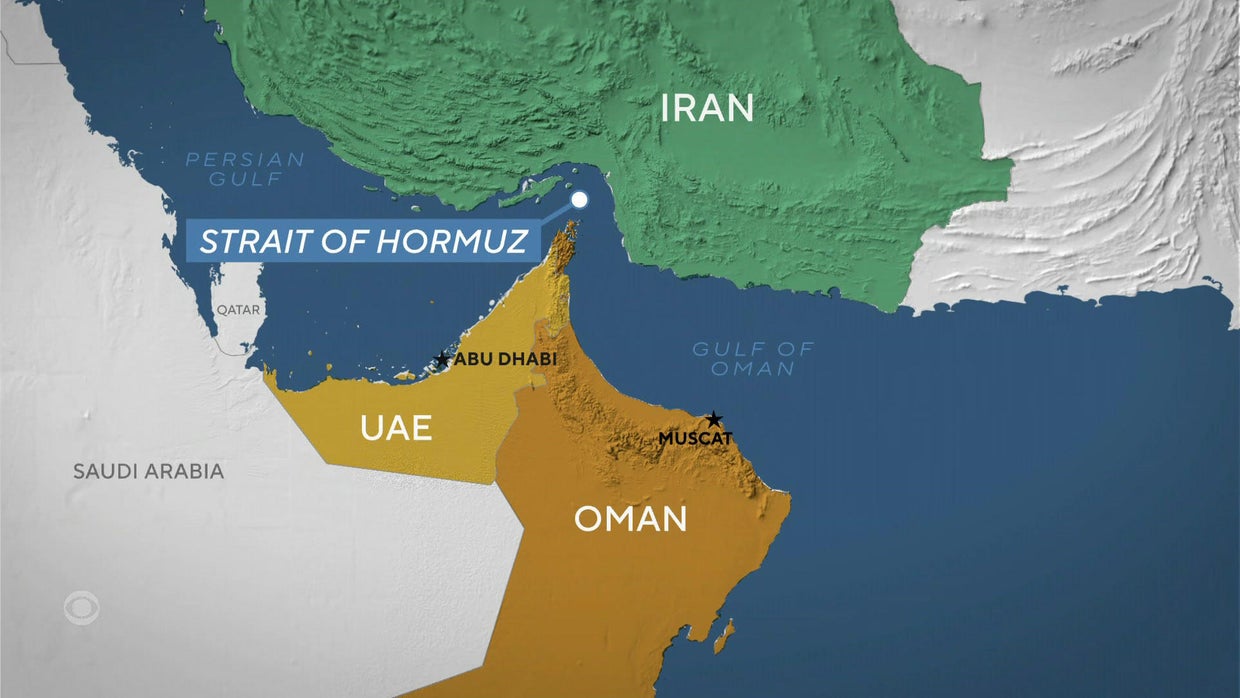
Trump warns Iran to “make a deal or we’re going to finish the job”
President Trump warned Iran Monday that the U.S. will either “make a deal or we’re going to finish the job.”
“I’d rather make a deal, because I don’t want to affect 91 million people,” Mr. Trump said. “We can knock down their bridges in one hour. We can knock out their energy supply.”
Talks between the U.S. and Iran were on hold for the funeral of Iran’s slain supreme leader who was killed by a U.S.-Iran strike in the opening moments of the war in February.
Slain supreme leader’s funeral continues in city of Qom
Authorities flew late Supreme Leader Ayatollah Ali Khamenei’s coffin to the Shiite seminary city of Qom overnight, where more mourners have gathered to pay their respects.
Iranian state television early Tuesday aired live images from a helicopter of hundreds of thousands of people walking toward Jamkaran Mosque, just south of Qom, for a funeral service for the former supreme leader, who was killed in an Israeli or U.S. strike on Feb. 28, the first day of the war.
Stringer/Anadolu/Getty 
As the week-long funeral has gone on, mourners have increasingly called for Khamenei’s death to be avenged, holding signs and chanting for the killing of both President Trump and Israeli Prime Minister Benjamin Netanyahu.
Such signs were seen again Monday along the procession’s route.
“We are here to show that his path will continue, and every single one of these people will continue down his path with clenched fists, and soon we will certainly avenge his death against the U.S and Israel,” said mourner Sahar Zaraatgar.
Mohammed Salem/REUTERS 
U.S. federal authorities have been tracking Iranian threats against the president and other administration officials for years, stemming from Mr. Trump’s ordering the 2020 killing of Qassem Soleimani, who led Iran’s elite Quds Force. Iran has repeatedly denied plotting to kill Mr. Trump, though hardline propaganda video produced by the regime has long suggested he is in Tehran’s crosshairs.
Mr. Trump, meanwhile, promised to destroy Iran’s civilization during the war, among other threats.



