
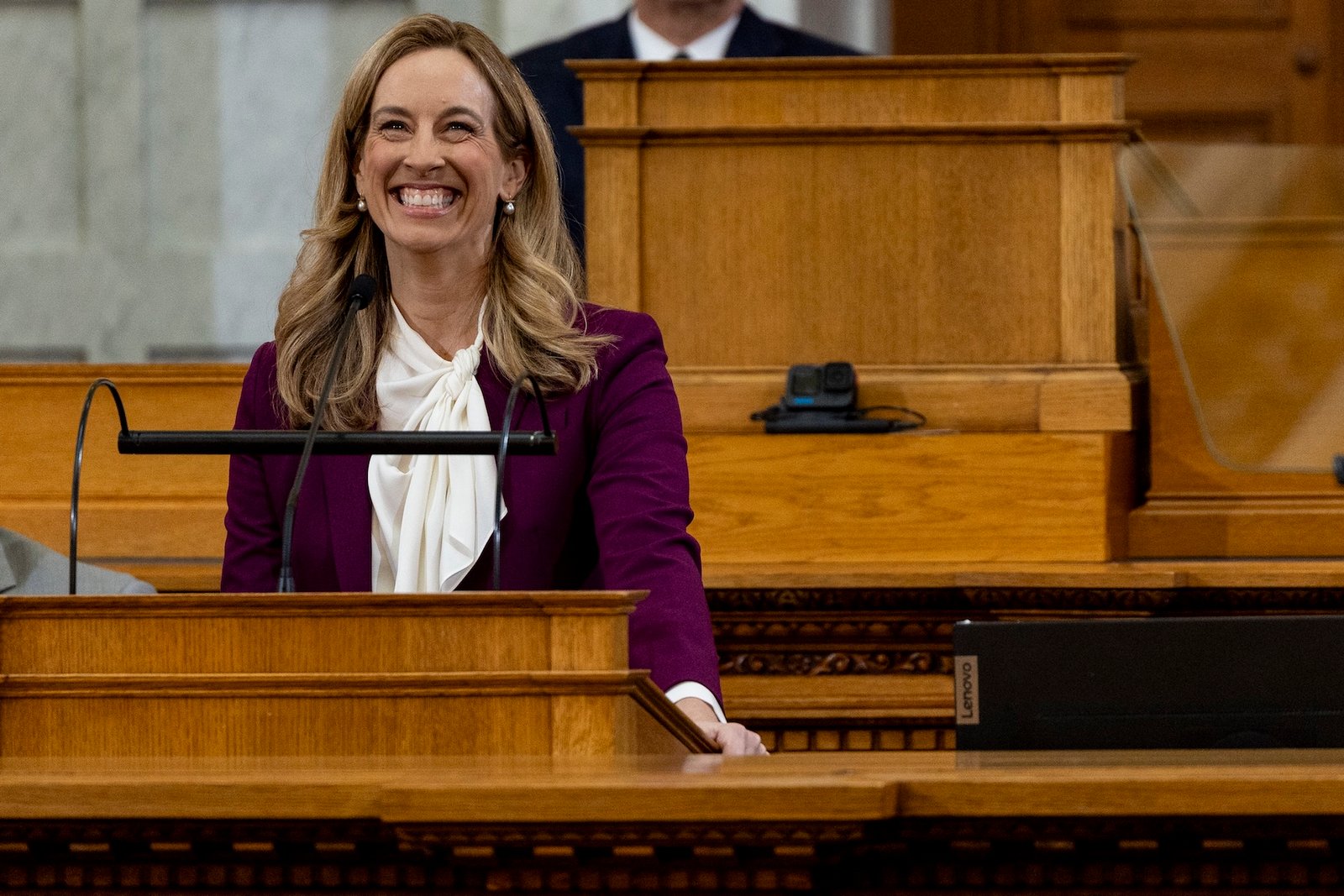
Gov. Mikie Sherrill signed a trio of bills meant to lower electricity prices and blunt the impact data centers have on them Tuesday.
The bills would create a separate rate-setting process specific to data centers, eliminate a bump to return on equity New Jersey’s utilities get for joining the state’s regional grid, and require utilities get new approvals from the state before building some types of transmission infrastructure whose costs are ultimately borne by ratepayers.
“I’m bringing accountability back to New Jersey energy and standing up to everyone who makes your families pay for their mistakes. We’ve started digging out of the hole, but as we saw with the storms and heat this weekend, our grid desperately needs upgrades to prevent blackouts,” Sherril said at a press conference at the Woodstown home of Aileen Bailey, the mother of Assemblyman Dave Bailey (D-Gloucester).
The bill package is meant to slow growth in electricity rates that have shot up across the grid that serves New Jersey and 12 other states in response to soaring demand driven almost entirely by artificial intelligence data centers that can consume as much power as cities like San Francisco.
The data center bill, sponsored by Bailey, would require the Board of Public Utilities, New Jersey’s energy regulator, to create a special rate-setting process for data centers graded to consume at least 50 megawatts that would require large data center customers shield other ratepayers from their impact on electricity prices.
The rules mandated by the bill, which the BPU must complete within 12 months of Tuesday, must also incentivize data centers to stand up their own new renewable generation, prioritize other electricity users over data centers if demand approaches grid limits, and shield ratepayers from costs for transmission infrastructure meant to serve data centers that end up closing.
Sherrill acknowledged data center-specific electricity rates could have limited impact on New Jerseyans’ electricity bills because supply and demand set prices for power across the entirety of PJM’s 13-state grid.
That means data centers in Virginia or Pennsylvania would boost electricity costs in New Jersey and vice versa, but Sherrill said other states were looking to follow New Jersey’s lead on data center rate setting.
“We, I think, are a leader in this space, but we have all kinds of states reaching out. We’ve seen them working to pass similar legislation,” Sherril said. “I think we will act as a region to get these costs down because, yes, that is a big concern.”
Virginia’s energy regulators, for example, in November approved a new rate class that would boost the share of power costs leveled at large industrial and commercial users, including data centers.
A second bill signed Tuesday would effectively eliminate a 0.5% bump to return on equity — the rate at which New Jersey’s electric distribution companies can profit on infrastructure investments — that New Jersey utilities received for joining a regional transmission organization like PJM or another similar entity.
Federal policy makes that 0.5% increase available to any utilities that voluntarily join a regional transmission organization. The bill makes voluntary membership impossible by making membership mandatory.
“We’re also closing a loophole that has resulted in hundreds of thousands of dollars in added costs to New Jersey ratepayers due to an outdated federal policy,” Assembly Speaker Craig Coughlin (D-Middlesex) said shortly before the bills’ signing.
The bill does not specify that New Jersey’s generators must join PJM’s grid, and four in-state power producers responsible for a combined 1,622.4 megawatts in nameplate capacity — about 8.9% of New Jersey’s total — send their energy to New York’s single-state grid, according to Energy Information Administration data.
Sherrill expressed openness to making PJM membership compulsory for New Jersey’s generators but stopped short of a full endorsement.
“I’d be very interested in that,” she said. “That’s something I’m happy to work with our team in the legislature to see if it makes sense here, but what we really want to do in the near term is enable local governments here in New Jersey to make good choices and have the power to hold data centers accountable.”
The third bill Sherrill signed Tuesday creates two state-level approval tracks for supplemental transmission infrastructure, like wires and poles, whose oversight had largely been left to the federal government, with the faster track set for projects that use more advanced transmission technologies.
New Jersey was one of only two states on PJM’s grid that did not require supplemental transmission projects to secure certificates of public convenience and necessity, and officials hoped the new law could end unnecessary transmission investments.
“This was sort of like the hidden place where the utilities could make more money, and they’ve done very well with it,” said Sen. John Burzichelli (D-Gloucester).



