
Although he would go on to make several films that defied the studio’s expectations, it was not until “Tattooed Life” that director Seijun Suzuki received his first warning from Nikkatsu for “going too far”. Features such as “Youth of the Beast” and “Gate of Flesh” had already demonstrated Suzuki’s predilection for violating genre conventions in favor of a more extravagant, almost pop-art style. However, “Tattooed Life” proved too much for the studio, which expected a far more conventional—and therefore more marketable—yakuza picture.
Compared to those earlier productions, this film largely follows the conventions one would expect from a yakuza story, featuring gunfights, action scenes, bloodshed and a spectacular finale. Nevertheless, “Tattooed Life” transcends its genre formula by incorporating reflections on Japanese imperialism alongside a deeply fatalistic story about two brothers trying to escape the clutches of a yakuza clan.
Buy this Title on Terracotta
by clicking on the image below
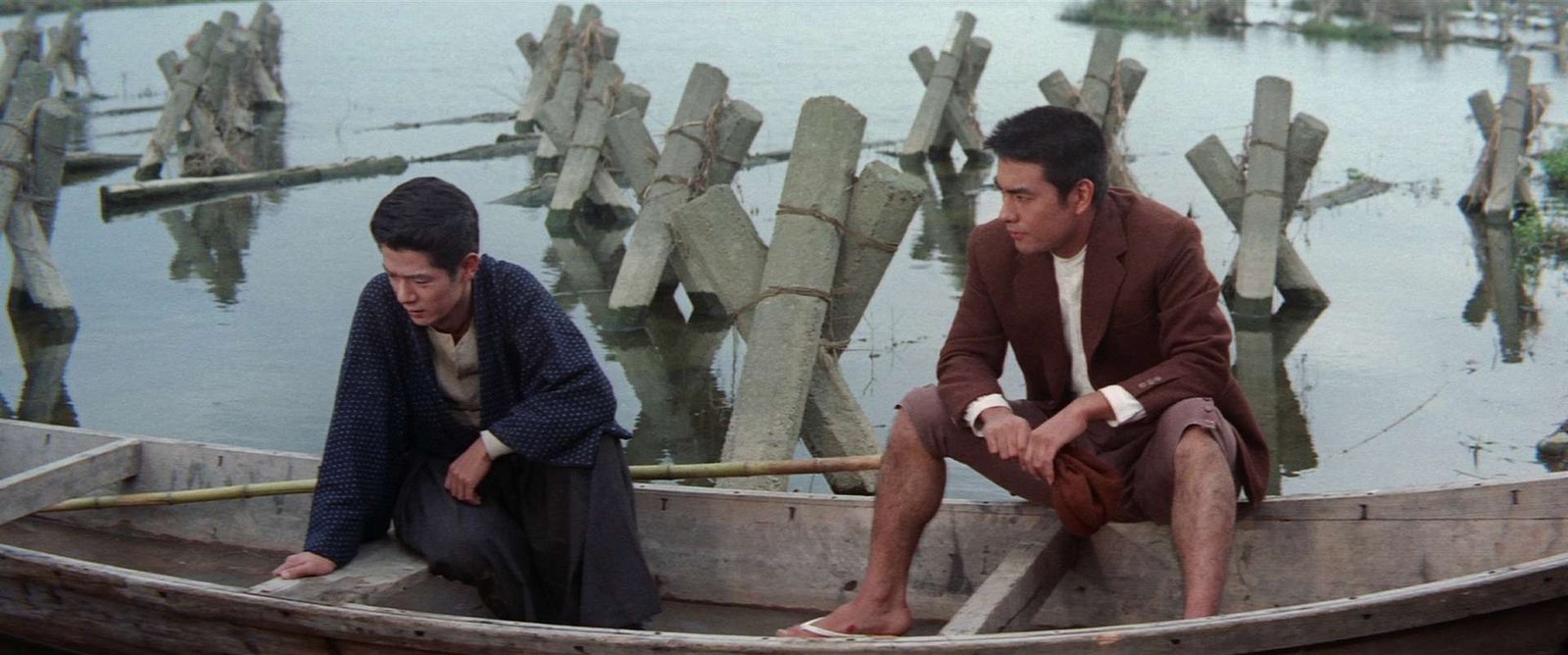
After killing a gang boss in self-defense, yakuza hitman Tetsutaro Murakami (Hideki Takahashi) and his younger brother Kenji (Kotobuki Hananomoto) decide to flee to Manchuria in search of a new life. Having devoted himself entirely to his clan, Tetsu is far more experienced when it comes to surviving on the run and dealing with dangerous adversaries. Most of the money he has earned has been spent on supporting Kenji’s artistic ambitions in the hope of getting him accepted into a prestigious art school. However, with the clan closing in on them and a swindler stealing almost everything they have left, the brothers are forced to find work in order to finance the boat that will take them to their promised new beginning.
Eventually, they find employment at a remote construction site and quickly become friends with the workers. Their peaceful existence proves short-lived, however, as Kenji becomes infatuated with the foreman’s wife and cannot stop sketching her. At the same time, Tetsu falls in love with Masayo (Hiroko Ito), causing him to question whether fleeing to Manchuria is truly necessary when a peaceful life with her suddenly seems within reach. Yet any hope of such a future disappears once the men from his former clan finally catch up with the brothers.
While “Tattooed Life” may not be as revolutionary for the yakuza genre as “Tokyo Drifter” or “Branded to Kill”, it nevertheless remains a key work in Suzuki’s career. On the one hand, it revolves around one of the central themes running throughout his films of the period: the longing for a normal life and the hope of a new beginning. Both Tetsuya from “Tokyo Drifter” and Hanada from “Branded to Kill” share important similarities with Kenji and Tetsu, as their conflicts with the yakuza ultimately lead them to pursue an ordinary existence—a dream that is inevitably doomed to fail.
In “Tattooed Life”, Suzuki frames this recurring idea through the lens of Japan’s imperial ambitions, symbolized by the brothers’ desire to begin a new life in Manchuria. He wastes little time exposing this dream as an illusion, as Tetsu immediately falls victim to a con artist who steals nearly all of their money. By shattering this illusion from the outset, Suzuki shifts the audience’s attention toward the far more compelling image of two men desperately clinging to the hope of a normal life while remaining trapped in an inescapable transitional state.
As the opening title sequence already suggests, Suzuki is fascinated by the visual power of yakuza tattoos. Although they disappear almost entirely until the film’s final act, the camera’s attention to every intricate detail transforms them into works of art as well as important narrative devices. Beyond their obvious aesthetic appeal, however, the tattoos also embody the film’s underlying fatalism. They symbolize a destiny permanently inscribed onto the bodies of those who wear them.
As much as Tetsu longs to leave his criminal past behind, he cannot escape his yakuza identity, making any attempt at a new beginning impossible. Worse still, the decision to bear the clan’s tattoo has not only condemned his own future but has also dragged his younger brother into a world of violence and crime. While Suzuki’s yakuza films are often remembered for their visual flamboyance, this belief that one’s fate is sealed the moment one enters the underworld closely connects his work to the films of Kinji Fukasaku and Hideo Gosha.
One aspect that truly distinguishes “Tattooed Life” from many contemporary yakuza films is its portrayal of the relationship between Kenji and Tetsu. Hideki Takahashi’s Tetsu initially appears to be the archetypal yakuza, willing to sacrifice everything for his clan and unquestioningly obey every order, whether it involves murder, theft or other crimes. Torn between the family he was born into and the one he chose within the underworld, he develops into a far more complex protagonist than one might initially expect. Kenji, by contrast, is his complete opposite.
Although one could argue that Suzuki could have made even greater use of the character, Kotobuki Hananomoto delivers perhaps the film’s most fascinating performance. His fascination with the human body mirrors the film’s own obsession with tattoo art introduced in the title sequence. In Tetsu’s eyes, Kenji represents innocence and purity, yet his relentless search for beauty borders on obsession, leading him to jeopardize not only his own safety but also that of his brother.
“Tattooed Life” is a fascinating yakuza drama about the impossibility of a new beginning once fate has been permanently inscribed onto one’s body. Seijun Suzuki tells the story of two brothers whose contrasting obsessions ultimately define their destinies: one cannot live without art and beauty, while the other is incapable of escaping the criminal life that has quite literally been tattooed into his identity.



