
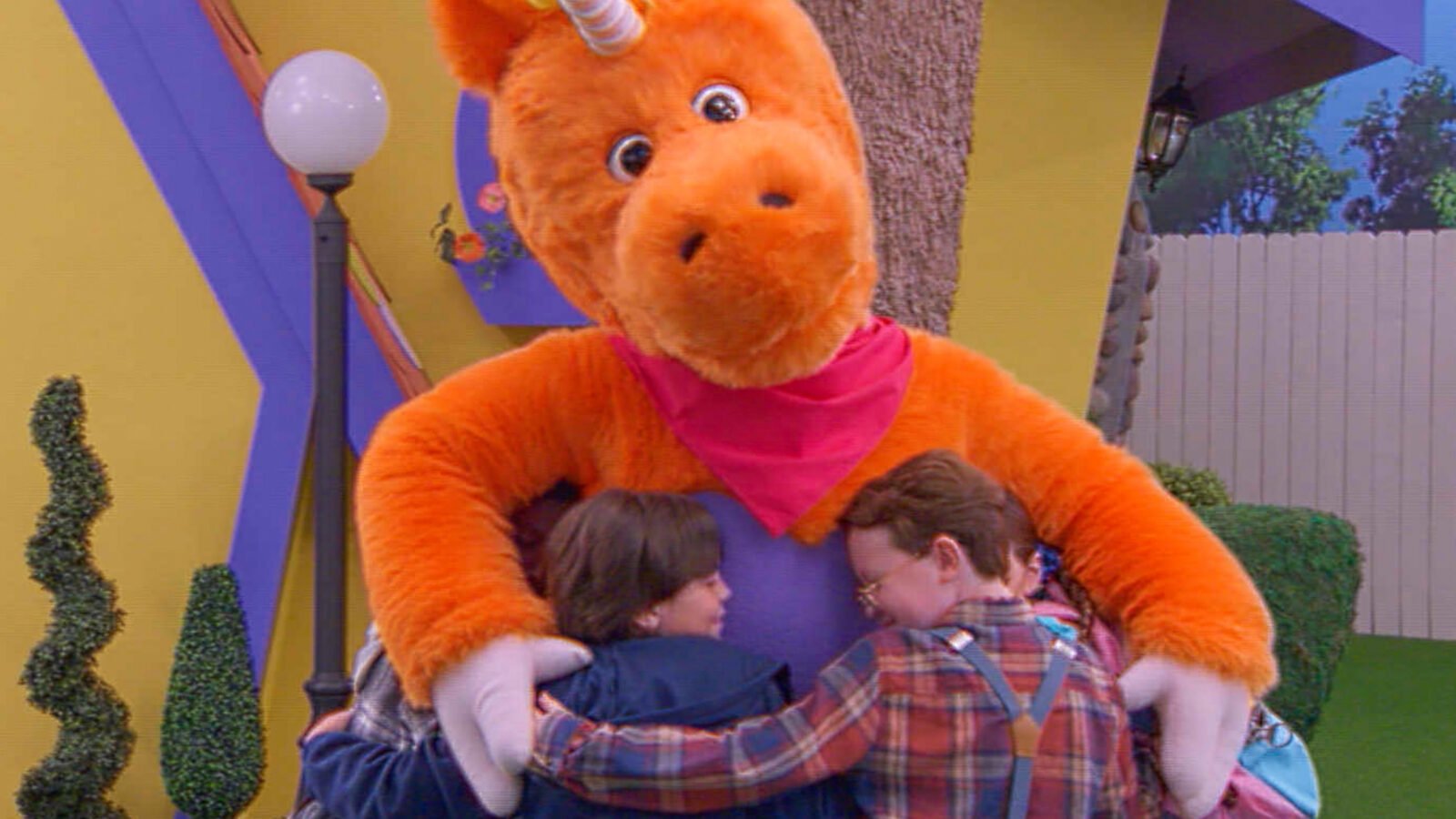
Casper Kelly makes his directorial debut with Buddy, and approached his first film like it might be his last.
“I might be guilty of throwing in everything and the kitchen sink. Executives will say, ‘Well, that’s a hat on a hat,’ but I love to put in as much as I can. I make movies like, ‘Am I going to get to make another one?’ I’m going to go for it. I’m going to try to swing.”
The film tells the story of It’s Buddy, a children’s show in the vein of Barney & Friends in which Keegan-Michael Key voices the titular magical unicorn. Buddy welcomes children into his candy-colored house — but they defy him at their peril. Cristin Milioti and Topher Grace also star.
From ‘Too Many Cooks’ to Just the Right Amount of Cooks in Buddy
Casper previously directed Adult Swim Yule Log and “Too Many Cooks,” which became an online obsession thanks to creepily ridiculous details like a cat puppet named Smarf.
Buddy, which was shot at Cleveland’s TGR Studio and Vision, required production designer Anna Kathleen to envision sets ranging from the Old West to fields of talking flowers. The images were drawn partly from her and Kelly’s childhood memories.
“I thought of Barney & Friends, Dora the Explorer, and Blue’s Clues. I love sets that are made to look like an exterior, but are an interior set. Going back to The Wizard of Oz as a kid, that world is magical and heightened. Also, there are those great musicals, Oklahoma! or Seven Brides for Seven Brothers. I was excited that I had a chance to do those sets.”
The sets get especially strange when young Freddy (Delaney Quinn), Hannah (Madison Skyy Polan), and Oliver (Tristan Borders) decide to flee from Buddy and make a break for the Oz-like Diamond City.
“I knew from the beginning that we were going to have to embrace a certain fakeness, that we shouldn’t try to fool anybody that we’re in a forest or a swamp,” says Kathleen. “We have to embrace that this is an artificial environment. Lean into that aesthetic – that was a guiding light throughout. Everything is exaggerated and gets a little bit more textural and rugged as we get into the strange lands.”
Production Designer Anna Kathleen on the Humanity Behind Buddy

Color is essential to Buddy’s playground. Everything needed to pop to contrast with the horrors of kids in peril.
“I was draconian about the color palette to the point where I was playing referee with my team and other teams,” Kathleen explains. “It was important that we have a concise color palette. You can create production value that’s conceived, consistent, and a holistic vision. I laid out the color palette early on and got approval, of course. There’s almost no true red. It pops up in little set decorations in the playhouse and whatnot, but everything on the set was orange or pink or skirted around these traditional primary colors.”
Because Buddy is trying to pass as a normal children’s host, nothing could scream inherently scary. Even Buddy at his most frightening required innocence. He was designed by Emmy-winning puppeteer and director Devon Hawkes Ludlow.
“There’s a lot of iteration with these characters,” Kelly says. “But with Buddy, they originally had his pupils small and slightly askew. He looked crazy and menacing. There was a lot of back and forth with Devon like, ‘He’s got to look friendly like a real show.’ When he starts acting menacing, the audience will adjust their view of this impassive face.”
To imitate Barney & Friends, their main reference, Casper and cinematographer Zach Kuperstein (best known for Barbarian) went for even, flat lighting. Until the film takes a turn.
“In the first draft that I read, Buddy was scripted as orange,” Kathleen says. “He later briefly changed to blue, but orange was very important in how that character, our perceptions of him, evolved over the course of the show. He has to be orange, because there’s a brightness about it that works from the beginning with it being almost kinder and scholastic. The way that the orange interacts with the different landscapes that we get into later pops off the screen in a way that is important.”
While not everything is revealed about Buddy’s past, props on the set are open to interpretation.
“The prop people did an amazing job, and the pictures they had hanging on the wall and the little stories behind them, I thought were great,” Kelly says.
The Old West set was inspired by Kathleen’s upbringing on a ranch in Colorado.
“I wanted to make this sort of great American landscape with some distance, some depth, and some romance to it,” she says. “That was my favorite set, for sentimental reasons. But then it also helped create the next level of visual language that got us on the railroad to Diamond City.”
The care and labor that went into these environments is a testament to human artistry.
“We were making this movie in one of the first summers of AI,” Kathleen says. “AI was on everybody’s lips. It was post-strikes, of course, but the unions were in conversation about how to regulate the use of AI. It was special – getting your hands dirty, rolling your sleeves up, and making a movie in the old-fashioned way. I had a small but incredible team. Every person had exactly the right attitude in terms of like, ‘F— yeah, I can’t believe we get to make this movie.’ Everybody was willing to get scrappy and get weird, because movies aren’t made like this anymore.”
Buddy is now in theaters, from Roadside Attractions.
Main image: Buddy. Roadside Attractions



