
Instead, Trump announced this summer that he would personally deliver his own assessment of the threats to American elections, starting with a prime-time address last month from the White House. Trump has now spent a decade pushing discredited claims about the corruption and unreliability of American voting, including the preposterous assertion that Venezuela had somehow secretly rigged voting machines to cost him reëlection in 2020. Without the legally mandated assessments from career analysts at intelligence agencies, there were few limits on what he might say. Would he tell voters to shun the Democrats because some shadowy foreign adversary was scheming to elect them, or cherry-pick classified reporting to claim that deep vulnerabilities in the voting systems of certain states required emergency federal intervention? Would the loyalists he picked to head the Central Intelligence Agency and the Federal Bureau of Investigation—John Ratcliffe and Kash Patel—stand beside him?
Trump’s own self-absorption may have tripped him up. Instead of using his address to discuss present-tense threats, he mostly perseverated about his 2020 loss and recycled debunked claims. He overplayed three-year-old intelligence (hinted at in the assessment released after the 2022 election) that China had collected publicly available data about voters, implausibly argued that intelligence officials had conspired in a coverup to hurt him, and directed viewers to a trove of newly declassified documents that mostly undermined his own assertions. Fox News immediately distanced itself from his assertions. An anchor declared that the network “has not seen that evidence yet and is not in a position to evaluate the accuracy of the President’s statement and claims,” and Fox almost completely dropped the matter. Republican lawmakers, when questioned by journalists, mostly ran from the subject. Still, if Trump’s fearmongering was inept, his intentions were clear: he was unmistakably trying to distort classified intelligence in order to manipulate American voters.
Real threats seem to receive much less of Trump’s attention. Intelligence officials and independent experts have consistently maintained that it would be virtually impossible for a foreign power to meaningfully tamper with the counting of ballots—much less to do so without detection. And midterms also generally arouse less interest among foreign adversaries than Presidential contests, which have more direct consequences for U.S. foreign policy. But covert foreign influence—secretive troll farms, hack-and-leaks, or viral deepfakes—remains a growth industry. The easy, and increasingly convincing, fakery of artificial intelligence has arguably supercharged it. Swinging relatively few voters can change the outcome of state or district elections, especially in close races or small electorates. This year, a handful of such electorates will likely decide control of the Senate: Iowa has about two million voters, Maine about a million, and Alaska about six hundred thousand.
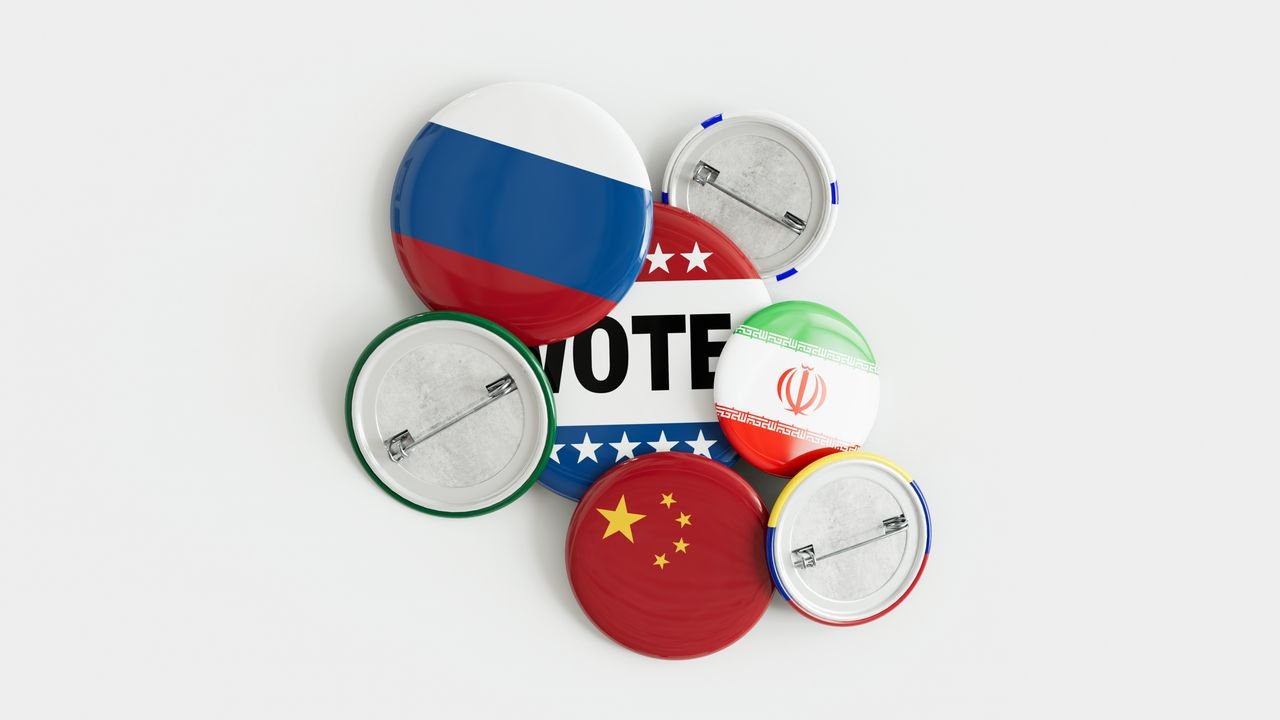
By the summer of 2024, the Office of the Director of National Intelligence, through its specialized Foreign Malign Influence Center, was providing periodic briefings to journalists about any potentially significant covert influence or interference operations from foreign governments that U.S. spies had detected. The Justice Department, in parallel, had filed an eye-popping criminal complaint charging that, through a front company, Russia secretly funded and directed a handful of pro-Trump online influencers, reportedly including Tim Pool and Benny Johnson. (The influencers said that they had no knowledge of the Russian involvement and took no direction from Russia.) And, by Election Day, the intelligence agencies had issued at least five notifications warning the public of information operations by Russia and Iran. But, as Trump took office, his Administration dismantled both the Foreign Malign Influence Center and a complementary F.B.I. task force. These days, no one (aside from the President himself, in his prime-time address) is briefing journalists, and, given the Justice Department’s apparent priorities, no one should expect to read another juicy federal indictment about what the Russians, Chinese, or Iranians may be plotting for the midterms.
After Russia’s attempts to exploit social-media networks in 2016, some tech companies also started trying to monitor and police this kind of underhanded meddling. Many appear to have scaled back these efforts following years of complaints from the Trump Administration and its conservative allies that the companies’ warnings about foreign-influence schemes reflected a bias against the right. David Salvo, a managing director at the Institute for Strategic Dialogue who tracks the efforts of authoritarian states to subvert democracy, told me, “The whole censorship-industrial-complex narrative has really deterred companies in the tech industry from monitoring that information ecosystem.” Yet, with the government silent, we are more dependent than ever on private companies—Microsoft may remain the most diligent—to warn voters about covert foreign attempts to manipulate them.



