
“When we see something very red in the universe, we often assume that it is surrounded by dust, like soot or ash,” Simcoe explains. “The same way that the wildfire smoke from Canada recently made the sky in Boston look bright red, astronomical objects can also appear redder than their intrinsic color when you see them through a veil of dust.”
But there were other signatures in the light that didn’t quite match up with what physicists expect from dust. The team also observed another strange pattern: The dot’s light was extremely bright, except below certain wavelengths, where the light completely disappeared.
This spectral drop-off is known as a “Balmer break” — a signature traditionally associated with dense gas soaking up photons in the atmospheres of stars that are a few hundred millions of years old. Vega, one of the brightest stars in the night sky shows exactly this pattern.
“The break we observed in this object is the deepest break we have ever observed in any object, ruling out ‘ordinary’ stars as the source,” Naidu says. “But it made us wonder if we were seeing a new kind of ‘stellar atmosphere,’ but on a spectacular scale.”
What’s more, the red dot’s light contained almost no signature of metals or any elements other than hydrogen and helium. “It was truly singular in so many ways,” Naidu says.
Pure light
To puzzle out what the source of the red dot could be, the team ran simulations of different scenarios to see what combination of astrophysical features could produce the red dot’s distinctive color.
“We started to ask: Could you make something that red using just hydrogen, without any dust?” Simcoe says. “To our surprise, it turns out you can, if you have an extremely dense screen of hydrogen, so dense that it looks more like the surface of an enormous star than a wispy interstellar nebula.”
Their simulations pointed to the red dot possibly being some powerful enshrouded energy source, surrounded by an extremely dense cocoon of hydrogen. If this were the case, it would explain the light-blocking Balmer break and the lack of anything other than hydrogen and helium that the astronomers observed. But it still wouldn’t explain the object’s extreme brightness.
“You have something that looks a bit like a star but is 100 billion times brighter,” Naidu says. “That means you can’t be powering this by nuclear fusion, which is the energy source that sits at the heart of all the stars we have.”
Black holes, however, routinely produce energy at the scales the team observed. Naidu and his colleagues incorporated an active, accreting black hole into their simulations of the hydrogen-cocooned star and varied the black hole’s mass, along with other parameters. They then compared the resulting brightness of the simulated “black hole star” with the brightness that JWST observed from the red dot.
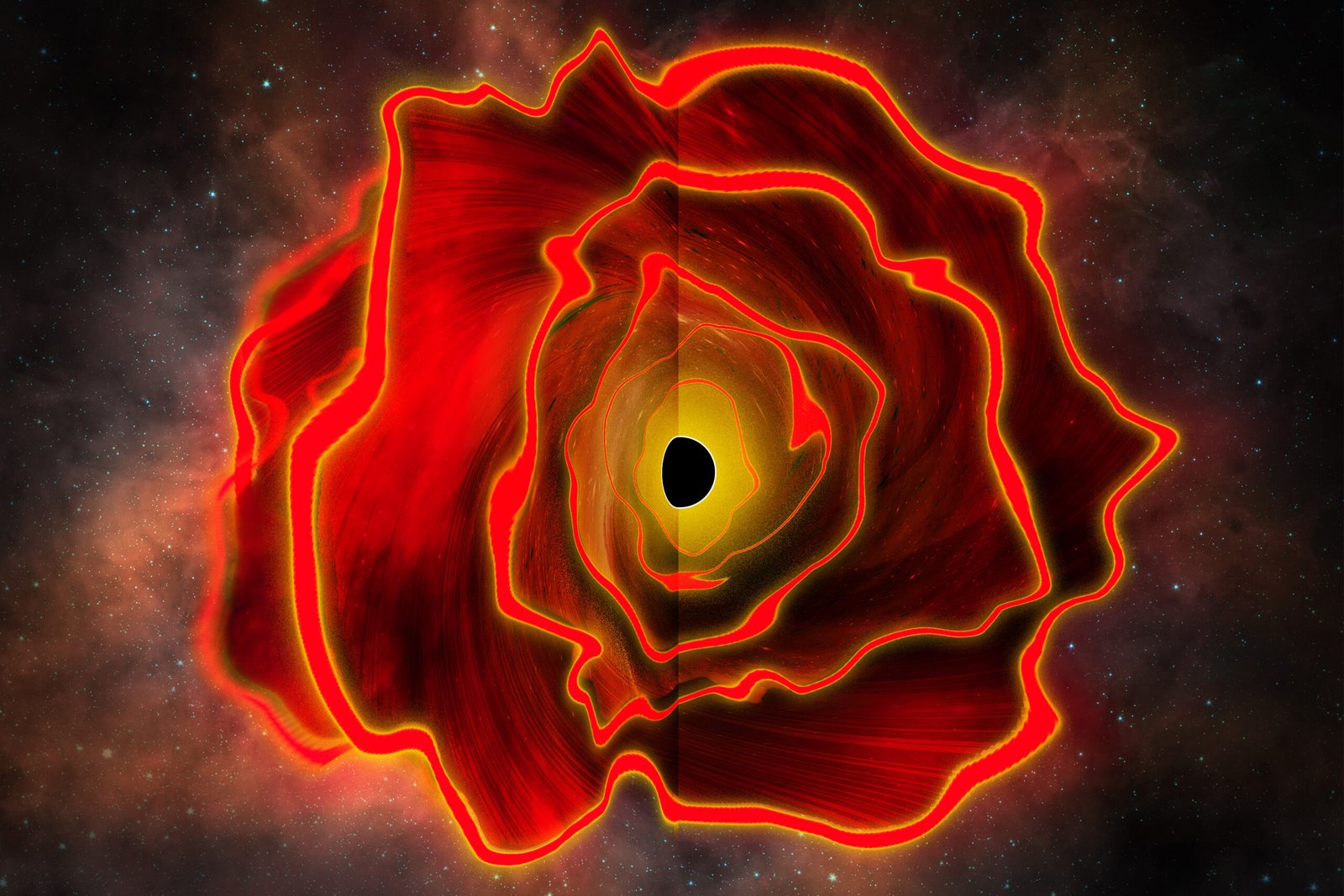
From these simulations, they found the closest match, and concluded that the most likely scenario to explain the red dot, is a black hole star. Specifically, the object likely contains a central black hole that is about 100,000 times as massive as the sun. This powerful core is surrounded by a dense, star-like cocoon of hydrogen that is roughly the size of the solar system.
The team has named the object MoM-BH*-1, after the survey that detected it, as well as the moniker “black hole star – one,” which implies that the object is the first of others. The researchers suspect that black hole stars could explain many of the other little red dots that appear in JWST images. Those objects are not as bright as MoM-BH*-1.
“Every little red dot is consistent with being a black hole star, embedded in a generic early galaxy,” Naidu says. “But what is special about MoM-BH*-1 is, the black hole star is essentially completely outshining its surrounding host galaxy, such that we’re seeing pure black hole star light.”
This research was supported, in part, by the MIT Department of Physics, NASA, and the Space Telescope Science Institute.
source: https://news.mit.edu/2026/astronomers-discover-brand-new-type-astrophysical-object-black-hole-star-0812



