
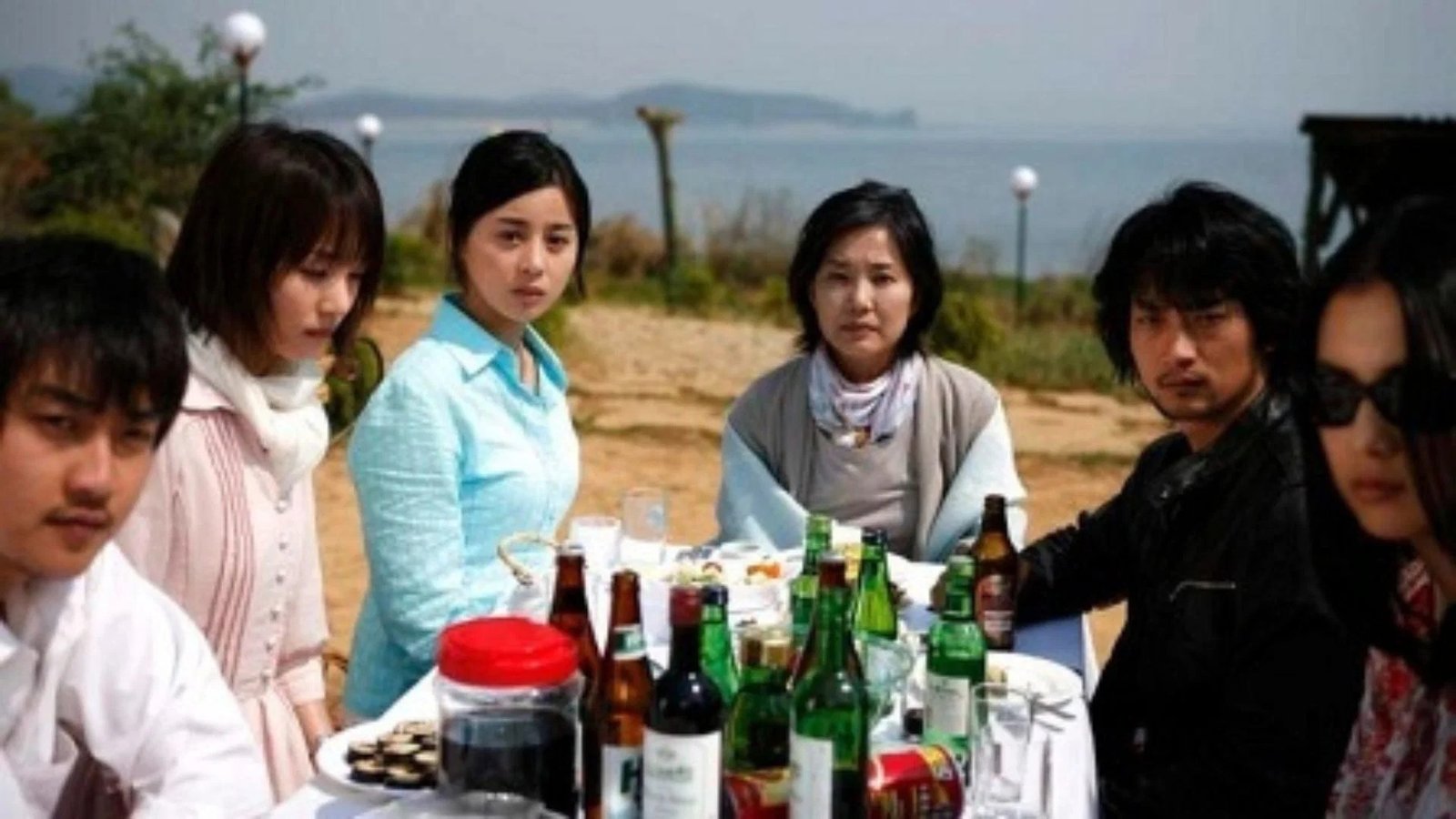
A shift occurred in horror in the early 2000s, where the focus turned to gritty, grimy, graphic genre fare that emerged as a reaction to the lighter, teen-favored content produced in the late 1990s. Spurred on by the likes of “Saw”, “House of 1000 Corpses,” and “Hostel,” the genre turned to brutal, splatter-heavy fare with an emphasis on realistically rendered carnage. Kill scenes emphasized the pain and torment of the situation far more than the suddenness and creativity typified before, creating a dark, grim look that runs wild throughout these movies. This trend eventually carried over into Asian cinema, with several titles attempting to emulate the style. One of South Korea’s notable efforts was Lim Dae-wung’s 2006 slasher, “Bloody Reunion
Click on the image below to follow our Tribute to Netflix
After gathering at a former teacher’s house, school friends Mi-ja (Seo Young-hee), Myung-ho (Lee Dong-kyu), Eun-young (Yu Seol-ah), Sun-hee (Lee Ji-hyun), Dar-bong (Park Hyo-joon), Jeong-won (Jang Seong-won), and Se-ho (Yeo Hyeon-soo) hope the visit will boost Mrs. Park’s (Oh Mi-hee) spirits after she receives bad news regarding her health. However, the visit quickly morphs into an opportunity to spill old grudges and uncover buried secrets rather than a celebration of the educator who helped raise them. As the group starts to fracture, they fail to notice the ruthless, bloodthirsty killer stalking the premises and picking them off one by one. When they finally realize who’s responsible for the gruesome deaths and why, they must race to stop the rampage before it’s too late
For the most part, “Bloody Reunion” is a solid slasher effort. The straightforward storyline from writer Park Se-yeol makes it easy to root for, grounding itself in a fantastic premise that screams old-school slasher. The setup—getting the former classmates out to a remote beach house under the guise of an affectionate reunion—works well for this type of revenge story. It cleanly establishes the isolated setting while giving us enough room to get acquainted with the characters. Writer Park Se-yeol relies on broad, simple, yet effective archetypal strokes: Mi-ja is the kind-hearted one who kept in touch; Sun-hee is the former outcast now obsessed with her appearance; Dar-bong is the former star athlete sidelined by injury; Jeong-won is the brash, obnoxious classmate ready to sell out everyone’s dirty secrets; and Eun-young is the quiet wallflower following along. Each character carries a secret, wounded past just waiting to boil over.
Once the initial pleasantries turn hostile and the long-buried grudges come to light, the film hits a fun, energetic stride. The building tension works exceptionally well as it’s revealed that every single one of them harbors deep resentment toward Mrs. Park. The dynamic gets even better once “Bloody Reunion” pivots into a series of paranoid accusations when the bodies start turning up. With so many viable suspects harboring legitimate motives, the central mystery keeps the group at each other’s throats.
When it comes to the set pieces themselves, the kills are merciless, gory, and easily among the most brutal in this subgenre. One victim has their eyelids stapled shut and is forced to watch as they are mutilated; another is forced to swallow razor blades that slice their throat from the inside; another has their eyes gouged out; and others are savagely beaten. The movie’s willingness to linger on these torturous set pieces creates a nasty, claustrophobic atmosphere suited for a blood-soaked revenge spree. Coupled with the chilling, unnerving child’s rabbit mask worn by the killer, the film delivers impressive visual iconography for gorehounds.
However, “Bloody Reunion” isn’t without its drawbacks, mostly stemming from its third act. The script introduces way too many late-stage visual twists that actively undermine the goodwill built up during the first two acts. Rather than committing to the simple, effective narrative of a group being hunted by a masked killer, the screenplay swerves into a series of convoluted rug-pulls that feel more like artificial audience manipulation than meaningful storytelling.
The introduction of the detective investigating the scene is clunky from the start, and the subsequent reveal—that much of what we witnessed didn’t actually occur the way it was presented—leaves behind far too many loose threads. A late flashback completely rewrites Mi-ja’s personality, undercutting the protagonist we’d been following the entire time. The overwhelming number of retcons makes the final resolution difficult to digest, playing out as a twist for the sake of a twist and bringing down the overall experience.
Slightly disappointing due to its messy finale, but still thoroughly enjoyable for its violent set pieces and moody atmosphere, “Bloody Reunion” is a worthwhile take on mid-2000s Korean horror. Viewers who appreciate brutal, ultra-gory slasher fare from this era will find plenty of carnage to enjoy here.



