
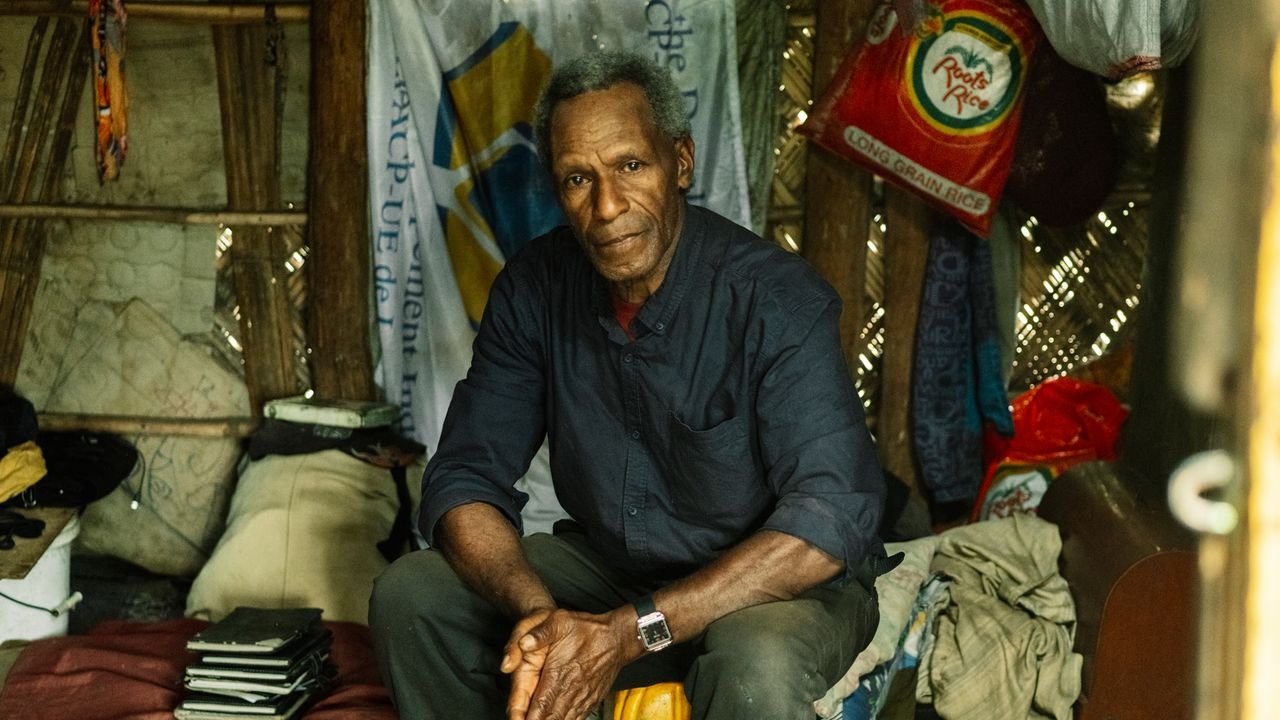
Gajdusek selected Mbaginta’o, he explained in a legal declaration, because he seemed the “most intelligent and adaptable to civilized society.” Mbaginta’o came from the Anga people, then known as the Kukukuku, who lived in a more remote region than the Fore, surrounded by uninhabited forest and steep mountains. In a college essay that Mbaginta’o wrote years later, edited by Gajdusek, he described the first rite of his initiation into manhood. Awakened by bamboo flutes, he and other boys, some as young as seven, began saying goodbye to the women in their family, whom they wouldn’t see again until they grew up. During the next three days, they were struck on the back with sticks, held animal hearts in their mouths, and went to a stream where a blade of cogon grass was stuck up their noses until they bled into the water. On the second day, Mbaginta’o wrote, “the young novices must suck the penises of the older initiated men in order to grow up fast. This homosexual act was to remain a secret of the men, and if it was told to the women, the teller would be killed.”
Versions of this initiation practice, which was largely abandoned by the nineties, have been described by anthropologists studying the community. “I have found here in the Western Kukukuku (and I believe that in the past, at least, it was true for the entire Kukukuku) a culture in which pederasty—or pedophilia—has been institutionalized,” Gajdusek speculated, in a journal that was typed up by his staff, printed by the N.I.H., and distributed to hundreds of his colleagues.
Not long after his initiation, Mbaginta’o ran away from the Anga people. Both of his parents had died. He began living among the Fore, under the care of Luwi’s grandfather, calling Luwi’s mother his sister. It was there that he encountered Gajdusek. “He was first white man ever met,” he wrote later. “He thought me his western worlds and confuse me in my bush life.”
With permission from the Australian colonial government, which controlled Papua New Guinea, Gajdusek and Mbaginta’o left the country together in 1963, making a stop in Guam on the way, to visit an N.I.H. lab. Mbaginta’o didn’t know his age, but Gajdusek guessed that he was eleven. In the hallway, they passed a morgue where a white corpse was being loaded into a coffin. “Mbaginta’o stopped short at the sight of the body, and beheld it in such amazement that I too was amazed,” Gajdusek wrote in his journal. Gajdusek asked what was wrong, and Mbaginta’o responded, “Wait man em i dai tu?”—“The white man, he died, too?” It was only then, confronted with the corpse, Gajdusek wrote, that Mbaginta’o could “suddenly grasp the fact that I, too, belong to a race of mortals.”
In America, they were greeted at the airport by Gajdusek’s friend Joseph Wegstein, a prominent computer scientist at the National Bureau of Standards. “He was dressed like a boy fresh from a British Colonial office, but instead of stepping out of British Colonial history, he was stepping across 10,000 years of time,” Wegstein wrote in a school recommendation. At the airport, Wegstein continued, Mbaginta’o “would not say anything but ‘hello,’ ‘yes,’ and ‘no.’ ” In a letter, François Jacob, a French biologist who’d won the Nobel Prize in 1965, wrote that Gajdusek had wanted to see “whether this boy, living in the wild forest, could be accustomed to the modern and sophisticated life.”
Mbaginta’o enrolled as a sixth grader at Georgetown Day School. Wegstein tutored him in math three times a week. “His insecurity & anxiety directs him to hard work & quiet withdrawal & diligent attempts to help, to accomplish much, to please!” Gajdusek wrote. Wegstein, who didn’t have his own family, prepared meals for Mbaginta’o, bought him clothes, took him sailing, and kept a journal of their time together when Gajdusek was away. After three months in the U.S., Mbaginta’o went with Gajdusek to see the Andrei Tarkovsky film “My Name Is Ivan,” about a twelve-year-old orphan who works as a scout during the Second World War and is visited by dreams of his childhood. Mbaginta’o soon decided that he would adopt a new name, easier for Americans to pronounce: from now on, he would be called Ivan.



