
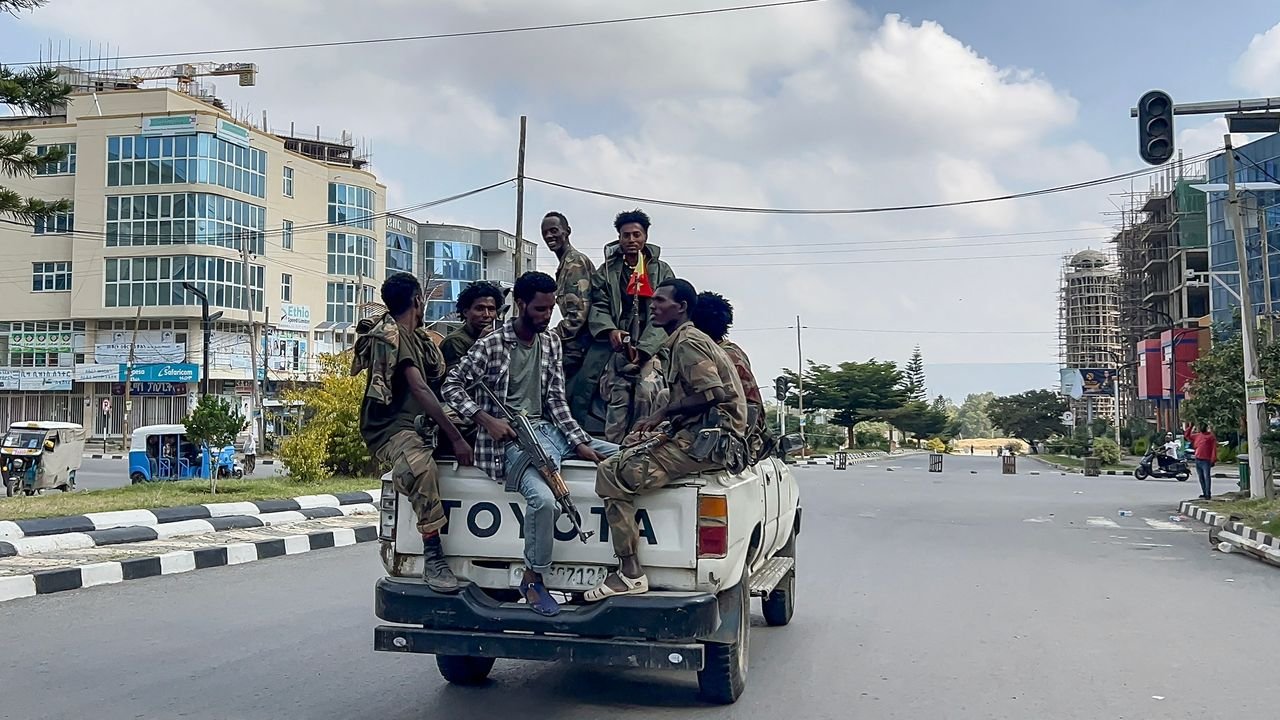
If talk of a collapsing “international order” can feel like a distant abstraction, look to the Horn of Africa for a sense of its reality on the ground. The countries of this region—marked by rugged highlands, rift valleys, and arid coastal plains—have become troubling examples of a new era of global politics, where the strong dominate the weak, the institutions set up to forge peace are constantly failing, and the transactional economic interests of an array of outside powers overshadow the plight of civilians. In Ethiopia, a long-simmering conflict recently exploded into open war. Over the weekend, government troops and allied fighters pushed back the advances of an alliance of factions that are in rebellion against Prime Minister Abiy Ahmed’s central government. By Monday, they were in control of Mekelle, the capital of the Tigray region and the seat of the Tigray People’s Liberation Front, which is one of the militias in the coalition that wants to oust Abiy. Weeks of violence, stretching from Addis Ababa, the capital, to areas in Ethiopia’s north and east, have led to dozens of reported casualties, internet and phone disruptions, and fears of a humanitarian crisis. Friction between the T.P.L.F., which had once dominated Ethiopian politics, and Abiy’s government underlay a civil war that began in 2020 and saw estimates of as many as six hundred thousand people killed and allegations of war crimes. An internationally brokered peace in 2022 failed to hold, amid various turf wars, paving the way for fresh trauma.
The situation is grim on its own, given the complexity of Ethiopia, Africa’s second most populous nation and the home to dozens of different ethnic groups. But it’s made all the more fraught by the broader regional context. Shadowing the renewed fighting in Ethiopia is Sudan’s civil war next door. Abiy’s government has been reportedly involved with training troops belonging to the Rapid Support Forces, the paramilitary organization that controls swaths of western Sudan and has carried out numerous alleged atrocities and massacres of civilians during its protracted war with the Sudanese Armed Forces. Tigrayan fighters, meanwhile, have reportedly appeared alongside the Sudanese military in its battles against the R.S.F. In the earlier fighting over Tigray, Eritrean soldiers collaborated with their Ethiopian counterparts. Now Eritrea appears to be backing the Tigrayan rebels, and this prompted Ethiopia to expel ten Eritrean diplomats and to shutter its Embassy in Asmara, the Eritrean capital, last week; Eritrea, in turn, severed diplomatic relations. Last week, Ethiopia’s Army chief accused Egypt, Eritrea, and the Sudanese Armed Forces of fomenting the new insurgency. Their governments all issued denials, and, over the weekend, their leaders met in Egypt with the President of Somalia—who is also at odds with Abiy over the latter’s overtures to Somaliland, an autonomous self-declared republic that sits within Somalia’s internationally recognized borders. They issued a statement that aired shared grievances over Ethiopia’s designs on access to the Red Sea, which it had lost when Eritrea gained independence, in 1993, and its creation of a major dam on the Nile; the statement also rejected any recognition of or support for Somaliland. (Israel is the only U.N. member state to have established formal ties with the territory’s government.) On Monday, Abiy fired back, reiterating his view that Ethiopia must have “an outlet to the sea,” which it is now trying to regain through links with nearby Somaliland.
If you think this is complicated, hang on. Hovering in the background are the schemes and interests of a constellation of greater powers, including Gulf monarchies such as the United Arab Emirates, Saudi Arabia, and Qatar, as well as Turkey and Egypt. They are all players in an arc of conflict and opportunity that spans war-torn Libya on the Mediterranean Sea to war-torn Yemen on the Red Sea, fuelled by a scramble for control of strategic waterways and lucrative resources—oil, critical minerals, water—as well as broader tussles for geopolitical influence. Rivalries between these countries manifest in proxy struggles. In Sudan, the U.A.E., despite its denials, appears to have supported the R.S.F. with arms and funding, while the Saudis, Egyptians, and Qataris are far closer to the SAF; in Somalia proper, Turkey has a substantial military footprint, which eventually could be countered by the deployment of Israeli and Emirati assets in Somaliland. (At an event last month, in New York City, Somaliland’s President, Abdirahman Mohamed Abdullahi, told me that, despite the speculation, there was no Israeli military presence in his republic “at the moment.”) “The Horn has become this dysfunctional part of the fractured politics of the Middle East,” Alex Rondos, a former European Union special representative for the region, told me, adding that the fighting in Ethiopia “means we have a fusion, a convergence into something wider and more dangerous.” Michelle Gavin, a former U.S. diplomat and National Security Council senior director for Africa during the Obama Administration, sees a series of fractious conflicts that seem to be coalescing into one. “I start to sound like somebody with a lot of red string, but there are so many points of tension that have now become connected to other points of tension, that it feels like it would be very easy for escalation in one place to trigger escalation throughout the region,” Gavin said.
Processes exist to prevent a conflagration, but they don’t seem to be working. In Sudan, various groupings of foreign powers—the “Quad” of the United States, U.A.E., Egypt, and Saudi Arabia, and the “Quintet” of five international bureaucracies, including the African Union and the E.U.—have been unable to stop a civil war that’s now in its fourth year, having displaced about a third of its population and left more than two-thirds of it in need of humanitarian relief. (A joint call from humanitarian organizations published Monday warned that aid shortfalls and continued fighting are putting this year’s harvest at risk in Sudan, an outcome that will likely worsen what’s already the world’s worst hunger crisis.) Some of the Middle Eastern countries still maintain interests that are driving the conflict, while other outside actors don’t seem able to muster the leverage to persuade warring parties to cease hostilities. The latter group includes the United States—the Trump Administration has gone through the motions of claiming that it wants to end the Sudanese conflict and has pursued rounds of talks, but analysts say that its engagement has been, at best, superficial and insufficient. The Biden Administration helped facilitate the end of the Tigray conflict in 2022, but its successor “has picked a side” in Ethiopia, Cameron Hudson, who served as director for African affairs in the National Security Council under President George W. Bush, wrote in Semafor, pointing to the prioritization of major commercial sales of U.S. aircraft to Ethiopia and the Trump Administration’s sanctioning of a number of Tigrayan officials earlier this year.



