
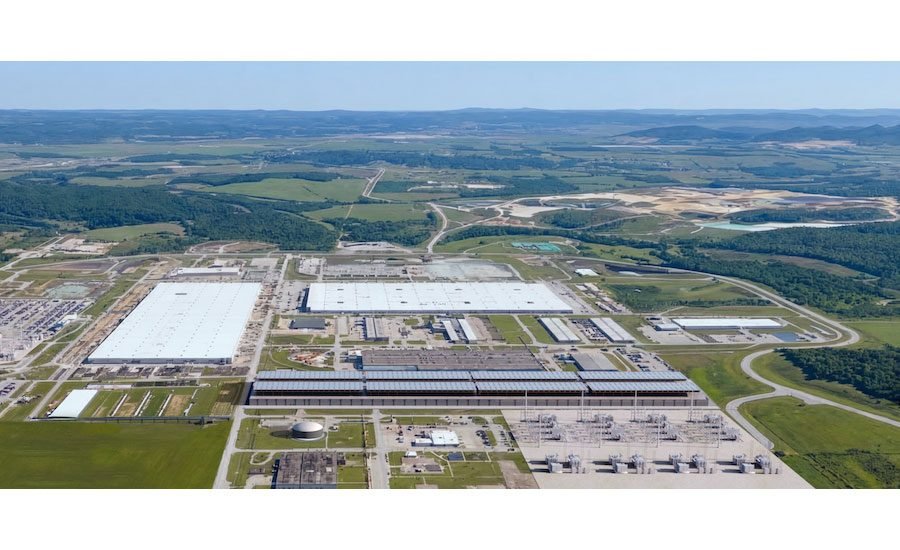
NVIDIA is investing to up to $105 billion to secure land, power and shell (LPS) capacity for the massive PORTS-Pike Technology Campus planned on the site of the former Portsmouth Gaseous Diffusion Plant, a long-shuttered uranium enrichment facility near Columbus, Ohio.
The project includes a planned 10-GW data center campus bolstered by an equal amount of power generation capacity, about 9.2 GW of which would come from natural gas.
As ENR reported in March, Bechtel and Kiewit Corp., have already been tapped to provide engineering, procurement, construction and other services for the project.
Under the arrangement, SB Energy, a subsidiary of SoftBank Group, will develop, own and operate the data center campus, including the power generation and delivery systems as well as the physical buildings. NVIDIA will supply its computing technology, which the tenant, OpenAI, will use to power large-scale AI workloads. NVIDIA also has said it will invest $1.5 billion in SB Energy to support its growth.
“Our role in the project is really the development,” SB Energy CEO Rich Hossfeld told CNBC. “We’re securing the land. We are doing the power solution and we are going to build the shells—the turnkey centers … if you think of a maybe $500-billion project, our role is 30 to 40 percent of that.”
“AI factories require a full stack of critical resources: advanced
chips, packaging, memory and networking—as well as land, power and
shell,” said NVIDIA CEO Jensen Huang in a blog post. “Just as NVIDIA has used its scale, long-term visibility and
supply-chain partnerships to secure critical semiconductor resources, we
are now applying that same discipline to secure LPS capacity
exclusively for NVIDIA AI factories.”
“The initial deployment is expected to provide
4.25 gigawatts of AI factory capacity. Each generation of NVIDIA AI
factory systems deployed at PORTS-Pike could represent approximately 1.5
million NVIDIA GPUs, or approximately $150 billion to $200 billion in
NVIDIA revenue. Over 20 years, the site can support multiple upgrade
cycles,” Huang added.
LPS capacity refers to the infrastructure required to launch high-performance data centers. Land refers to the physical site; powers refers to the large-scale electrical supply and grid connectivity required to operate AI systems; and shell describes the constructed data center buildings furnished with core mechanical and electrical systems, ready for installation of computing equipment.
The agreement reflects a growing industry trend in which access to land and power is a primary constraint on data center development, particularly for AI applications that require much higher energy capacity than traditional computing. By securing LPS capacity in advance, NVIDIA and its partner seek to accelerate deployment times and reduce infrastructure risk, the company states.
“Infrastructure is vital for the AI economy. With SoftBank Group, OpenAI and NVIDIA, SB Energy is building power-first infrastructure at unprecedented scale while strengthening the communities that make it possible – protecting ratepayers, creating tens of thousands of well-paying jobs and investing in infrastructure to revitalize southern Ohio,” Hossfeld said in a press release.
SB Energy also lans to invest at least $4.2 billion in new regional grid infrastructure through a partnership with AEP Ohio, a subsidiary of American Electric Power, intended to protect ratepayers from rising energy costs.
Source: www.enr.com



