
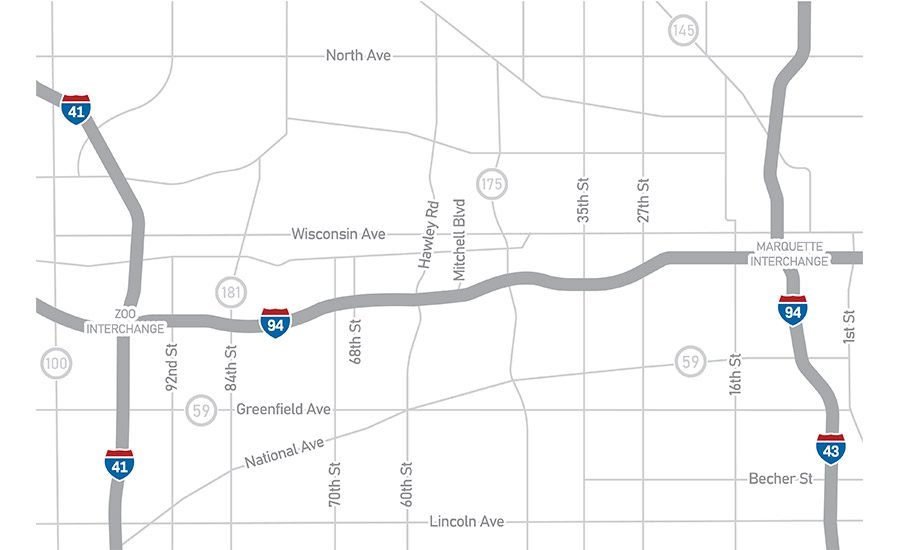
A $1.65-billion project to expand Interstate 94 in Milwaukee County, Wis., faces a potential two-year delay and an added $60 million in cost due to the elevated expense of utility relocations along the corridor extending from 16th Street to 70th Street in Milwaukee.
In a letter introducing the August annual status report provided to the Transportation Projects Commission, the Wisconsin Dept. of Transportation reports the “department is trying to reduce or eliminate the potential delay by reconfiguring let packages to deliver portions of the project earlier and avoid those conflicts; this would require shifting additional funds into the 2027-2029 and 2029-2031 biennial from future years.”
It adds that “pulling this additional funding forward would allow the project to reconfigure let packages and accelerate portions of the project to remain on schedule.”
Legislative approval would be required to move previously authorized transportation funding into earlier fiscal years.
The eight-year, 3.5-mile project aims to expand the roadway to eight lanes and reconfigure a stadium interchange at Miller Park Way, near American Field where Major League baseball’s Milwaukee Brewers play. It was scheduled for completion in 2033, but may now be pushed to 2035.
As part of the multi-phase project, Zignego Co. of Waukesha, Wis. is the contractor on a segment of work underway associated with National Avenue and 70th Street to Miller Park Way. Zenith Tech, which has offices in Wisconsin and Minnesota, has a $61-million contract for reconstruction of the 27th Street bridge over I-94, St. Paul Avenue work and other related improvements.
Converting the stadium interchange into a diverging diamond is estimated at $80 million. The interchange conversion is slated to start in 2027 and would be part of a future project bid package, Wisconsin Dept. of Transportation says.
This 3.5-mile portion of the I-94 East-West Freeway corridor opened to traffic in 1961 and 1962.The agency says it has maintained and rehabilitated the ramps, bridges, pavements and other structures over the past 60 years, but the corridor is nearing the end of its useful life.
Source: www.enr.com



