
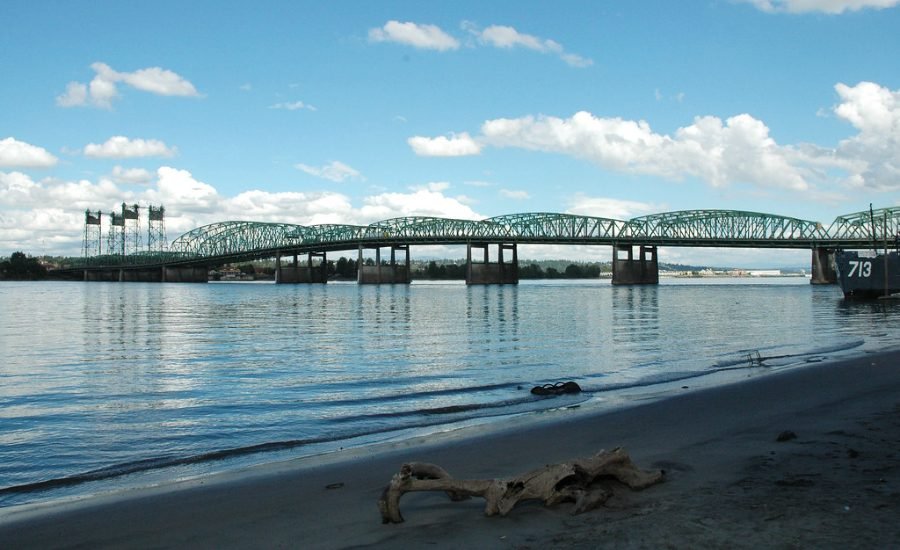
A $14.4-billion bi-state program to replace the aging Interstate 5 bridge corridor between Portland, Ore., and Vancouver, Wash., is moving toward construction with procurement of its first major contract for the project’s initial phase.
The Interstate Bridge Replacement (IBR) program issued the RFQ this week for the $3.9 billion first phase of the $7.8 billion effort to replace the bridge. The larger Columbia River Bridge Replacement project, will cost $14.4-billion includes replacing the bridge with a seismically resilient modern structures and rebuilding the five mile interstate corridor it sits within.
So far, $5.7 billion in available funding from state contributions, federal grants and future tolling allows the project’s first phase to move forward. The two states have committed to pursuing construction of a full five-mile corridor.
Federal grant funding would be forfeited if construction does not begin in 2026.
RELATED
I-5 Bridge Project Under Fire from Oregon Officials as Costs Soar
The bridge cost is roughly $2 billion more than was last presented in 2022. IBRP says says an increase in cost estimates “reflects national trends of significant cost increases driven by inflation and market conditions leading to higher construction bids.”
The revelation of the projects escalating costs due to a growing risk contingency blindsided public officials earlier this year. Since then both the Oregon and Washington governors reiterated their commitment to the project and filling the funding gaps. The project was split into phases to ensure it would get started.
“The bridge must and will be replaced,” Washington Gov. Bob Ferguson (D) said in a statement last March. “Delaying a major project has never made costs go down. We’ve achieved important progress in the past year, and we will continue to move forward by focusing on the core mission of replacing the bridge.”
Oregon Gov. Tina Kotek (D) agreed, saying “it’s time to start building” a new bridge and urged focusing available funding on core projects will deliver results.
Upgrade Urgency
The current bridge is one of the oldest river crossings on the West Coast. It consists of two nearly identical side-by-side lift spans crossing the river. The first was constructed largely for horse-and-buggy in 1917 and the second in 1958, paid for by eight years of tolls. Together they now carry more than 140,000 vehicles and $132 million in goods each day. Built on timber piles driven into sandy soils, the bridges are considered a seismic risk.
The updated design, including adjacent transportation connections, will feature two new single-level, fixed-span bridges with three through lanes and one auxiliary lane in each direction. Plans call for safety shoulders with space for bus-on-shoulder service, decking compatible with the addition of separated light rail on the southbound structure and a separated shared-use path on the northbound structure.
The first phase includes replacing the existing bridge with a new bridge, connecting the replacement bridge to I-5 in Oregon and Washington, connecting Hayden Island and State Route 14 to I-5, advancing transit system design, building toll infrastructure to begin collection in 2028 and removing of the existing bridge.
The program selected the progressive design-build delivery approach, administered by the Washington State Dept. of Transportation working closely with the Oregon Dept. of Transportation, for “greater cost certainty and transparent pricing,” according to the program.
The RFQ process will create a shortlist of qualified firms who will then be invited to submit detailed proposals when the formal request for proposals is issued in November. A design-builder selection is expected in mid-2027, with design to begin immediately and construction to start in 2028. There is a Sept. 30 deadline on the RFQ submission.
“We’re excited to engage with the construction industry as we move from planning to construction, and we look forward to identifying a partner who shares our commitment to delivering this generational investment safely, efficiently and on time,” said John White, WSDOT assistant secretary for urban mobility, access and megaprojects.
A major two-state effort to replace the bridge, known as the Columbia River Crossing project, ran from 2005 until 2013 when contention around design, transit inclusion and budget led the Washington State Senate to reject funding for the project. The project gained new life in November 2019 when the states’ two governors signed a bi-state Memorandum of Intent to restart work on the Interstate Bridge.
This RFQ follows the Federal Highway Administration and Federal Transit Administration issuing an amended record of decision for the program in July, completing the National Environmental Policy Act review.
“Reaching an amended record of decision reflects years of detailed study in coordination with our local and federal partners, including responding to over 9,000 individual public comments,” said Carley Francis, IHB interim administrator. “We now get to go do the work of actually building this bridge.”
Source: www.enr.com



