
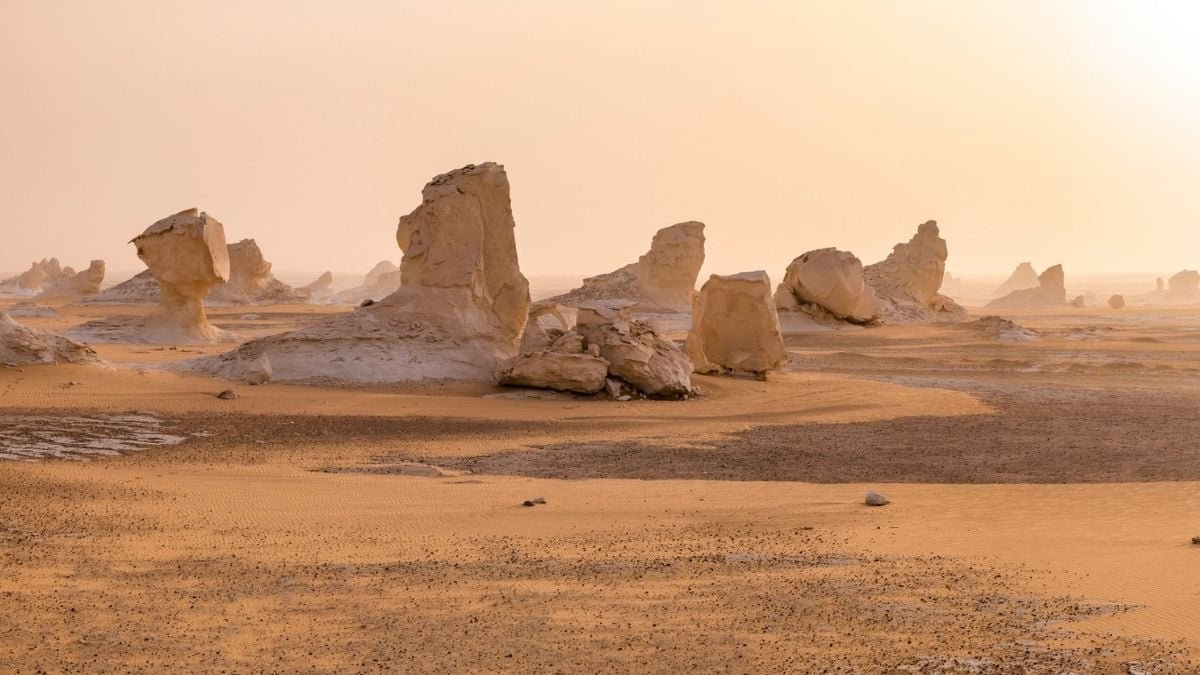
The desert sands of Egypt have been dry for thousands of years.
As difficult as it is to picture now, however, much of that desert was once submerged beneath a sea that covered much of the northern perimeter of the African continent.
Nor was it a dead sea – evidence suggests that, during the Cretaceous period, it may have been a tropical wonderland, where rising currents lifted nutrients into the water column to feed a thriving ecosystem.
Now, buried in what was once the floor of that long-ago sea, on the Abu-Tartur Plateau, paleontologists have found evidence of its lushness: the teeth of sharks that would have thrived amid the bounty of fish.
And not just one shark. The total number of different species found in that layer of the Duwi Formation now numbers at least seven – offering a glimpse of the rich marine ecosystems that once flourished along the northern edge of Africa.
“Collectively, this assemblage highlights a nutrient-enriched, high-productivity marine ecosystem along a phosphogenic shelf margin,” writes a team led by paleontologist Tarek Yassin of Cairo University in a paper published in Cretaceous Research.
During the Cretaceous period, between about 145 to 66 million years ago, our Earth was a very different place. Under a greenhouse climate driven by tectonic activity, the world was warmer, with little to no polar ice; higher sea levels meant that much of the land we inhabit today was underwater, including northern Africa.
We know this at least partially because of phosphate. Phosphorite deposits commonly form where marine productivity is high, and phosphorus is being intensively cycled and concentrated.

The extensive phosphate deposits of the Duwi Formation therefore preserve not just the remains of this ancient sea, but clues to how productive its waters once were.
In previous research, Yassin and his colleagues had identified two shark species in a handful of teeth found in the fossil bed – an intriguing signal, since a community capable of supporting multiple large predators requires a productive food web beneath them.
So they went back to Abu-Tartur to see if they could find out more.
And the black and yellow layers of the Duwi phosphate ponied up the goods. They found another 14 shark teeth – representing another five shark species, none of which had been identified at Abu-Tartur.
When all you have is teeth – and with ancient sharks, that’s usually the case – subtle differences can be the sole metric on which a species diagnosis hangs.
With the Duwi teeth, the differences were not always subtle.
Several of the teeth were long and slender, like a needle. Others were broad and serrated, probably better suited for slicing than penetrating. One tooth was prominently curved like a karambit. Some had small, fang-like side projections, called cusplets; others did not.
 frameborder=”0″ allow=”accelerometer; autoplay; clipboard-write; encrypted-media; gyroscope; picture-in-picture; web-share” referrerpolicy=”strict-origin-when-cross-origin” allowfullscreen>
Based on other fossil records around the world, the researchers identified these teeth as belonging to five extinct species: Cretalamna cf. maroccana, Scapanorhynchus cf. raphiodon, Serratolamna cf. serrata, Squalicorax bassanii, and Squalicorax pristodontus.
All five are new records for Abu-Tartur.
Two were new for Egypt entirely – Serratolamna cf. serrata and Squalicorax bassanii.
One stood out as extraordinary. Scapanorhynchus cf. raphiodon – the one with the needle teeth – may represent the first known occurrence in Africa. In addition, it could be the most recent example on the fossil record, the researchers said – all other specimens are significantly older.
Those identities, however, paint a much more interesting picture than “a bunch of sharks”.
As their teeth might suggest, they may not have been directly competing, but occupying different ecological niches in a rich marine environment.
“The presence of Squalicorax could suggest an input from nearshore/inner shelf settings, while the occurrence of Scapanorhynchus reflects deeper-water conditions on the outer shelf and slope,” the researchers write.
“Lamniform taxa such as Cretalamna and Serratolamna further support stable open-shelf conditions.”
The researchers believe that the secret to this richness may have been upwelling.
Nutrient-rich waters rising from deeper in the ocean would have delivered phosphorus and other nutrients to the sunlit surface waters, driving intense primary productivity – plankton that came to feast.
That would have supported small fish and invertebrates, then predators such as Squalicorax and Cretalamna, with Cretoxyrhina and marine reptiles higher up the food web.

But this is where the shark “graveyard” gets interesting. There was very little sediment accumulation during the time that the sharks lived, so the phosphate bed represents a more condensed span of time than you might find somewhere with more mud.
Related: World’s Biggest Glowing Vertebrate May Be Using Its Own Light as a Hunting Tool
Consequently, the teeth are a time-averaged accumulation from multiple ecological niches, not evidence that seven shark species lived at the same time and all died there together.
But it does add to evidence that these ecosystems were common across the northern edge of Africa during the Late Cretaceous. Other phosphate deposits from places such as Morocco and Syria record large numbers of shark species hanging around – suggesting the entire region was a great place to conduct shark business.
Today, little remains of that shark paradise. The Tethys is gone, the seafloor has become desert, and the predators that prowled its waters vanished millions of years ago.
Like a projector from the past, however, just a scattered handful of teeth embedded in a rock can conjure up an entire lost world.
The findings have been published in Cretaceous Research.
This article was fact-checked by Rebecca Dyer and edited by Rebecca Dyer. While we pride ourselves on our process, we are only human. If you spot a mistake, please let us know.



