
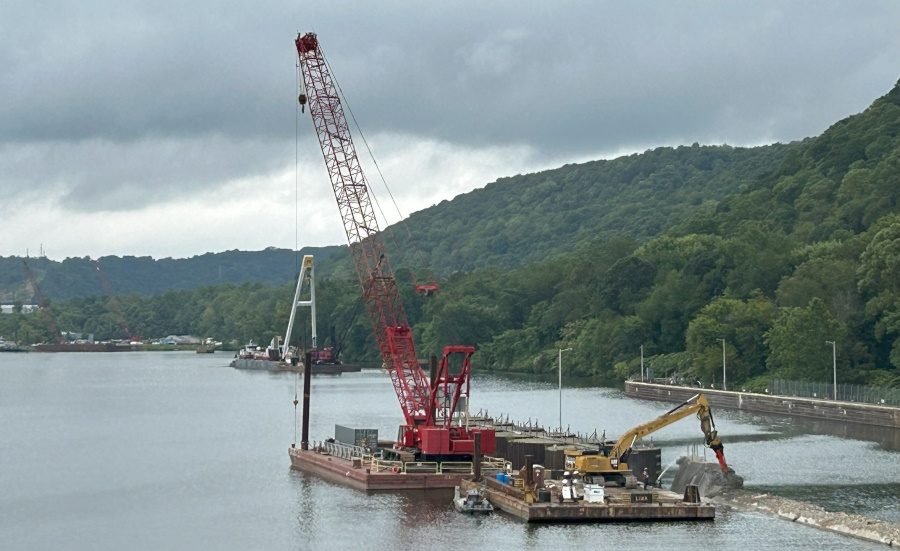
The Waterways Council has reiterated its call for a program manager for all locks and dams and other river construction projects currently managed by the U.S. Army Corps of Engineers as separate projects.
During a tour of the Mel Price Lock and Dam in St. Louis earlier this month with project stakeholders and journalists, the advocacy group, which represents users of the nation’s inland waterways, criticized the version of the Water Resources Development Act that has been moving through Congress this summer. While the House version of the bill includes creation of a project management office for the U.S. Army Corps of Engineers oversight of inland waterway projects, it lacks unified leadership to improve project delivery, according to Jennifer Armstrong, vice president of government relations at the council.
“[Our goal is for the work to be managed] as a program as opposed to individual projects managed at individual districts, kind of competing [for resources] or not always being executed in the same manner,” said Armstrong. “It also is a way for lessons learned to be communicated across the system because it is a connected system, and the funding implications or decisions made in one project have impacts on the entire program. There needs to be that visibility across the program.”
The Corps has tried out several approaches to manage its many projects separated by geography and Corps districts along the inland waterways as one program. This has led to cost overruns and experiments with in-the-wet construction and other methods that have sometimes led to budget increases, pushing back priorities elsewhere.
The Senate Environmental and Public Works Subcommittee moved forward in July on a separate WRDA bill that does not include the Inland Navigation Construction Organization but would, presumably, still have a chance of having the organization included in a compromise bill by negotiators from both houses of congress. The Senate version of WRDA does include 15 new water resources projects and 61 project feasibility studies.
It has been difficult for the Corps to advocate for its own position during the WRDA negotiations this year, as its officers have not been allowed to speak to Congress without authorization since a a 2025 Defense Department memo changed public relations policies for all military agencies.
Impact of Funding Changes on Corps Work
Prior to 2006, the Corps operated with its contractors on a continuing contract basis, which meant it could obligate federal funds before they had been appropriated. Congress ended that practice in 2006 and the change forced the Corps to halt work on a project when funding ran out.
Looking for quick answers on construction and engineering topics?
Try Ask ENR, our new smart AI search tool.
Ask ENR →
This has had a noticeable impact on project delivery. The Corps has completed only three large-scale projects—the Olmsted Lock and Dam in Illinois, the Charleroi Lock and Dam in Pennsylvania and the LaGrange Lock and Dam also in Illinois—in the 20 years since continuing contracts were ended, Armstrong said. While funding uncertainties made procurement cycles difficult for contractors on all three, other projects such as the Chickimauga Lock and Dam in Tennessee and the Brandon Road Invasive Carp prevention project in Illinois have seen their contracts canceled and work stopped, respectively, as ongoing funding became an issue. It also has an impact on addressing the rolling repair and upgrades to the Corps’ aging assets. More than 80% of the 219 locks and dams in the nation’s inland waterways system are over 50 years old.
Armstrong said the Corps is operating on three budget cycles at once because of Congress’ practice in recent years of passing omnibus bills and continuing resolutions to fund the government rather than going through the full budgeting process. She noted that there were additional challenges this past appropriation cycle due to the DOD memo as well, as districts couldn’t communicate capabilities to Congress without prior approval.
Another congressionally mandated responsibility the Corps has is briefing the Inland Waterways User Board on the annual capabilities of projects. The group is an 11-member federal advisory committee with shippers, operators and other river users from across the system. But, as Tracey Zea, president and CEO of the Waterways Council wrote earlier this month, the board has been suspended since April 2025 when the Trump Administration dismissed all sitting board members. The Waterways User Board has not met since December 2024.
“They did determine that it should be reconstituted. However, we’re still waiting for that,” Armstrong said. “The last time this happened during the Biden administration was before the Infrastructure Investment and Jobs Act funding bill came out, and so a lot of those decisions were made without the advice and recommendations. It can have significant consequences. It’s also how we get updates on the projects that are ongoing and other issues that are important, major rehabilitations, low water situations and other efforts.“
One low-water situation happened on the Monongahela River in western Pennsylvania after the removal of the Elizabeth Lock and Dam in December 2024. Both the Port of Pittsburgh have been considering solutions such as dredging the bottom of the Mon to create a larger pool for shippers, but any such project would need to go through the users board and to Congress and it’s been in states of suspension twice ever since the lock and dam were removed.
Source: www.enr.com



