
For the longest time, the bay area’s bona fides have been questioned.
By skeptics and trolls. By rival owners and national media. And, in the worst moments, by crippling self-doubt.
This is what happens when you draw 19,704 fans for a playoff game. Or when you win 100 games and finish 28th in the league in attendance.
The truth is, it ain’t easy being a Major League Baseball market. It takes money, it takes steady crowds 81 dates a year and, these days, it often takes a state-of-the-art ballpark. Unfortunately, Tampa Bay has consistently come up short in all of those categories.
Which is why the upcoming week may be the most consequential in franchise history.
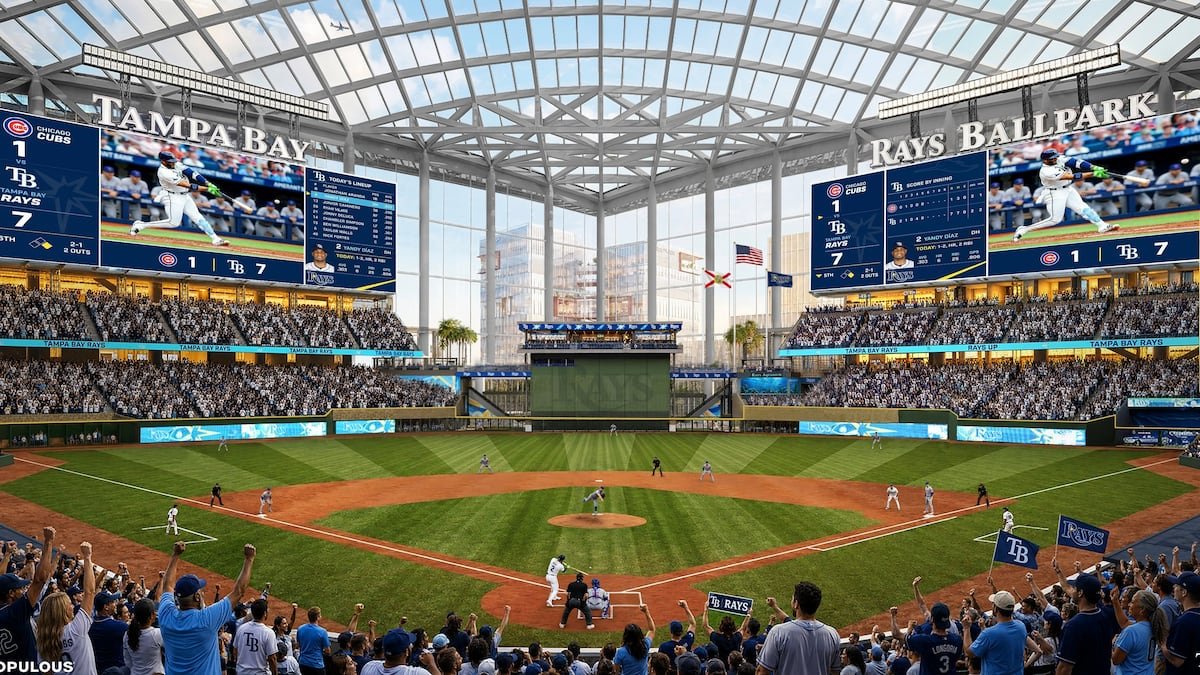
The Rays have tentatively forged an agreement to build a $2.3 billion stadium in the heart of Tampa. That’s significant, because the most common excuses for the team’s attendance woes have been the drabness and location of Tropicana Field. Now, in one fell swoop, the Rays can solve their problems of geography and aesthetics.
All it will take is affirmative votes from the Tampa City Council on Thursday and the Hillsborough County Commission on Friday. The expectation is that the two government entities are poised to approve more than $900 million combined in public funds as part of the financing structure of the deal. But even through that optimistic lens, it’s possible the final vote could be 4-3 in both cases. That means any hiccup in the next few days could derail Tampa Bay’s stadium hopes. Again.
And if anything goes wrong this week, Tampa Bay may not get another do-over.
From the time Patrick Zalupski, Bill Cosgrove and Ken Babby purchased the team, they have struck an overly positive tone about Tampa’s stadium prospects. Now, they have reached a point where deeds need to replace promises.
“When we bought the team, Patrick and myself and our partners made a very strategic, and we thought appropriate, decision to extend an exclusivity period to Tampa to Sept. 1,” Babby said late last week as the final documents were being readied. “Sept. 1 would effectively be the beginning of a different chapter, either a chapter that is setting up a groundbreaking ceremony at Hillsborough College, where we’re moving forward with this incredible project, or the beginning of this franchise considering what may come next.
“We firmly wanted the former. That was really the direction, the decision, the intention when we bought this team to be here. We are the Tampa Bay Rays. We want nothing more than to be right here in Tampa Bay.”
Cities on the prowl

You’ve heard implicit warnings before. This is the latest, and likely the most realistic.
That’s because the use agreement at Tropicana Field is finally nearing its conclusion. And MLB’s patience is growing thin. Baseball commissioner Rob Manfred has previously expressed support for baseball in central Florida, but the expectation is that another swing-and-miss will finally send Tampa Bay to the back of the bench.
With the commissioner’s expected permission, the Rays could take a quick look into Orlando’s stadium plans, but the door will also be open to talk to Raleigh, Nashville and other hopefuls.
Is there a serious threat of that happening? For years, even before Zalupski took over, the Rays have quietly acknowledged that other communities routinely reach out to gauge the possibility of relocation. Come Sept. 1, those phone calls will likely take on a different tone.
As for the possibility of the Rays actually leaving Tampa Bay if this stadium isn’t approved, the odds are a little less dramatic. None of those cities has a pile of ready cash and 100 acres in their back pocket. The team’s goal is to be in a new ballpark by 2029, and that deadline would not be met in any other city. The Rays’ best chance remains right beside Dale Mabry Highway.
But it’s not as if relocation is off the table. This market is still unproven when it comes to attendance. And there are precedents. In the 21st century, there have been 14 new ballparks proposed in Major League Baseball. Twelve were done in the local market, but two franchises have packed their bags and fled.
Since purchasing the Rays last October, the Zalupski group has purposefully avoided talk of other cities. At least in public. Elected officials, on the other hand, have heard it. They’ve been told of the Sept. 1 cutoff date. They’ve gotten gentle reminders that other options exist.
But the Rays chose not to leverage that possibility out loud. Until now.
“Those who study these things say … the Rays should have pitted Tampa against other cities,” Babby said. “Some would say we should have had a series of conversations between St. Pete and Tampa. We didn’t do that. We didn’t. You will not find a single record of us having conversations anywhere else in North America about the future of the Tampa Bay Rays. We meant it when we said we were going to give Tampa an exclusivity period. We want to be right here in Tampa Bay.”
Understanding history
Fan fatigue is real. Babby knew that when he came here from Jacksonville, but he now understands its depth.
From the St Pete waterfront to the Carillon area in north St. Pete to a reimagined Trop site to Ybor City to Tampa’s waterfront and finally to the Hillsborough College campus, there has been news conferences, T-shirts and pitches coming from nearly every corner of Tampa Bay.
Babby recently hopped into an Uber after flying into Tampa International Airport and got into a friendly conversation with the driver. When talk turned to the Rays stadium quest, Babby asked the driver when he would feel confident that the Rays had a forever home in Tampa Bay.
Would it be when the politicians formally approved the funding?
No.
Would it be when bulldozers finally broke ground on a ballpark?
No.
So what would it take to convince him?
“He said, ‘I’m not going to believe this project’s happening until I’m sitting in the ballpark in April of 2029,’” Babby said. “I think that’s the sentiment from the community because of what they’ve been through. Even in St. Pete. They celebrated the votes, they had the Here to Stay celebration, right? I watched all of that and then, you know, the terrible hurricanes came. The bond validation went the other direction. I mean, things sometime happen with these projects.”
If you take a historical look at other stadium projects around the nation, it often doesn’t come to fruition until there has been an ownership change. It creates a fresh start, but also a greater sense of urgency in the community. As if there is an unwritten acknowledgement that there won’t be many more bites at the apple.
The Zalupski group’s arrival completely changed the calculus when it came to a stadium in Tampa. While officials in Hillsborough County were always willing to entertain stadium pitches, their enthusiasm often seemed muted. That changed when Gov. Ron DeSantis — an ally of Zalupski’s — got behind the idea of rebuilding the Hillsborough College campus and providing the Rays with 100-plus acres of land for a stadium and mixed-use development.
The idea of pairing the ballpark with condominiums, offices, restaurants and other development that would broaden the area’s tax base and create a destination site for residents sounded more appealing for those in office. Depending on how you crunch the numbers, the Rays will be paying anywhere from 50% to 60% of the stadium’s cost. The concept is not universally beloved — the expected closeness of the votes this week reflect that — but it provided a path forward.
So why, after all this time, talk about deadlines and relocation now? Surely, the Rays understand, people will see it as a threat ahead of the votes.
“(What) I understand is the community has an incredible opportunity to do something transformational, and its elected leaders, we hope, will act to move this project forward,” Babby said. “You want to feel one, united, with a community. A Major League Baseball team is not just a team that goes out and plays a game every night. We are members of this civic community. We’re stewards of a franchise, but we’re also a member of the community in all facets.
“We want to be here. We’ve always wanted to be here. And this is really that moment.”
Getting to yes
In his absurdly organized office beyond the wall in left-centerfield at the Trop, Babby has a half-dozen copies of the book “The Obstacle is the Way: The Timeless Art of Turning Trials into Triumph” on the credenza behind his desk. Any psychoanalytical clues there?
“No,” he says, “but my senior staff is reading that book right now.”
Did you hand out copies to City Council members?
“No, no, no, but maybe I should have,” he laughs. “But (council member) Bill Carlson shared a book with (Hillsborough administrator) Bonnie Wise and myself called ”Getting to Yes.” It’s probably the most famous negotiation book of all. It talks about how parties, even with vast differences, can ultimately get to yes together. That’s how I hope this goes.
“Maybe that will be your headline: Getting to Yes.”
For 20 years, Rays fans have been waiting to hear somebody say yes.
It happened — briefly — in Pinellas County in 2024 but wasn’t meant to be. In retrospect, maybe that was a godsend.
Because here we are, two years later, with the possibility of a stadium on the side of the bridges where the past two ownership groups, MLB, the corporate community and a good number of fans have always wanted it to be. The possibility is two votes away.
Finally, baseball in Tampa Bay may get to yes.
• • •
Sign up for the Sports Today newsletter to get daily updates on the Bucs, Rays, Lightning and college football across Florida.
Every weekday, tune into our Sports Day Tampa Bay podcast to hear reporter Rick Stroud break down the biggest stories in Tampa Bay sports.
Never miss out on the latest with your favorite Tampa Bay sports teams. Follow our coverage on X and Facebook.



