
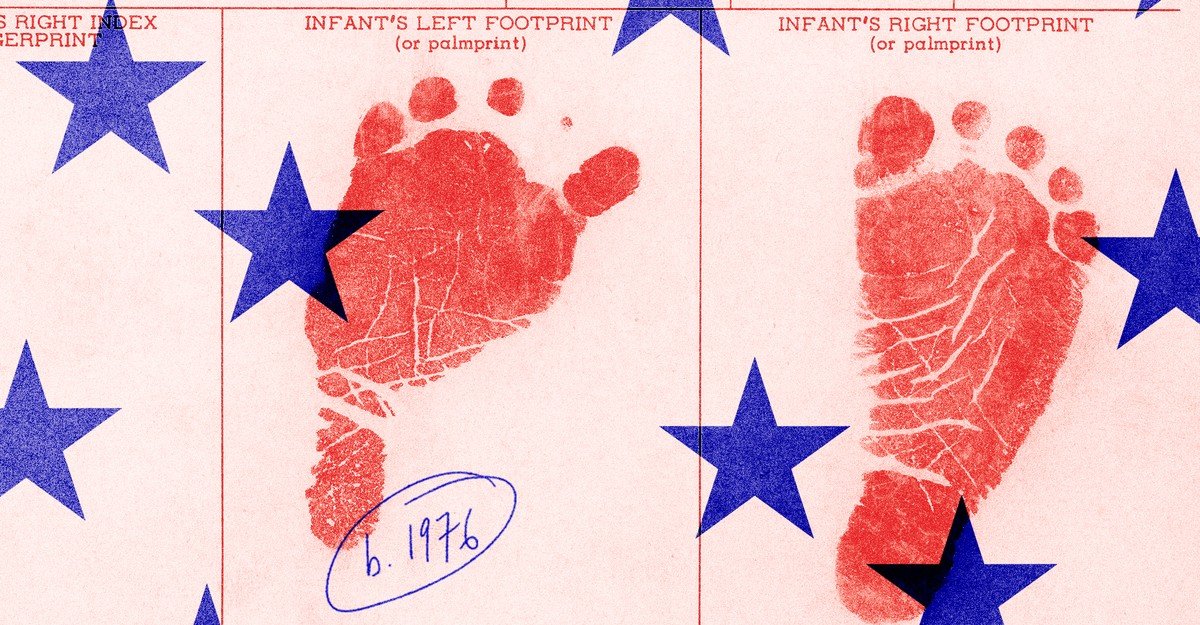
Thirteen seconds after midnight on July 4, 1976, Karen Steele was born in Montclair, New Jersey, and was anointed the first “bicentennial baby.” Newspaper articles followed. President Gerald Ford and his wife, Betty, sent a note to the family. And then it kind of became a thing. Any baby born that year was treated like they had emerged playing the fife and drums. In Mobile, Alabama, new mothers received a commemorative blanket. In Covington, Louisiana, a hospital handed out (for $2.50) special “bicentennial baby” certificates on faux parchment, a “memento that can be framed and cherished as a family heirloom for endless generations.”
This was a year of jaw-dropping kitsch, an explosion of red, white, and blue everything—toilet paper, lollipops, even condoms (pleading: One Time for Old Glory). Branding newborns this way became part of the general patriotic fun. And although the tchotchkes surely ended up moldering in a red, white, and blue landfill somewhere, the label stuck. I know: I was one of those babies, born in August 1976.
Being a bicentennial baby was not anything I ever thought about all that much. In fact, it was really only when meeting another person born in 1976 that it came up at all. Oh, you’re a bicentennial baby too, one of us would say to the other, smiling dumbly. This was a secret handshake that opened zero doors. But unlike other indelible parts of my identity that felt small in their particularity—like being the child of immigrants or being nearsighted—having my birth hitched somehow to the history of the country, to its forward motion, felt big whenever I was reminded of it.
Beyond the horror of realizing that five of my current lifespans stacked up is all that separates me now from Benjamin Franklin, I’ve been thinking about this cohort of which I’m a part. Expounding on the significance of one’s own generation can lead rapidly to wild generalization, self-absorption, and some misplaced nostalgia. I know this. But I’m convinced that my fellow bicentennial babies and I have been through something unique. We’ve followed a distinct arc over the past 50 years: one of disillusionment. Better than most, we understand the disjunctions of our present because they happened at crucial inflection points alongside the timeline of our lives.
We were born during a period of palate-cleansing. The Vietnam War was over. President Richard Nixon had, in 1974, resigned after Watergate, a redemptive scandal that renewed people’s faith in self-government. Journalists—yes, journalists—were sex symbols. Robert Redford played Bob Woodward in All the President’s Men. And the peanut farmer Jimmy Carter, a man who campaigned teeth-first, would be elected president in the fall, having promised a new era of idealism.
I don’t remember any of this, of course, but babies like me were launched into an atmosphere of reawakened good vibes. When Time magazine commissioned the polling firm Yankelovich, Skelly & White to gauge the country’s temperature from June to September of 1976, the company found a 10 percent jump in positivity on its “state of the nation index” between those months, the most rapid increase it had seen since it began tracking the metric. The following years were also a time of crime and stagflation and the Iran hostage crisis, but at least by the indicators used by pollsters to determine collective mood, things continued to get generally sunnier into the ’80s. “The Zeitgeist has turned zesty,” Kurt Andersen wrote in a 1984 assessment of that year’s numbers. “The U.S. is at peace, and between rising employment and fading inflation, the economy is aglow. Americans are feeling more sanguine and comfortable about their country than they have felt in two decades. A rebirth of the American spirit, as Carter dearly hoped five summers ago? It sure feels like it.”
I remember this optimism and confidence. On November 9, 1989, I sat watching television with my grandfather—a Holocaust survivor who that day, and most days, had his shirt off and a captain’s hat on his head. The Berlin Wall was coming down. This happened when we bicentennial babies were 13 and highly impressionable. Look at them, my grandfather said, his voice breaking, as people pick-axed their way out of East Germany. I recall the total elation on their faces when they finally broke through, and then the bracing thought that they were trying to get to the side where I already lived.
For many young Americans in those years, a feeling of transcendence was possible. You had a sense that good fortune had placed you somewhere that everyone in the world wished they could be. At the same time, that wider world, with its crumbling empires and ethnic cleansing and genocides, seemed very far away. Even the Gulf War of the early ’90s appeared, to those of us safe at home, as a ghostly green video game playing on CNN, transmitted from somewhere hard to recognize as real.
You may not believe me when I tell you that I read Francis Fukuyama’s The End of History and the Last Man at 19, for fun, when I was a junior and living abroad in France. But I did, and then after college I went into the Peace Corps and lived in a village in Cameroon for two years. Although many of the people there thought that I was working for the CIA (I was not), I felt I was doing something uncomplicatedly wholesome, even a little patriotic.
We were 25 when 9/11 happened. I moved to New York City in October of that year, like a salmon swimming upstream—or like a salmon following a girl. Everywhere were posters of missing people. During my first days of couch surfing, New Yorkers were further terrorized by anthrax spores sent through the mail, addressed to political and media targets. That terrible fall was a hinge moment for all Americans but maybe especially for us young adults, who were also at a hinge moment in our lives, suddenly vulnerable and less innocent in new ways, feeling silly for having believed that history could have an end.
I haven’t mentioned the internet yet, but it also came around for us as adulthood hit. I got my first email address in college and accessed my inbox in the library basement at a computer lab that perpetually smelled like Doritos. It was all so new that you could forget to send a paper to a professor and then offer the excuse that the email probably just got lost. I spent a lot of time outside that library, chatting, with nothing in my hands besides a cigarette. I think I knew someone who had a beeper. We got flip phones in our 20s. We were in our early 30s when the first iPhone arrived and Facebook showed up. We were told that these were revolutionary tools. Maybe we believed this more than other people did, still being relatively young and feeling like we were being handed powerful megaphones in our prime—a chance to make change, to connect. Then the tools congealed into yet more products that would waste our hours and make us feel terrible about ourselves and our fellow citizens.
We made lives against the backdrop of distant wars, unceasing notifications popping up on our phones. The year we turned 40, Donald Trump was elected president. Four years later came COVID. Just as we were balancing more and more—perhaps children, a challenging job, ailing parents—the world seemed to conspire to keep our heads spinning. In these past few years, before we and the country hit our big milestones, we were assaulted by panicked warnings about the state of American democracy—and the future of the entire human race. What has AI been up to over the past few days? Creating new viruses and independently cyberhacking, it appears. We are less naive, though more exhausted. It has not been lost on us that the people warning that AI could lead to our extinction are the same people who invented it. This is a pattern we’re familiar with now: Technology gives us something with one hand while robbing us of something else with the other.
I’m leaving out a lot. We also had private joys and tragedies totally impervious to what America writ large was up to. But I can distinguish a progression toward an increased sense of emergency, toward alienation, toward a mournfulness that makes me read the newspaper through my fingers most days. I don’t think this is the birthday blues talking—or, if I’m honest, maybe not just the birthday blues. It’s also the metrics: about loneliness and economic stagnation and political polarization and the whole insane technological surround sound of our lives. My point is that bicentennial babies, regardless of their individual circumstances, have all been strapped into the first row of this ride.
Someone born on America’s centennial, in 1876, could well have argued that they had witnessed much more consequential change by their 50th birthday. They might have gushed about the expansion of railroads and telegraphs, about seeing the first airplanes, telephones, and radios, and then explained what it was like to face the reality that as many as 20 million people could be killed in a single war. I wouldn’t want to go head-to-head with them. Every generation has its story. But we bicentennial babies have lived through a major rupture. For all else that might be good in our lives—and I’m lucky to have a lot that’s good—this is not such an exuberant place to find ourselves at 50.
Can we imagine anyone proudly calling the babies born this year—what? semiquincentennial sprouts? A mouthful, granted. But that’s not what makes it sound strange. Behind the “bicentennial babies” moniker was a kind of hope. We would be the Americans of the future. And we would be moving toward that future not with dread but with anticipation. Whatever one’s political affiliation, people do not have much enthusiasm these days when they picture where we’re headed.
When the Pew Research Center surveyed Americans just before this year’s semiquincentennial, 59 percent of respondents said that the country’s best years were behind it. Asked to imagine the United States 50 years from now, 44 percent were pessimistic and only 28 percent were optimistic. Perhaps most telling, 27 percent chose neither option; they just felt blah. Recently, Conan O’Brian, speaking on the podcast The Rest Is History, talked about the “undiluted joy” he remembers feeling as a preteen experiencing the bicentennial. Now: “It’s very hard for some people, maybe, to just say, I’m really excited about our 250th when our current state is so divided.”
I can’t conceive of myself being around for the tricentennial—and if I did suggest living to 100, my mother might faint from all the spitting she’d have to do to ward off the evil eye. But if I do make it there, I will have lived through a third of the country’s existence. I’ll have a lot more data to work with. Will 2026 appear in retrospect as another hinge, or simply as a snapshot of us—mouths open and eyes closed, as in an amusement-park photograph—mid–free fall? Will there be self-correction or a piling-on of bad decisions? Disintegration or newfound connection? No one can really tell. Though I do know what I would like on my 50th birthday and the country’s 250th: something for us to look forward to.
When you buy a book using a link on this page, we receive a commission. Thank you for supporting The Atlantic.



