
Data center construction, electric vehicle charging demand and climate change among other factors are posing big water and power challenges for the Pacific Northwest. A Washington state mandate that all electric utilities transition to a 100% clean, greenhouse gas-free electricity supply by 2045 makes the challenge even greater.
John Wilson, assessor for King County, Wash., told attendees of Infraday Pacific Northwest in Seattle, held Aug. 20, that there are 30 local, non-hyper-scaled data centers in the county that depend on distributed energy, not the electric grid. Climate change is decreasing local snowpacks, posing a risk for the supply of water and hydroelectric power to those centers.
Garrison Marr, senior manager, power supply for Snohomish County, added that while the county reviews its 20-year power plan every two years, “one data center equals ten years of growth,” complicating infrastructure planning.
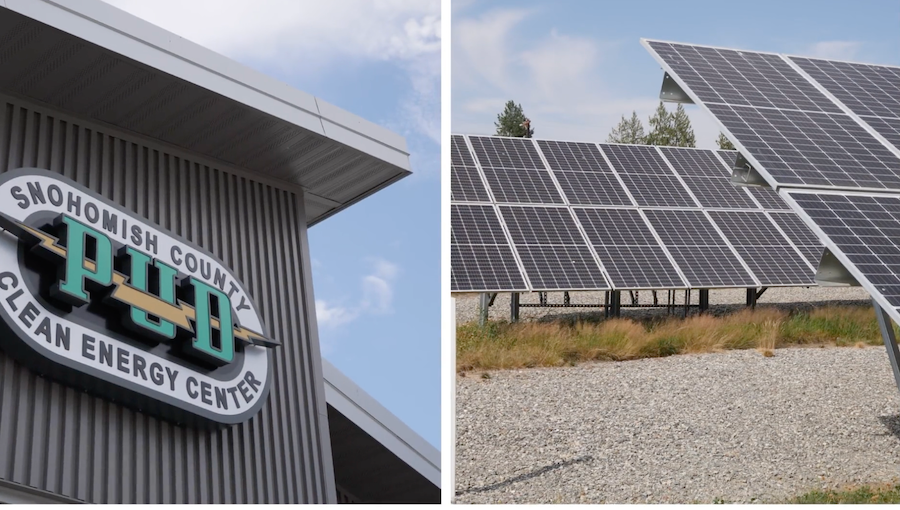
Marr noted a 6-month emergency moratorium on large-scale data centers that includes associated backup infrastructure like battery storage. However, the 25-MW Arlington Battery Energy Storage System, located on a clean-energy campus in Arlington, is set to open later this year after just three years of construction, he added. “It will save one million dollars a year per customer,” he said.
Tyler Keller, vice president of data center solutions for ACI, said that technology to increase efficiency of cooling chips in data centers is evolving and may eventually lessen the need for water. Ya-Han Brownlee-Chen, vice president of data center strategy for DP World, added that sources such as small modular reactors and nuclear battery systems might help data centers contribute energy back to the grid.
But workforce poses another challenge. Don Baker, regional operations director for EC Electric, said that there will be a shortfall of 70,000-80,000 electricians every year for the next ten years.
Aside from data centers, “thousands of electric vehicle chargers will be needed” in the coming years due to high demand, said Katherine Rice, senior electric vehicle charging planner for the city of Seattle. “We can only have so many lines over the Cascades. We have to manage electric vehicles, data centers, etc., in constrained environments.”
With some 10 million rides taken on electric scooters, and e-cargo bikes launched last year, the city transportation department is trying to collaborate with Seattle City Light, parks, libraries and other city agencies to coordinate electrification resources, she added.
Will Jolley, vice president of commercial analytics with GridStor, also noted the need for collaboration in building energy projects. “It takes five to eight years to build a project, but four to five years for revenue certainty,” he said. “It’s speculative development—will energy needs be the same in five years? Instead of guessing, we need to work together on the planning side.”
Collaboration between airlines and airport staff led to the investment of $3 billion in the past ten years at the Port of Portland, said Chris Czarnecki, director of aviation business, properties and airline affairs. Christian Venturino, capital project manager for aviation with the Port of Seattle, said a new 19-gate terminal is being considered for Seattle-Tacoma International Airport.
Building Resilience and Reuse
Brandon Rakes, director of Chehalis-Centralia Airport, said it is considering electrification and hydrogen-fueled aircraft someday. Ann Richard, aviation director for the Washington State Dept. of Transportation, added that rural airports are being used as fuel sources for firefighting equipment during the wildfires. “We’re looking at using airports as power producers; acreage is available for solar or hydrogen.”
Seattle Public Utilities is following up on an initial 2018 seismic study to prioritize capital projects that will increase resilience of 190 miles of water transmission pipelines and 1,680 miles of distributed water pipelines, said Stephen Anderson, its head of water infrastructure planning and seismic resiliency. There is a 20% chance of a catastrophic quake within the next 50 years, and an 85% chance of a quake similar to the Nisqually quake of 2001, at 6.8 magnitude.
Major pipelines such as the Cedar River Pipeline are being assessed, Anderson said. Options for such pipelines include adding flexible couplings or ductile iron, or completely replacing pipe sections. Other planned projects include water tank retrofits and pump station improvements. A $58-million project to replace the Bitter Lake Reservoir began this year. Ultimately, the goal is to have water service restored 100% to customers by two months post-quake.
Anderson’s counterpart in Mason County, general manager Kristin Masteller, said that her public utility district is looking at ways to reuse water to offset its consumption by such entities as golf courses, and building storage facilities in collaboration with the private sector.
Cody Colt, director of public works for the city of Yelm, said that reclaimed water is now being added to concrete for industrial use. “We are exploring other uses for ‘poop’ water,” he said.
Source: www.enr.com



