
Subscribe here: Apple Podcasts | Spotify | YouTube
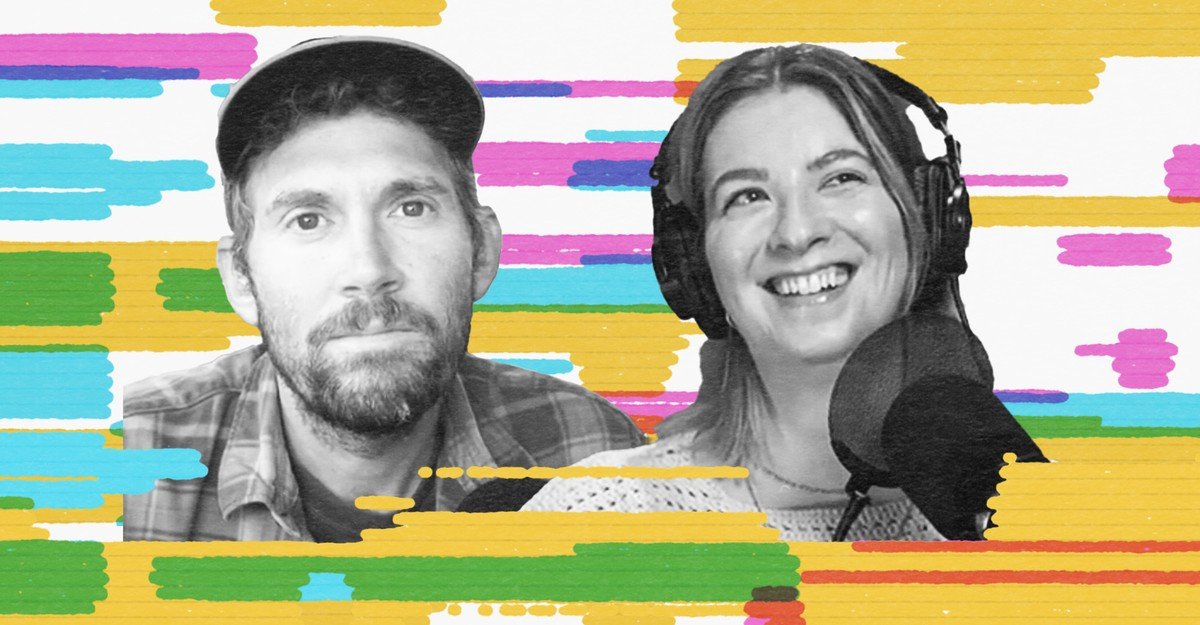
A lot of people are getting tired of their phone—they’re sick of the algorithms and overwhelmed by what can feel like a loss of control. The Atlantic staff writer Julie Beck dug into why and how people are trying to renegotiate their relationships with technology. She and our colleagues just released a five-part podcast series called How to Touch Grass, and in this episode, Galaxy Brain host Charlie Warzel talks with Beck about why people are nostalgic for the pre-internet days, how our brains are changing, and the good that can come from getting lost.
The following is a transcript of the episode:
Charlie Warzel: How does the phone make you feel? How does a TikTok binge make you feel, or even just, like, a before-bed scrolling session that we all have?
Julie Beck: Oh, sick. Absolutely sick. It’s like when the aliens get you, right? They take you up and then they probe you, or they do whatever they do, and then when you come back down, you don’t know what happened. It’s erased. It’s lost time. So I feel like I have emerged from lost time and like what happened during that time is unclear, but I don’t feel good.
Warzel: I don’t know that I have the amnesia part of it, but it promotes self-loathing in a way that like truly no other activity does because it just feels like a deletion of my one precious life.
I’m Charlie Warzel, and this is Galaxy Brain, a show where today we’re gonna answer a question. Maybe it’s even the question of the online age. How can we live lives where we use tech and don’t let it use us? This is the animating question of How to Touch Grass, a new podcast series by my colleagues here at The Atlantic. Over five episodes, Julie Beck and her co-host and producer, Natalie Brennan, explore what exactly is happening in this moment that has so many of us out there feeling like we need to renegotiate our relationships to our technology.
At the beginning of this year, I made a few predictions about trends that we might see, and one of them was that there would be what I was calling a scrolling backlash. That people are just really tired of their phones, of the algorithmic internet, of this idea that they’re being manipulated all the time, and that their attention is being directed towards things that don’t make them feel good or whole or happy. Now, as predictions go, this is a pretty safe one, but it’s really been borne out in recent months. These things are hard to measure, but you can just feel it out there in the world. In the artists who are asking that people leave their phones at home or in their pockets at concerts, in the genuine concern over whether younger generations are going to be able to read like older generations. And while the data-center backlash that we’re seeing right now is complicated, and it’s about a lot of things, including AI, I also see that as an outgrowth of this larger frustration about the role that big tech is playing in our lives and the way that people just feel this fuzzy loss of agency right now. It’s a loss that just can’t be separated from the devices that we use.
How to Touch Grass digs into so many of the ideas that I’ve been trying to poke at here in the first year of this podcast. Our motto here at Galaxy Brain is that we pay attention to where we pay attention, which also happens to be exactly what I found so valuable about Julie and Natalie’s work. And so I decided to bring Julie on here today to talk about this moment and to talk about what she’s learned in this series. How badly have our attention spans actually been fractured? How has she reevaluated her relationship to all of her devices? Is the backlash that we’re feeling and seeing right now justified? And crucially, where might we go from here? Julie joins me now to talk about it all.
[Music]
Warzel: Julie, welcome to Galaxy Brain.
Julie Beck: Hi, Charlie. Thanks for having me.
Warzel: So let’s talk about this. Let’s talk about the touch-grass moment that I think we are in. Even even the phrase itself, right? Why is “touching grass” something that people are talking about? And what made you want to just dig in and report on it?
Beck: Yes. So we had originally thought about calling the season How to Log Off, but that’s not as fun. But I think it also speaks to just a sort of general renegotiation that people are doing right now between how much they actually want to be on their devices and how much they actually want to be inhabiting the embodied world around you and the grass and the trees and the people and everybody around you. We wanted to look at like the various shifts that are happening both in the culture of the internet itself and the technology itself but also
the shifts in the culture of how people are thinking about their devices and how they’re talking about them, and how much they want to use them.
Warzel: Why did you feel like this was a project you wanted to embark on?
Beck: I have deleted and re-downloaded TikTok on my phone roughly four to five times.
Warzel: Nice.
Beck: And it’s usually like my friend ends up sending me a Lord of the Rings meme and then you click it, and to click it, to see it, you have to re-download the app, and they get me every time.
Warzel: It’s a gateway drug.
Beck: Lord of the Rings memes are the gateway drug kids. But no, I noticed something happening maybe six-ish months ago when whenever I was on my last round of being on TikTok, which is: Every time I would go on there, I would get nothing but reels of “how to be offline more”, like “how to live more analog,” “how to heal your attention span” on this app where I was actively in the process of degrading my attention span. So I thought that irony was interesting, and so I think there was a shift that I was just sensing within myself, but also in conversations that I would have with people in real life and in what I was seeing online of people really trying to just be on their phones less, be on social media less. And I was curious why now, when obviously we’ve had smartphones for a very long time, we’ve had the internet for a very long time, we’ve had social media for a long time.
Warzel: What is the answer to that? Why now?
Beck: Why now? I think some of it is that we’ve had it for long enough that the shine’s off the apple, right? And I think some of it is a confluence of these different bigger conversations. Obviously, there’s like a big push by many to get kids off of social media, right? Or there’s lawsuits against Instagram, and What is Instagram doing to our mental health? And so I do think that those things have leaked down in some way, but also even TikTok, right, has been pretty popular for a few years. We’ve had a few years of living in this sort of algorithmically optimized short-form-video environment. And it’s gotten to the point where maybe people have had enough experience with it that they’re starting to see the effects in their own lives and like starting to question that rather than just, Oh, isn’t this fun? I can watch Lord of the Rings memes. And I think combining that with the sort of arrival of AI on the scene, right? And seeing all of these extreme stories about people replacing relationships with AI, using AI as a friend or a lover—God forbid—I think there’s been a sort of opposite, if not equal, reaction to valuing more the embodied world and the real social relationships that we had. So I think people are reacting in part to the sort of evolution of the internet culture and social-media environment and the arrival of this new technology that’s really like getting its little tendrils into every area of our lives.
Warzel: So one of the episodes—to pivot here—explores nostalgia, which I think is a very big part of all of this hand-wringing that we are all personally going through, right? Is this moment different from others? Are we doing something uniquely awful to our brains that none of our ancestors ever did? And when you talk about nostalgia, there’s particularly a focus on young people who weren’t really around to have that pre-internet life. In that episode though, you have this moment where you describe a time that you got truly and deeply lost. And so it struck me that your co-host, who’s slightly younger than you, never had that experience. She’d never been an adult without a smartphone.
And so what do you think is the value of being in a place where you don’t have a phone to save you? Are we losing something when we don’t experience that vulnerability?
Beck: Yes and no. I do look back on it with a fondness. I would no longer—unless my phone died, I guess—I would no longer ever be in a position where I simply had to throw myself on the mercy of strangers and hope that they helped me. If I were lost somewhere, I can just follow the blue dot until I figured it out. And I don’t know that I yearn to go back to that. In some ways, that wasn’t very safe. I was like a young woman traveling alone in a country where I didn’t speak the language, and I had no idea where I was and no way to really communicate with anyone. I’m not mad that I have Google Maps and I have some sort of safety features to keep me safe when I go places. And I do think we have lost a little bit of something of just, kind of, being where you are and letting the experience be what it is. And those opportunities for connection, right? I would not ask someone for help. I would just use my phone. So I feel ambivalent about it. And I would say that, in fact, ambivalence is the primary emotion of the season and of just today’s technology.
Warzel: So there’s this stat that you reference—because we’re talking a little bit about people who haven’t had access to a life without smartphones—and I found it honestly just bracing, maybe even troubling, but the stat is essentially that 60 percent of Gen Z wishes that they could return to a time before everyone was “plugged in.” And nostalgia’s a very common thing. You get into this in the episode. Everyone has nostalgia for some period of time. But Gen Z’s nostalgia for this time before they were alive, it seems like something else to me. Like it seems like a genuine indictment of this moment that we are in. How do you read that stat? What does that make you feel when you hear that?
Beck: I take that status as not actually indicative of if you presented them with a time machine and were like, “You can go live in 1985,” that they would go in there and live in 1985. I don’t think they actually want to give up on all of the other things that have happened since then. But it’s just this sense of like, Something in my life isn’t working. I attribute it to this device, and it’s being expressed as like, I just wish we could go back. But I don’t think it actually means they wish they could go back.
Warzel: Yeah. I think one thing that I’m trying to figure out is: Do you feel like it’s just an escapist phenomenon in that way, or just a coping mechanism? Or do you think it actually leads to or has the potential to lead to a genuine backlash or push or protest against some of this stuff. I think about just the physical-media boom, like a push to do some things in a more analog way, even if it is kind of “niche” or “hipster,” or whatever you wanna call it.
Beck: Yeah, I feel like maybe I went into this thinking it is just kind of an escapist fantasy, in the way that somebody might be like, I should’ve been born in the 1920s. I would have made such a great flapper, or whatever it may be. But the expert who we interviewed for that episode, Clay Routledge, he studies nostalgia, and his whole take on nostalgia overall is that it’s about the future as much as it is about the past. So it’s not just warm feelings for the past and like, What a nice time I had doing whatever, but it’s also telling you something important about the way that you want to live now and going forward. And so, especially seeing what you’re talking about: the sort of rise in people buying physical media again, people giving up their smartphones for dumb phones. I do think it is inspiring some level of actual behavioral change. And even if you don’t go so far as to get a dumb phone and try to LARP your life like it’s the ’90s, I think it still tells you something important about what you value and maybe smaller shifts that you do want to make in how you relate to technology and how you set up your life.
Warzel: If there’s one real theme of How to Touch Grass, I think it’s that the tools that we use change us, obviously, in these unexpected ways, right? Our habits, how we see ourselves, how we see other people, how we talk to each other—everything. And the show explores this from anxiety to body image. And I wanna play you another clip from your own show here.
Sophie Gilbert: I don’t think anyone is supposed to see their own face as much as we do now. I think about this a lot, like how our ancestors would have felt like catching a glance at themselves in a lake. And instead we’re front-facing camera, front-facing camera, front-facing camera, and it’s weird. It’s warping our brains.
Warzel: That was our fellow staff writer, Sophie Gilbert, talking to you. What strikes me a bit about being hyper-connected is that, in theory, the access to abundant information that we have should be a good thing, I think. And it just doesn’t seem to work that way in practice. Like the way that we can learn anything, but we tend to gravitate towards information that confirms our biases, right? And pushes us deeper down whatever rabbit hole. Or how we can learn anything about our bodies and then it pushes us to go and Google these things that lead to more and more anxiety. The thing that Sophie gets at in that clip, really, is something that you hear a lot of people say, which is, We were never supposed to have this much access to ourselves, other people, information, and yet we hold that up as: That’s the beauty of the internet. That’s the great thing—more, more, more, abundance, the Library of Alexandria at your fingertips, whatever, right? But what do you feel like this access is doing to people?
Beck: I think what I’ve been thinking a lot about since wrapping up the interviews for that season is that there are costs to every way of living. And what is happening is that the design of our technology—the design of these apps of smartphones, or honestly the design of society in general right now—is pushing you to accept a certain set of costs and trade-offs. And that is: constant distraction and the slow degradation of your attention span and maybe some body-image problems in exchange for the most abundance of entertainment, connection, communication, relationships, information that you could possibly imagine. And that is a trade-off that you may decide is worth making, right? At this moment in time, maybe I’m waiting for the bus and it is worth it to me to degrade my attention span a little and be entertained. But are you actually consciously choosing those costs, or are you just sort of being pushed by default into making those trade-offs? And there are trade-offs to inserting more distance between yourself and your phone as well. The phone is kind of where the people are, and so if you want to be on your phone less, then maybe you are gonna be a little bit less connected to long-distance loved ones, or maybe you’re gonna have a harder time figuring out what is the weather today, or getting that information that you need right now about how to get into the concert venue. It’s like there are costs either way. However, all of society is kind of set up to push you towards one set of costs. And I think people are starting to question that a little bit.
Warzel: Yeah, and I think if there’s an insidious part of the Big Tech experience, right, it is making people feel when they’re using these things like there aren’t any trade-offs. They are marketed as Connection is a universal good or This thing is a universal productivity increaser, and you should feel this way about them. Some of what we’re feeling in this moment, I think, is maybe not fully being gaslit, but you’re experiencing the trade-offs, the costs, and you’re sort of conditioned not to think that there are any. So you’re like, What’s wrong with me that I can’t get a handle on this, that I can’t get a handle on my attention span or feel this way? And I think it’s a bit of, like: No, no, no, no, no. You have to do that inventory of the give-and-take. And you also have to know that it’s not a fair fight and that’s okay. You just need to be armed with that information. I think that we’re not as much these days.
Beck: Yeah. Well, I also think a lot about the way that—a lot of the response to this, a lot of the current movement to log off or do whatever is very draconian. It’s like, I’m getting rid of my phone and I’m getting a dumbphone, and I’m never gonna look at social media ever again. Because I think the reasonable alternative, unfortunately, is that you just kind of have to manage it forever. Like you said, the deck is stacked against you. These companies are not going to decide that they want less of your attention, wake up one morning and decide that they’ve had enough. And so it feels for a lot of people that the fantasy is to just completely leave it behind forever and walk into the sea and live an analog existence.
And if you don’t want to live that way, or if it is not reasonable to live that way, which I think for most people it’s not, then unfortunately the answer is just kind of dealing with that push-and-pull and designing something—it’s very DIY, right?—it’s designing something for yourself with your phone, with your technology that works for you. And it requires kind of constant upkeep, constant management, and constant resistance of the forces that are trying to suck you in, and that’s kind of exhausting.
Warzel: Yeah, absolutely. You devoted an episode to the ways that technology is changing the way that we learn. And I think that people can feel that disruption right now, especially with chatbots. I wanna play a clip from an interview you did with Michelle Miller, who’s a cognitive psychologist at Northern Arizona University.
Michelle Miller: I think that teaching another human being how to do something, that is one of the highest and best expressions of humanity that there is. It’s one of the best and most positive ways that we interact with and contribute to one another. So I do think it comes back to that core, our self-agency and our connection to this great web of humanity. I mean, it comes about through learning.
Warzel: I love the great web of humanity.
Beck: Me too.
Warzel: I hope we can preserve it. So what I take away from this is: Learning is social. And what’s interesting about that is the current internet is full of other people, other people’s opinions, broadcasting yourself for other people. It’s social. But it’s also a lot of synthetic stuff, a lot of synthetic people, a lot of people behaving in ways that they wouldn’t, or in antisocial ways. And it’s also this medium that very clearly isolates us. And so as you’re exploring this, do you feel like we’re losing something fundamental here when it comes to learning? Or is it just a different way of learning that will produce different results? Where have you come out on all that?
Beck: I think that doing this series also reminded me, and especially when it comes to learning, all of the genuinely good things that I do get from technology. I like to knit and crochet. And where do I go to learn how to do a new crochet stitch? I go on YouTube because they have a video and it’s perfect and I can see it and I can do it. So I get a lot out of that, right? Or for my job, I read a lot of PDFs on the internet to obtain knowledge.
Warzel: Hell yeah.
Beck: And that is very useful. And I think that, like Michelle was saying, learning is extremely human. And at one point, she mentioned that learning is the way that you build the brain that you live in. It’s not just going to school and doing your multiplication tables and then growing up to calculate all of your tips on a calculator for the rest of your life. You cannot help but experience the world through the black box of your own mind. And so to build your own mind is building how you perceive the world, how you interact with the world. And so to outsource that to a machine to me is just anathema.
Warzel: And, too, I found this really interesting talking to educators, as I’m covering AI, but the idea that no one likes writing the whatever, the five-paragraph essay that you learn how to do.
Beck: Yeah, yeah, yeah. “In this essay, I will …”
Warzel: But at the same time, it’s actually helping your brain understand like, When I encounter new information, these are the programs that I can run to figure out what I think about it. It is just scaffolding, in order to help yourself work through a complex idea and sort it. And I love that idea of, it is elated to your brain’s perception; you live in the world built around your own critical thinking. To sort of expand on that, in the series you talk a lot about attention. You end up doing an experiment near the end of the series based off of finding a baseline of where your attention is at right now. And I don’t wanna spoil it, but I’m wondering what made you wanna do this experience? What was worrying you about your own attention?
Beck: It’s a lot of what I’ve heard from many people, which is just like feeling my attention pulled in so many different directions, or just having a baseline feeling of buzzy stimulation and not like the calm focus on one thing that I know at some point I was capable of and wanting to see if the phone was indeed the culprit and if I could find that again.
So yeah, I did an experiment which was based on an actual study that came out like a year ago, where they blocked the internet on people’s phones for two weeks and tested their attention before and after. I got in touch with one of the researchers who did that study, and he kind of helped me do my own version of it where I took the same measures that they did. And I blocked almost everything, for 23 hours a day and did that for two weeks and then took the test again so
Warzel: Again, I don’t wanna totally spoil things for people, but I think what we can say here is that in a short amount of time, there were—correct me if I’m wrong—somewhat dramatic results, or at least meaningful results.
Beck: Yeah.
Warzel: I want to end here asking how your relationship to your devices has changed while exploring all of this stuff. Do you feel a little more positive about all of it, just having had the experience of immersing yourself in this and with these experts who like to figure it out? A big part of the challenge for a lot of people, I think, is not really knowing what to feel good or bad about. I got a sense going through the series that you’re orienting yourself to this problem, and sometimes that’s like all we need, when it is so pervasive. But how has your relationship to the devices changed?
Beck: I think you’re right. I think I have a little bit more clarity around my values and my ideal scenario. I’m not always living up to it, obviously. But I think for instance, for me, I don’t really use AI. Maybe that will change, but if it does change, I’m gonna be real careful about how I want to use it and in what very specific scenarios. And one of the things that Jenny Odell said and we interviewed her for the attention episode was to think about things as an experiment. And then of course I went and did an experiment, but I think that that has helped me feel a little bit less guilt and shame of if I backslide or if I do whatever—it’s like, Let me just try this thing and see how I feel about it. And so sometimes when I do end up on Instagram for, you know, 45 minutes or whatever it may be, to just take a moment and ask myself, Did I see anything that added value to my life in those 45 minutes? And sometimes I did. Sometimes I saw some cute pictures of my friends’ babies and I got to see how they’re doing, or maybe I got an idea for a story. And sometimes I’m like, No, I saw nothing of value at all. And so that’s important data for the ongoing experiment that is life.
Warzel: Well, thank you for coming on the podcast, for talking about this, exploring it. And basically, you know, I see this as just such an extension of what we’ve been trying to do here, which is pick these things off in small ways and give people just some understanding of the stew that we’re all marinating in here every day.
Beck: Yes, I’m always trying to understand the stew, and I appreciate you having me. It’s been so fun.
[Music]
Warzel: Thanks so much, Julie. And now, rather appropriately, we are pleased to share the final episode of How to Touch Grass this season. It’s called “How to Heal Your Attention Span.” I hope you enjoy it as much as I did.
[Music]
Beck: Are you happy with your relationship with your phone, or are you not happy with it?
Person 1: I wish I could reduce some of the Instagram Reel-ing, particularly at night, where I kind of go down the rabbit hole and it’s like, Oh my God, it’s midnight.
Beck: Oh, yeah. I’ve been there. It’s like lost time. You know like when the aliens come and they get you, and then they put you back down, and it’s just lost time.
Person 2: It has impacted my attention span. I get bored after half a paragraph of reading.
Beck: Do you have a sense in your mind of when you noticed that you feel like your attention span was getting worse?
Person 2: Probably been, like, since the start of COVID, probably in the last five years.
Person 3: The thing that kills me sometimes is how much I want to look stuff up in conversations. I still constantly have a few books that I’m trying to read through and trying to rebuild attention, or something like that.
Beck: I’m Beck:, a staff writer at The Atlantic.
Natalie Brennan: And I’m Natalie Brennan, a producer at The Atlantic.
Beck: This is How to Touch Grass.
[Birds chirping]
Brennan: Julie, attention is one of the biggest things we’ve heard people talk about when they are renegotiating their relationship to their phone.
Beck: Ironically, I feel like every time I go on social media these days, I see someone talking about how they’re trying to heal their attention span from technology that they’re currently using.
Brennan: (Laughs.) Yes.
Beck: And it’s always that word too, heal. It’s like we’re sick or we’re injured, and we must heal.
Brennan: Is it something that you’ve been worried about?
Beck: I do worry about my attention sometimes. Like every time I go to the gym lately, I forget to lock the locker that they have in the locker room. I put my stuff in there; I shut the door.
Brennan: And you don’t lock?
Beck: Then I guess I simply walk away.
Brennan: Huh!
Beck: And I don’t realize until I get back that—I mean, no one has taken my stuff, luckily, so it’s all good. Good Samaritans out there. But that has happened not once, not twice, more than twice. (Laughs.)
Brennan: I guess the way that the attention-span thing comes up for me the most is when I think about the number of hours that I spend on my phone.
Beck: You’re pouring your attention into that phone.
Brennan: Yeah, I see those as very interconnected. But I’ve also noticed that I very actively try not to think about it. I rush to swipe away the screen-time notification every Sunday. Obviously, that anxiety points to the fact that I want to have a different relationship with my phone, right?
Beck: What do you think has stopped you from actively trying to get that screen time down?
Brennan: I think it’s scary to sit with ourselves when we have grown really accustomed to all the stimuli.
Beck: Mmm. Love stimuli.
[Music]
Jenny Odell: We talk a lot about, you know, looking at your phone as a negative thing, and we talk about it in the negative, right? Like, I wanna do less of this thing. There’s this thing that I do a lot; I wanna do less of it. And there’s not as much talk about what I wanna do more of.
Beck: That’s Jenny Odell, the author of How to Do Nothing. When that book came out in 2019, and I remember at the time it was one of the first things I read that really raised a concern about what modern technology and social media were doing specifically to people’s attention. So now it’s seven years later, and I asked Jenny how her thinking has evolved and how she’s doing with her own screen-time habits.
Jenny Odell: I mean, I’m … [(Laughs.)] Look, I’m doing great.
Beck: That’s—I’m so happy to hear it. I can’t say the same. (Laughs.)
Odell: I’m okay with my relationship with my phone and screen time.
Beck: So can you walk me through a little bit?
Odell: Yeah. I would say, like, part of the attention economy is the selling of quick fixes when, you know, habits form over time. They’re like grooves, right? Like, they need to be sort of formed over time. And so …
Beck: Like, geologically.
Odell: Yes, exactly. And I think, you know, if you try to, say, go cold turkey, it can be frustrating when you don’t see immediate results.
Beck: Yeah.
Odell: Or even within a couple of months, right? And then in that meantime, there’s all this uphill struggle of, like, your friends are still doing it. You need to be on Instagram to see this and that, and there’s just muscle-memory things, things you’re used to. You get up in the morning; you look at your phone. These are just—that’s hard. Like, those things are really ingrained, especially, I think, if you’re younger. I’m good now. But I just wanna stress that it took some time, and in that time there’s a little bit of a leap of faith.
Beck: Yeah. I mean, I deleted TikTok off my phone for the third or fourth time, who’s counting? But like you were saying, the muscle memory of, like, the thumb going up and down, has just transferred to Instagram unfortunately. So we gotta work on that.
Odell: I would say there’s, honestly, you know, I’m almost 40. Actually standing, like, with your very heavy head, like on your neck; when you get older, you start to notice the problems from that, and it’s like that is another kind of physical limit. I can’t sit at a computer for that long without injuring myself.
And then I think I really had to think about my relationship to the news was a really big one that I hadn’t quite figured out. When you’re kind of scrolling, you’re scrolling through it, you’re not really deeply engaging with any one particular issue.
Beck: Yeah.
Odell: You’re just seeing a list of bad things, and they’re bad in all different kinds of ways, and they’re terrible. Like, even just sitting with one of those things produces this paralysis. It’s like, in order to do something, you need an orientation toward the future and a situation in which you feel that you have some agency. There are certain things that I have started to do in the last couple years. One of them is volunteering at a native-plant-restoration project every week. I’ve also been going to a lot of repair fairs. Also kind of volunteering-type things that are in person.
Beck: Where you bring like a broken toaster or something—
Odell: Yeah.
Beck: —and learn how to fix it.
Odell: And learn how to fix it. Yeah. Totally. When I’m there, there is no desire to look at my phone. Like, it’s just so far from my mind, and it has this weird lasting effect throughout the week, actually, because I had this experience that was so direct, that was so meaningful.
Beck: And tell me what is the good thing about the repair café, about the, you know, weeding the native plants? Like, what is the good thing?
Odell: I think, you know, some of it is just recognition. I think we as humans, we want to be socially recognized, right? We want to feel seen. We wanna feel heard. We wanna feel welcomed. You know, it’s like Cheers or whatever.
Beck: (Laughs.)
Odell: Like, you wanna walk into a room and have people be like, Hey, it’s you. I know you.I’m happy to see you. This is just kind of like a really basic thing that we want. I kinda think that social media, especially early on, the evil genius of it was that it was hijacking that. And so I feel like these are in-person events. I feel incredibly recognized and acknowledged. And then it’s like, when you feel This is the real thing,
it becomes very obvious what is not the real thing. That’s a big part of it. And I think you’re there. You have a shared project. You’re getting some traction with something, right? Instead of just sort of constantly being washed over with information and not really having anything to grasp onto.
Beck: For most people in this day and age, totally going without a smartphone just isn’t possible, or at least not practical. Like, the infrastructure of society, you know, they’ve got the QR-code menu at the restaurant, the stores are all accepting Apple Pay and Google Pay, and so many websites require you to receive a text and then put the code in to even get in there. So trying to resist getting sucked into your phone just feels like resisting the inevitable sometimes. Have you found a way to resolve this tension for yourself?
Odell: I live in the same society you’re describing, and I just used my phone to pay for lunch before this. But then I put it away.
Beck: Mmm.
Odell: I use the phrase standing apart as a way of kind of not leaving or believing in the fantasy of escape from something, and just sort of being like, I’m standing in a position from which I can see the thing.
Beck: You’re not running away from it or—
Odell: But I have critical distance. And I think about something like food. You know, you go to the grocery store and, I mean, depending on the grocery store you’re in, you kind of understand that 80 percent of the food in it is bad for you. We kinda know that, right? It has been that way long enough.
Beck: Doesn’t stop me from getting the Flamin’ Hot Cheetos, but yes. I do know. Odell: (Laughs.) But it’s just this understanding that that space is just not set up for me to thrive.
Beck: Mm.
Odell: And I think that it’s helpful to maybe transpose that to your phone. What is a phone? A phone is a communication device. What I want from this is communication. The apps, you know, social media in particular, are not designed for you to thrive. They are designed for the opposite. (Laughs.) These are actively bad for me, and I won’t feel good.
For me, it’s sort of a level of acceptance of, like, antagonism has been helpful. Where it’s like, I’m never going to have a peaceful relationship with that universe, and I’m just gonna kind of accept that and take what I need and leave.
Beck: You know, recently I hear so many people, both online and in real life, talking about, “healing their attention spans” from the damage that they feel like technology has done. And I’m curious why, of all the things, you think people are worried about their attention specifically.
Odell: One would hope that what you pay attention to is what is important to you. That’s an ideal situation.
Beck: Not always the case.
Odell: Right, exactly. So if you’re not paying attention to things that are important to you, there’s something, I think, like, deeply unsettling about that on the level of identity because it’s like, Am I even who I am? Right? Am I who I want to be if I’m paying my attention to something that I don’t feel I ever chose?
Beck: Yeah.
Odell: I think it really deeply affects people on the level of, like, self-control and their sort of understanding of their identity.
Beck: Yeah. Well, it seems like the solution that many people have landed on for healing their attention span is just trying to be online less, however they can. So do you think that logging off is the answer, or no?
Odell: I think that the best approach, personally, is to just treat it as an experiment. Honestly, it makes it interesting, like I’m a curious person and I’m curious about myself and my own reaction to things. Kind of being like, Okay, I’m gonna try this. I’m gonna see what happens when I try this.
[Music]
Beck: Natalie, immediately after this interview, I really felt the itch to do what Jenny said—to try an experiment. And when I was thinking about how to do that, I remembered this study I had seen from 2025 where researchers blocked the internet on people’s smartphones for two weeks.
Brennan: Okay.
Beck: And just doing that, they found that the improvement to people’’ sustained attention was equivalent to reversing 10 years of cognitive decline.
Brennan: After two weeks?
Beck: After two weeks.
Brennan: That discrepancy feels huge.
Beck: It’s huge. So I tried the experiment on myself for two weeks. Now, I didn’t perfectly replicate the conditions of the 2025 study, to be clear. They blocked mobile internet using an app called Freedom. I used, instead, this device called a Brick.
Brennan: Huge among my friends.
Beck: Oh, your friends are all into it.
Brennan: Yes.
Beck: Okay, so you know. So I used this device. I picked all the apps I was gonna block, and you have to physically touch your phone to the device to unlock it.
Brennan: Right.
Beck: I tried to, you know, keep all of the things that would allow me to communicate with other people, and so I blocked all games; I blocked all social media, email, Slack, internet browsers, and most internet-connected apps.
Brennan: Okay.
Beck: So I blocked all of that for 23 hours a day. I was allowed one hour of non-Bricked time if I needed or wanted it. And I could do whatever I wanted on a computer, same as in the study. It was only the phone that was restricted.
Brennan: And how were you going to test this?
Beck: So I got in touch with someone from that 2025 study, and they shared an attention pre-test with me and a self-report questionnaire. So I took those for a baseline.
Brennan: How long was the test?
Beck: It felt like 1,000 hours.
Brennan: Totally. (Laughs.)
Beck: I think he told me it’s actually, like, eight minutes. (Laughs.) I did both of those things before I started the experiment, and then I took them again at the end of the experiment. And I agreed to record a little audio diary along the way.
[Music]
Beck: Captain’s log, day one. My phone has been Bricked pretty much all day. I’ve definitely been kinda low energy. I don’t know if that’s, like, dopamine withdrawal. I’ve definitely been carrying my phone around with me everywhere even though there’s not really that much for me to look at.
Morning, it’s day two. My husband is out of town right now, so it is daunting to have two of my biggest sources of entertainment, my husband and my phone, unavailable to me at this time, but we persevere.
It is Saturday. It’s my first full weekend day. I ordered a big order of yarn, so I have a lot of knitting and crochet stuff to work on.
Good morning, it’s day five. Knitting right now. Joe and I went birding. The one thing that I am noticing mood-wise is that I do feel pretty calm, like maybe more calm than usual.
Brennan: OK, Julie! First check-in. What off the bat did you think you were going to do more of with your time that you didn’t wind up doing?
Beck: Using the phone as a phone, as a communication device. Actually, like, calling my loved ones to catch up, you know, what the phone was invented for. Shout-out Alexander Graham Bell. But I think because I had blocked so much, and I was getting more used to just not having my phone on me and in my hand at all times, I was just thinking about my phone less overall, which was the goal.But I kinda come to think that as much as the distraction of the phone, like, has a cost, there’s also a cost to putting more distance there, because the phone is where the people are.
Brennan: It’s interesting how much our relationship to our phones is intertwined with our relationship to others.
Beck: Yeah.
Brennan: When we overuse our phones, that isn’t good for our relationships, and the way we use our phones is definitely influenced by other people.
[Music]
Odell: I think we don’t realize how much of our habits kind of live in other people. Like, think about it. When do you pick up your phone? It’s when the person you’re talking to picks up their phone, right? Like, the person picks up their phone; what are you gonna do? Sit there? Stare into space? That habit, like, lives between people.
Beck: It’s so true, because my friends will, you know, text me TikToks still even though I am trying to get off TikTok. And then if I’m like, Okay, I’ll just watch the, like, Lord of the Rings meme that they sent me, of course my phone prompts me like, Don’t you wanna download TikTok again? And so it is, like, sort of driven by, like, the relationship of wanting to see this meme. But I guess my bigger question is: Is logging off to pay attention to something else in the real world actually better, or is it just different?
Odell: I always think about, like, if you saw someone hiking and looking at their phone, you could be like, That’s so depressing. But then it’s like, what if they’re looking at iNaturalist?
Beck: Yeah.
Odell: And they’re, like, identifying a plant. There are good things on the phone; there are bad things on the phone. There are good things IRL; there are bad things IRL. One thing that you can say is that the sort of quality of attention that one often experiences on the phone with things like social media is pretty narrow versus things off the phone. There are so many different kinds of experience, so many different scales of time, so many different scales of space. I love seeing movies in a movie theater.
Beck: Oh, yeah. Me too.
Odell: I’m like a movie-theater junkie. I love to see horror movies in a theater.
Beck: Oh. Not me.
Odell: So there’s things like that, but then there’s things like looking at a very small bird in your neighborhood, or being at a table with a group of people and being part of a conversation. Like, these are all just so different. Even if you think about your body in those spaces; it’s so different. I think it’s good to have a variety of different contexts for your attention. I think that’s probably healthy.
[Music]
Beck: We’re gonna take a quick break but when we come back: how the way we think about our phones affects the ways we use them.
Odell: I think about it more as like: When I look at it as an object, it looks like a tool. And it did not look like a tool to me before. It looked like a black hole.
Beck: Like a portal to the underworld or something.
Brennan: Plus, did Julie fix her attention span? The results of her experiment, coming up.
[Break]
Beck: So day six, and wouldn’t you freaking know it, I did the exact same thing at the gym again. Sure enough, I forgot to lock it again. I’m legitimately concerned. Anyway, my attention is not fixed yet!
Good morning. It’s day seven of the experiment. My average screen time is down 74 percent from last week. I certainly haven’t been, like a perfect screen-abstinent person this week. I’ve watched plenty of TV. I have been able to, I think, focus a bit better. I read 200 pages of my book yesterday. I wonder how much of this could be achieved without such a draconian approach. I’ve been pretty surprised by how quickly I kind of, like, submitted. But yeah, just how quickly the cravings to check my phone all the time really receded.
Brennan: Julie, day 7 was midway through your experiment. What started to shift for you by that point? Did the way you think about your phone start to change?
Beck: I think what you learn, or at least what I learned when you block access to almost everything on your phone, is that the phone is not just one thing. There’s a lot of different stuff in there. Like—
Brennan: Yeah.
Beck: —you know? I think in our frustration with our attention span sometimes, people, myself included, will demonize the phone as a device. Like, smartphones are evil. Smartphones are sucking our life force, and they’re making us stupid, and that kind of flattens the problem, I think. What kept coming up for me is there’s a lot of different things I turn to my phone for, and some of them are more problematic than others. Like, checking the weather is, uh, very helpful.
Brennan: You made a mistake in blocking that one (Laughs.)
Beck: I did. Like, I realized that actually the first day. But I suppose that is the point of the experiment, right? To figure out which parts of my phone are actually adding to my life and which are taking away from it.
[Music]
Beck: Jenny, have you heard of these devices that block certain apps on your phone? There’s the Freedom app, the Unplug, the Brick device.
Odell: Yeah.
Beck: What do you think of the recent popularity of these things?
Odell: Honestly, I’m all for it. I don’t use any—I’m not trying to brag. I don’t need them. I think they’re great. There’s one in particular that I think is called SocialFocus, and it lets you kind of change the appearance of websites. Like, you could go to YouTube and not see the auto suggestions, for example.
Beck: Mmm.
Odell: Or maybe not see comments. It kind of allows you to change what you see. And I think there was a Chrome extension that came out called News Feed Eradicator. And guess what happened? I stopped going to Facebook. And I didn’t decide to do that. It was because the News Feed is there to keep you on Facebook. So if you eradicate it, replace it with some sort of mindfulness quote, you go to the site; it’s inert. It can’t grab you in that way.
Beck: Hmm.
Odell: And so I just simply stopped going. It was a totally unremarkable thing. I didn’t even tell anyone, Oh, I’m quitting Facebook. I just stopped going to it. And I think that’s really powerful. So that’s why I’m a big fan of anything that can give someone sort of granular control over what the—it sort of reintroduced choice in areas where people have never experienced choice. Because that, in and of itself, will cause someone to reflect upon what it is that they want.
Beck: All of this reminds me of a study I’ve been thinking of a lot lately, that found using an app that was similar to the Brick for two weeks had such a big effect on people’s attention spans that it amounted to, like, reversing 10 years of cognitive decline—
Beck: Oh my God.
Beck: —which seems really huge.
Odell: Wow. That’s incredible. I’m surprised and not surprised. Actually, honestly, this reminds me of, like, ecological restoration because when you restore a site, some things come back quickly and some things don’t, right? Like, you restore a wetland, some species are gonna come back almost immediately. The nutrient cycling of the entire site might take 100 years. Maybe our attention is similar in that, or our behavior, let’s say, it takes a long time to totally overhaul something. But at the same time, I think you might be surprised at how quickly certain things change. Like, in times when I was a little bit more embroiled online and using my phone a lot, and then I would maybe go somewhere, put it away for a while or whatever, I found that after a couple of days, I would notice that my attention felt different.
Beck: Hmm.
Odell: And by attention felt different, I mean I would notice details or small differences in things. It’s almost like having a higher-resolution image or something.
Beck: Are there other seemingly small changes to your routine that you feel like might have that kind of big cognitive benefit?
Odell: You know, I think trying to replace habits with other habits—I meditate in the morning, only just for, like, 10 minutes. I kind of calm down to a level where then it’s not going to as easily occur to me to then pick up my phone, or at least I’ll be a little bit more reflective about it.
Beck: Yeah. My thing so far, my recent thing has been taking up knitting and crochet, and this seems so small, but it’s like now while I’m watching TV, instead of looking at my phone, my hands are in hand jail, right? Doing knitting.
Odell: (Laughs.) Hand jail.
Beck: And it doesn’t seem so virtuous when I’m like, Now I’m only looking at one screen, but I feel like, you know, it’s an improvement.
Odell: I think that’s great.
Beck: Maybe I’ll get down to zero screens, TBD. But the other layer to that that I was just thinking about when it comes to phones and social media and stuff is, like, a lot of times where I’m going to learn how to do this new stitch or whatever is YouTube.
Odell: Mm-hmm.
Beck: So it’s not, you know, one is totally replacing the other, but there is sort of a relationship. Like now I am using that tool kind of for this other thing.
Odell: Yeah. Right, and I think that points to an important distinction, which is maybe a bit more nuanced than just, say, screen time as a statistic. You know, you were asking earlier about my changed relationship to my phone.
Beck: Mm-hmm.
Odell: I think about it more as like: When I look at it as an object, it looks like a tool. And it did not look like a tool to me before. It looked like a black hole.
Beck: Like a portal to the underworld or something.
Odell: Yeah. Or, frankly, I wasn’t even looking at it. I’m already picking it up. Like, I’m already in there. I’m already in that world. There wasn’t even a point where I perceived the phone as an object.
Beck: Yeah. You skipped right ahead.
Odell: Yeah. And now I feel like the things that I use it for: the Merlin app, it’s like Shazam for bird songs, I use that. I use iNaturalist. I use the Constellation app, voice memos for, you know, recording birds. That relationship, to me, feels really different because the intention and the purpose, I feel like I’m in control of that. I mean on my phone, the first home screen is all what I would call observational apps, so camera, voice memo, iNaturalist, Merlin.
Beck: Mm.
Odell: I’m kind of trying to remind myself of how I wanna use the phone. Like, I now associate my phone with those activities.
Beck: You write a lot about nature.
Odell: Yeah.
Beck: Being inspired by nature, how being in nature helps you, you know, pay attention. A common piece of advice for those who have been brain-rotted by the internet is to go touch grass. So are you also telling us to touch grass?
Odell: Yeah, pretty much. And, I mean, the weeds that I weed at my weekly project are grass, so—
Beck: And you’re touching them.
Odell: —actually, I’m saying Kill grass. No, I’m just kidding. (Laughs.) But the reason I think it became such a—that phrase caught on was because it’s just so obviously true. The obvious truth of it is, like, why it’s funny and annoying at the same time.
Beck: Yeah. What is it that you think the natural world has to teach us about attention?
Odell: Complexity, basically. Like, I think it’s a master class in complexity. It is kind of an antidote to the idea of the easy answer, which I think—I really blame Instagram for the oversimplification of political issues.Like, personally, that is just my ax to grind. And the idea that you could sort of absolve yourself by reposting something is just—yeah. It’s upsetting to me. But I think that there’s no easy answers to anything. Like, if you are a birder and you like birds, well, guess what? You’re gonna have to learn about trees.
Beck: Mm-hmm.
Odell: And then gonna have to learn about, like, seasons, and then, I don’t know, there’s just—everything is so tied to everything else, and there are so many things that are sort of, like, neither good nor bad or sort of arguable. We need lessons in that right now. Like, we need lessons in the sort of, like, Let me pick a point in space to look at, and then let me look at the context around that. Okay, now let me look at the context around that. And now you’ve sort of widened this whole ecosystem. I think the opposite of that is what happens online.
Beck: So Jenny, if someone is just starting to rethink the relationship they have with their devices, what advice would you give them?
Odell: Try to take an outsider’s perspective on yourself. I’m a big journaler, so I’ve journaled since I was a kid. So that would work for me. I would look at my phone, I would look at some stuff on my phone, and then I would just write down, kinda what it was and then how I felt about it. And I would be, like, brutally honest.
Beck: Oh, man.
Odell: Just pretend like you’re a scientist. And just talk to a friend about it. You could write it down, like, whatever. But, you know, I think there needs to be that, like, every so often you step to the side and you go, Okay, what did I just do? Like, Why did I do that? How did that make me feel? You can be super brief about it. Just do it for a week. Just see what it tells you.
Beck: Yeah.
Odell: Before you try to make any changes, because the danger is that a person feels shame, they feel that it’s bad. They’re like, Okay, I need to change this, and then they try really hard to change it, and then it doesn’t go the way they wanted, and then they feel more shame. And now it’s just, like, a spiral.
Beck: Yeah. I think especially with attention for whatever reason, it does feel very shameful, this like, Oh, I can’t focus; I can’t pay attention. I can’t even, like, read a book without having the desire to pick up my phone.
Odell: Yeah. And people think it means that they’re a bad person, and it doesn’t. You just gotta be patient and try a bunch of different things and maybe it’ll be more interesting than you think.
[Music]
Beck: Guys, huge news. Huge news. I locked my gym locker today. Nature is healing. I am the virus. For once in my goddamn life, I locked my gym locker.
It is day 13. I was on the computer all day for work because computer is where the money comes from. You can still screen fatigue yourself. (Laughs.) The old-fashioned way.
Captain’s log, the final full day of the experiment. Over the past two weeks, I read one full novel, I started two other books, I finished an audiobook, I crocheted a hat, I watched all of the first season of The Traitors. It’s not like I, you know, found myself with a magical abundance of time. I think it’s more like I just paid more attention and spent more time doing the things that I already like to do. That was time mostly well spent, so attention mostly well spent.
Brennan: Julie, when you set out to go on this experiment you got in touch with one of the researchers from the 2025 study, Kostadin Kushlev from Georgetown University, who agreed to go over the results of your post-experiment attention test with us. And before we call him up, are you nervous about your results, not so nervous about these results? Will it mean less to you if your attention span didn’t change on paper?
Beck: I mean, I guess I’m a little nervous. I mean, look, I am a nerd and I always wanna get an A+ on my projects. But I really do feel better, and if it’s just a placebo effect, well, a placebo effect is still an effect, right? Like, I’ll take it.
Brennan: Okay, I’m gonna dial Kosta up.
[Phone ringing]
Kostadin Kushlev: Hello.
Brennan: Hi, I’m Natalie. I’m Julie’s producer. I’m also gonna be sitting in on this call.
Kushlev: Hi, Natalie.
Beck: Hey, Kosta. It’s Julie. How are you?
Kushlev: Pretty good. How are you doing?
Beck: I’m doing okay! So, can we just dive right in?
Kushlev: Yes.
Beck: And tell me, before I started the experiment, how was my baseline attention span?
Kushlev: So your score was about three, 3.02.
Beck: Is that good? Good for a 35-year-old? Good, bad?
Kushlev: That’s pretty good. Essentially, you did about how our participants did. It’s a little closer to the level you might see in young adulthood or for somebody in their 60s. (Laughs.)
Beck: (Laughs.) Okay. Humbling. Humbling.
Kushlev: Yes. Yes. But, you know, but once we get to your post score—
Beck: Yes, let’s do it.
Kushlev: —things really change.
Beck: The big reveal.
Kushlev: Yes.
Beck: What changed?
Kushlev: So your post score was actually hugely better. So it was 3.8. And that is much bigger improvement than we saw on average in our study. So your improvement is about four to five times bigger than what the average participant in our study gained.
Brennan: Go Julie!
Beck: Write it down, Natalie. Write it down. (Laughs.)
Brennan: I’m taking notes.
Kushlev: Yeah. So you did really well on that.
Beck: Amazing, I think. Is 3.1 to 3.8 good? Have I reversed my cognitive decline? Or how would you characterize that?
Kushlev: You’re basically off the charts.
Beck: (Laughs.)
Kushlev: But it might take a while to reap the benefits of this improved attention.
Beck: Right. And it’ll probably go away if I just start scrolling Instagram again.
Kushlev: Right. Yeah.
Brennan: (Laughs.)
Kushlev: It’s certainly not a permanent increase. But I do like to point out that, you know, just taking a two-week break and not even a complete break from your phone, just sort of like reducing your use, can actually improve that ability to sustain attention. Our lives are just like so tied to these devices, so sometimes the question might be: Have we like essentially permanently damaged our, you know—
Beck: Yeah.
Kushlev: —brains? Like, have we changed our neurobiology and so forth? And so this seems to suggest that no, there is a way out. So it might be worth doing some of those digital-detox interventions.
[Music]
Beck: Thank you so much, Kosta. It was great chatting with you!
Kushlev: Alright, thank you, bye.
Brennan: Bye!
Brennan: Julie?
Beck: Mm-hmm.
Brennan: How do you feel about that?
Beck: Unbearably smug. No, no, no. I’m just kidding. No, I feel relieved, honestly. Like, even if the true effect size isn’t as big as it seemed, ’cause I am just one person; it’s not, you know, a full scientific study—
Brennan: Yeah.
Beck: —it still feels really good to know that it’s possible to improve so quickly.
Brennan: Right.
Beck: So it’s actually kind of wild that you can do something as simple as this and, like, bounce back so quickly.
Brennan: Are you going to keep using the Brick? Like, how are you feeling about—where’s your relationship at between you and your phone right now?
Beck: My relationship with my phone is cordial. We’re not—it’s not warm—
Brennan: (Laughs.)
Beck: —but it’s not cold. We’re cordial. We’re friendly acquaintances.
Brennan: That sounds like how people describe their exes.
Beck: Yeah. And, well, we haven’t broken up. It really is—it’s a situationship—
Brennan: Totally.
Beck: —that is ongoing forever. No, I’m definitely gonna continue using the Brick, and I have been still. Twenty-three hours a day? You know, maybe not.
Brennan: Yeah.
Beck: I have been Bricking my phone, at a minimum, before bed, so I can’t doom scroll right before I sleep, and I can’t look at my emails or Instagram the second that I regain consciousness. So that does help.
[Music]
But I would say that throughout this, I kept thinking about my favorite poet, Mary Oliver, and one thing that she wrote was, “To pay attention, this is our endless and proper work.”
Brennan: That’s beautiful.
Beck: So this season, I think what I’ve learned is: Your attention is your life. And I think on some level I knew that already, but after this experiment, I’ve really been feeling it.
Brennan: We started this season because we wanted to understand why so many people were feeling the pull to log off, right? We’ve explored a lot of the ways in which the internet can pull you into thoughtless patterns, whether it’s the way Instagram makes us feel bad about our bodies or the way that AI chatbots can send us into an anxious spiral. But it seems like what we are maybe actually looking for, right now, is ways to be more thoughtful.
Beck: Yeah, I wanted to feel more thoughtful about my life. I wanted to not to feel as much like I’m literally giving my life away to things that I don’t even care about. I wanted to stop nickel-and-diming the moments of my life away.
Brennan: Being intentional about where you give your attention.
[Music]
Beck: This episode was hosted by me, Julie Beck, and co-hosted and produced by Natalie Brennan, with production help from Elena Schwartz. Our editors are Claudine Ebeid and Jocelyn Frank. Fact-check by Gisela Salim-Peyer. Our engineers are Rob Smierciak and Miguel Carrascal. Rob also composed some of the music for this show. The executive producer of audio is Claudine Ebeid, and the managing editor of audio is Andrea Valdez.
Warzel: Thank you again to my guest, Julie Beck. If you liked what you saw here, new episodes of Galaxy Brain drop every Friday. You can subscribe at the Atlantic’s YouTube channel or on Apple or Spotify or wherever it is that you are getting your podcast these days. And if you want to support this work and the work of my colleagues like Julie and Natalie, you can subscribe to the publication at TheAtlantic.com/Listener. That’s TheAtlantic.com/Listener. Thanks so much, and I’ll see you on the internet.
This episode of Galaxy Brain was produced by Hadley Robinson, video edited by Denny Thomas and engineered by Miguel Carrascal. Our theme is by Rob Smierciak. Claudine Ebeid is the executive producer of Atlantic audio, and Andrea Valdez is our managing editor.
Learn more about your ad choices. Visit podcastchoices.com/adchoices



