
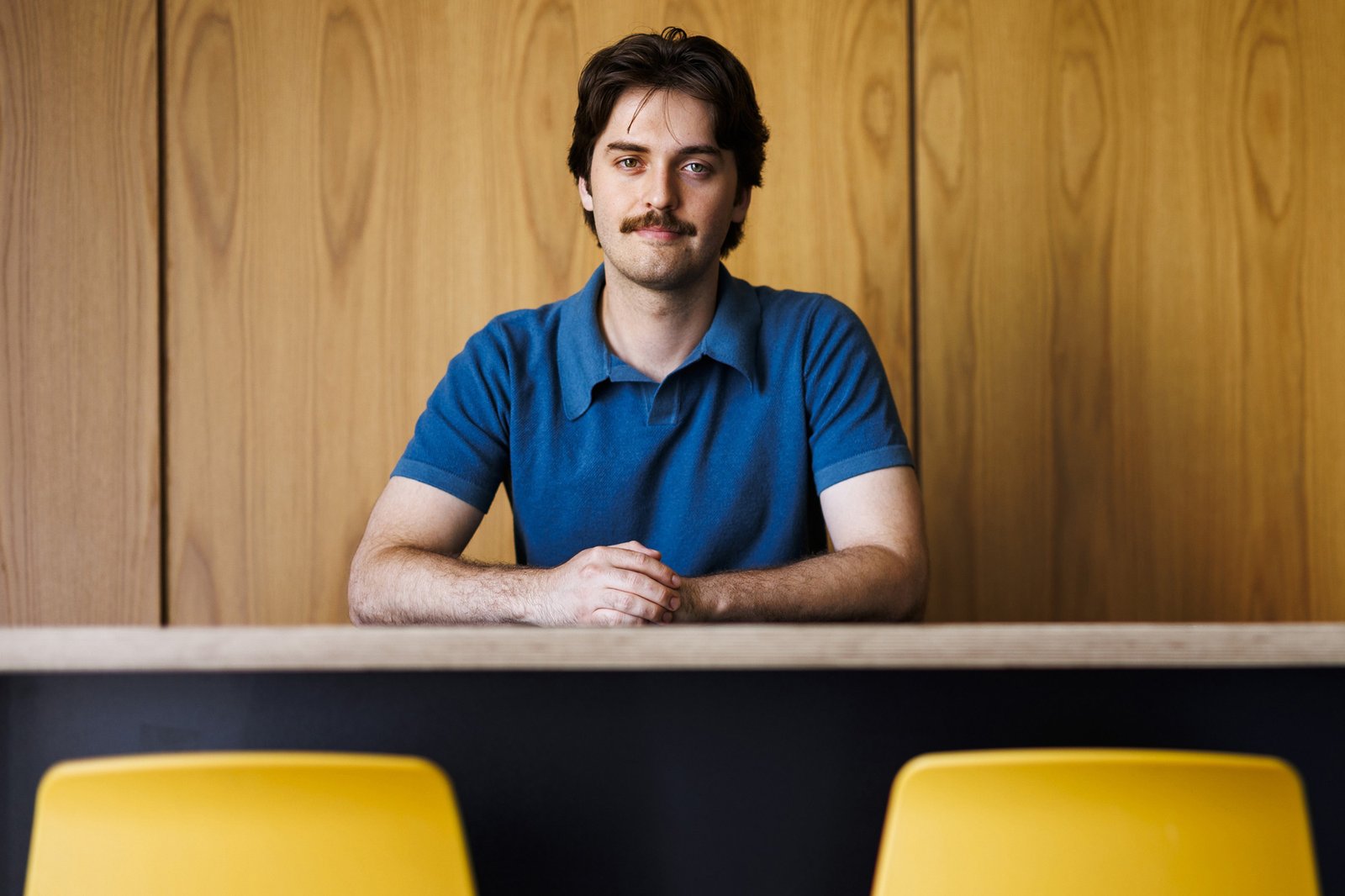
The transition from rural Tennessee to Cambridge, Massachusetts, and MIT has been a significant one. As a first-generation student, he did not learn about PhD programs until several years into college.
Once he discovered academic research, however, Coon was drawn to the possibility of spending his career learning.
“I discovered this world of academia, and so I was really excited when I learned about it,” he says. “I was like, ‘Oh my god, constant learning. That is exactly what I want to do forever.’”
Coon began studying the microbes that drive carbon and sulfur cycling in marine sediments as an undergraduate, eventually joining research cruises to investigate these processes firsthand.
His first research cruise, in 2022 after his second year of college, took him to the Atlantic continental slope to study methane seeps and how microbes prevent this methane from escaping to our atmosphere. For Coon, experiencing the ocean up close changed the way he understood the microscopic organisms he was studying.
“It is very powerful seeing yourself in the middle of the ocean, with a whole other world of complex life beneath you,” he says.
At MIT, working with his advisor Tanja Bosak, a professor of geobiology, Coon has continued studying microbial carbon and sulfur cycling, but with a greater emphasis on the applications. One of his major projects explores how microbes could be used to reduce methane emissions from wastewater treatment.
When wastewater is treated, microbes break down organic material in large tanks called anaerobic digesters. One of the final products of this process is the powerful greenhouse gas methane. However, Coon and his colleagues found a way to change what the microbes produce by adding gypsum, a waste product that is created from fertilizer manufacturing
The system uses the added gypsum to turn the methane into carbonate, which can be used to make cement, agriculture, and pharmaceuticals. The process also produces elemental sulfur, necessary for global fertilizer production, which is currently sources from oil and gas refinement. The approach effectively turns two waste products, sewage and waste gypsum, into useful materials while reducing greenhouse gas emissions.
For Coon, the possibility of creating a system that is both environmentally beneficial and economically useful is central to the project. Now that the laboratory experiments have ended, the researchers are looking toward conducting pilot-scale testing. Coon and his advisors have been communicating with companies interested in adapting the system to larger facilities, and hope the technology can eventually move beyond the laboratory.



