
Study design
MDT-BRIDGE (NCT05925530) is a global, nonrandomized, phase 2, single-arm study in patients with resectable and borderline resectable stage IIB‒IIIB NSCLC confirmed as EGFR and ALK wild type. Patients with mixed small cell and NSCLC histology, active or prior autoimmune or inflammatory disease, active primary immunodeficiency or a history of allogeneic organ transplant were excluded. Following initial MDT resectability assessment, all patients received two cycles of neoadjuvant durvalumab plus platinum-based chemotherapy every 3 weeks (Q3W), followed by MDT reassessment. Patients who were classified as resectable at reassessment received a further one to two cycles of neoadjuvant durvalumab plus platinum-based chemotherapy Q3W, followed by surgical resection. Patients classified as unresectable at reassessment received standard-of-care CRT for approximately 6 weeks. Patients deemed eligible for surgery at MDT reassessment but then classified as unresectable or who had progressed locally at the presurgery assessments also received CRT. After surgery or CRT, all patients received durvalumab Q4W for up to 1 year. The primary endpoint was the resection rate in all patients. Secondary endpoints included resection rates by baseline resectable or borderline-resectable status, resection outcomes, pCR rate in patients deemed resectable at MDT reassessment, EFS, PFS, objective response rate (ORR) after neoadjuvant treatment and after CRT, safety, overall survival and ctDNA clearance from baseline (before neoadjuvant treatment) to the presurgery/pre-CRT time point. Additional prespecified endpoints not reported in this manuscript include overall survival (due to data maturity); surgical procedures, approaches, delays and safety; changes in tumor staging and pulmonary function over time; further ctDNA dynamics and associations with pCR; associations of outcomes with PD-L1 expression; associations of pCR with clinical and radiographic outcomes; and genomic and peripheral blood biomarker analyses. These endpoints are planned to be reported in future publications.
Patient disposition
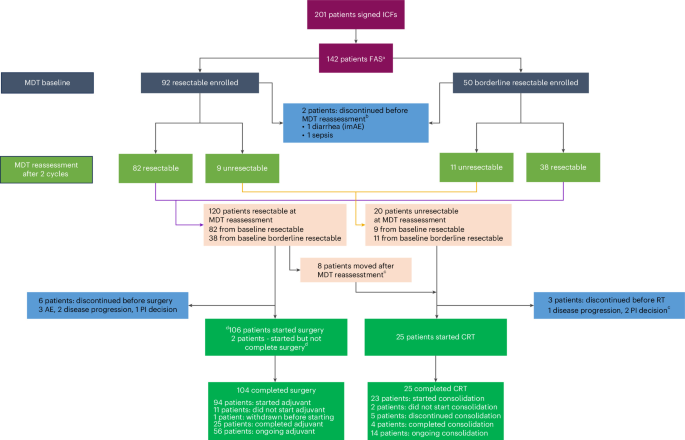
Patients were enrolled from 22 February 2024 to 2 July 2025. Overall, 201 patients signed the informed consent form and were screened. At the 12 January 2026 data cutoff (DCO), 142 patients were included in the full analysis set (FAS). Baseline resectability was assessed by the local MDT according to routine clinical practice, with patients classified as resectable or borderline resectable. No predefined protocol criteria were used to distinguish between these categories, and the rationale for the MDT assessment was prospectively recorded. At baseline MDT assessment, 92 (64.8%) patients were resectable and 50 (35.2%) were borderline resectable (Fig. 1). Of the 92 patients deemed resectable at baseline, 82 patients were classified as resectable and 9 patients were classified as unresectable following MDT reassessment after two cycles of neoadjuvant therapy. Furthermore, of the 50 patients deemed borderline resectable at baseline, 38 patients were deemed resectable and 11 patients were deemed unresectable at MDT reassessment. Overall, at MDT reassessment after two cycles of neoadjuvant therapy, 120 patients were deemed resectable and 20 were deemed unresectable; two patients discontinued before MDT reassessment and were not reassessed (one deemed resectable and one deemed borderline resectable at baseline). The patient who was resectable at baseline was included in the ‘resectable patients cohort’ (n = 121) and the patient who was borderline resectable at baseline was included in the ‘unresectable patients cohort’ (n = 21), as prespecified in the statistical analysis plan. Among the patients who were classified as unresectable at MDT reassessment (n = 20), the most common reasons for unresectability were tumor burden (50.0%), patient frailty (20.0%) and no response to treatment (20.0%; Supplementary Table 1).
DCO, 12 January 2026. aPatients who received at least one dose of study intervention. bThe patient who was resectable at baseline was included in the ‘resectable patients cohort’ and the patient who was borderline resectable at baseline was included in the ‘unresectable patients cohort’, as prespecified in the statistical analysis plan. cOne patient moved to the unresectable cohort but did not receive any definitive local treatment per the principal investigator’s (PI’s) decision. dPatients did not complete surgical resection as intended due to absence of a primary tumor in the lung parenchyma; only lymph nodes were removed. Both patients were included in the resected patients set. ICF, informed consent form; RT, radiotherapy.
After the presurgery/pre-CRT assessment, 106 patients proceeded to surgery (Fig. 1). Of these, 104 (98.1%) patients completed surgery and 94 (88.7%) initiated adjuvant durvalumab (Extended Data Table 1). Two patients did not complete lung surgical resection per protocol due to the absence of a primary tumor in the lung parenchyma; only lymph nodes were removed. Among patients who completed surgery, 12 did not proceed to adjuvant durvalumab. The most common reasons were adverse events (AEs; n = 5), progressive disease (n = 2) and patient decision (n = 2). Additional reasons included investigator decision (n = 1), meeting study discontinuation criteria (n = 1) and death (n = 1; Supplementary Table 2). AEs were the most common reason for premature discontinuation of adjuvant durvalumab, occurring in 8 (7.5%) patients, whereas 56 (52.8%) patients in the resected cohort remained on treatment at the DCO (Extended Data Table 1).
Among the 25 patients in the CRT-treated cohort, all patients initiated and completed CRT (21 (84.0%) patients had concurrent CRT and 4 (16.0%) had sequential CRT), and 23 (92.0%) subsequently initiated consolidation durvalumab (Extended Data Table 1). Two patients did not proceed to consolidation durvalumab due to progressive disease following radiotherapy (Supplementary Table 2). Five (20.0%) patients discontinued consolidation durvalumab prematurely, with AEs being the most common reason for premature discontinuation, occurring in three (12.0%) patients. Four (16.0%) patients completed consolidation durvalumab and 14 (56.0%) patients remained on consolidation durvalumab at the DCO (Extended Data Table 1). Of the patients initially classified as borderline resectable, 12 out of 50 (24.0%) completed CRT and 43 out of 50 (86.0%) ultimately received local therapy of any form (surgery or CRT).
Baseline characteristics
Baseline demographic and disease characteristics are summarized in Table 1. Overall, patient characteristics at baseline were generally balanced between patients classified as resectable and those classified as borderline resectable. The median age was 67 years (range, 46–82 years); most patients were white and current or former smokers. Approximately two-thirds had an Eastern Cooperative Oncology Group Performance Status (ECOG PS) of 0, and about half of the patients had stage IIIA disease and N2 disease. Approximately one-third of the patients had PD-L1 tumor cell expression status of less than 1%. Compared with the baseline resectable cohort, a greater proportion of borderline resectable patients presented with stage IIIB disease and T4 primary tumors (Table 1). There were varied reasons for patients who received no local treatment (no surgery or CRT, n = 11), with no common characteristics identified. Two patients discontinued due to immune-mediated AEs (imAEs; Supplementary Table 3).
Neoadjuvant treatment exposure
For treatment exposure analyses, resectable (without treatment switch) and unresectable (with treatment switch) cohorts were defined according to the treatment received during the neoadjuvant period, rather than resectability status at MDT reassessment as used for the efficacy cohorts. The resectable cohort excluded patients who switched to CRT, whereas the unresectable cohort included patients who switched from the surgical pathway to CRT. All patients received at least two cycles of neoadjuvant durvalumab plus chemotherapy, and 33.8% of patients completed four neoadjuvant cycles (Extended Data Table 2). Four cycles were completed in 37.5% of patients in the resectable cohort and in 21.4% of patients in the unresectable cohort. The median number of neoadjuvant durvalumab cycles was 3 (range, 2–4) in all patients. Most patients (89.4%) received carboplatin-based chemotherapy (Extended Data Table 2).
Resectability assessments and surgical outcomes
Among the 50 patients classified as borderline resectable at baseline, 38 (76.0%) were classified as resectable following two cycles of neoadjuvant durvalumab plus chemotherapy (Extended Data Fig. 1). Of the 120 patients considered resectable after reassessment, 14 ultimately did not undergo surgery, including seven who had been classified as borderline resectable at baseline. Overall, 92.3% of patients received either surgery or CRT following neoadjuvant treatment.
At baseline MDT assessment, tumor Tstatus alone was the most frequent factor contributing to borderline resectability (50.0%), followed by N status alone (32.0%; Extended Data Fig. 2a). An R0 resection outcome was considered uncertain in 28.0% of borderline resectable patients compared with only 3.3% of patients initially classified as resectable (Extended Data Fig. 2b).
At the primary analysis, the overall resection rate was 74.6% (95% CI, 66.7–81.6). Resection rates were 81.5% (95% CI, 72.1–88.9) among patients deemed resectable at baseline and 62.0% (95% CI, 47.2–75.3) among those deemed borderline resectable (Fig. 2a). Approximately 96% of surgical resections achieved R0 status across all cohorts (Fig. 2b).
a–c, Resection rates (a), resection outcomes (b) and pCR rate (c) in all patients and by baseline resectability status (FAS). DCO, 12 January 2026. The FAS consisted of all patients who received at least one dose of study treatment. pCR was defined as the proportion of patients who underwent surgery and had 0% residual viable tumor cells in resected lung and lymph nodes. aPercentages are based on the number of patients who started resection surgery as the denominator, and 95% CIs were calculated by the Clopper−Pearson exact method. The resectable patients cohort is defined as the subset of patients in the FAS who are deemed resectable after MDT reassessment and includes one patient who was resectable at baseline that discontinued before MDT reassessment.
Efficacy
ORR at presurgery/pre-CRT and in patients treated with CRT
In the resectable patients cohort, 76 out of 121 patients achieved an objective response at the presurgery/pre-CRT assessment, corresponding to an ORR of 62.8% (95% CI, 53.6–71.4). Responses included one complete response (0.8%) and 75 partial responses (62.0%; Extended Data Table 3). The median number of neoadjuvant durvalumab cycles was 3 (range, 2−4).
In the unresectable patients cohort, 4 out of 21 patients achieved an objective response (ORR, 19.0%; 95% CI, 5.4–41.9) at the pre-CRT assessment, with all responses being partial responses (Extended Data Table 3). The median number of neoadjuvant durvalumab cycles was 2 (range, 2−4).
Among the 25 patients treated with CRT, 84.0% had an objective response (n = 13) or stable disease (n = 8), as measured from the last scan before MDT reassessment (Extended Data Table 4).
pCR
Among the 121 patients in the resectable patients cohort, 27.3% (95% CI, 19.6–36.1) had a pCR per local evaluation. The pCR rate was 31.3% (95% CI, 21.6–42.4) among patients who were resectable at baseline, compared with 18.4% (95% CI, 7.7–34.3) among those initially classified as borderline resectable (Fig. 2c).
EFS and PFS
At the primary analysis of EFS, corresponding to 14.1% data maturity (20 out of 142), 12-month EFS was 88.5% (95% CI, 81.5–92.9; Fig. 3a). In patients who were resectable at baseline, 12-month EFS was 92.9% (95% CI, 84.8−96.8; Supplementary Fig. 1a).
a−c, EFS in all patients in the FAS (a), in patients deemed resectable after MDT reassessment and after resection (b) and PFS in patients deemed unresectable after MDT reassessment and after CRT treatment (c). DCO, 12 January 2026. The FAS consisted of all patients who received at least one dose of study intervention. The 12-month values were calculated by the Kaplan–Meier method, with the 95% CIs calculated using the log–log transformation. For the two patients without MDT reassessment, the patient who was resectable at baseline was included in the ‘resectable patients cohort’, and the patient who was borderline resectable at baseline was included in the ‘unresectable patients cohort’, as prespecified in the statistical analysis plan. PFS was defined as the time from the first dose of any study treatment until progressive disease, as assessed by the investigator per RECIST v1.1, or death (by any cause in the absence of progression) regardless of whether the patient withdrew from therapy or received another anticancer therapy before progression. PFS after CRT treatment was not a prespecified analysis as per the statistical analysis plan. EFS was defined as the time from the first dose of any study treatment to the earliest of: (1) progressive disease that precluded surgery (or, for patients who did not have surgery for a reason other than progression, progressive disease per RECIST v1.1 after MDT reassessment); (2) progressive disease identified and reported by the investigator when attempting surgery that prevented completion of surgery (or, for patients who did not complete surgery for a reason other than progression, progressive disease per RECIST v1.1, after surgery); (3) local/distant recurrence as assessed by the investigator per RECIST v1.1; or (4) death from any cause. EFS in resected patients was not a prespecified analysis per the statistical analysis plan.
Among patients in the resectable patients cohort, 12-month EFS was 90.1% (95% CI, 82.8–94.4), increasing to 92.9% (95% CI, 85.5–96.6) among those who underwent surgical resection (Fig. 3b).
In patients deemed borderline resectable at baseline, 12-month PFS was 62.0% (95% CI, 39.3−78.4; Supplementary Fig. 1b). In the unresectable patients cohort, 12-month PFS was 75.1% (95% CI, 45.2–90.2) and 85.0% (95% CI, 59.8–95.0) among patients treated with CRT (Fig. 3c).
The median duration of follow-up in censored patients was 10.9 months (range, 1.0–20.2) for the primary EFS analysis, 10.9 months (range, 1.2–20.2) among patients in the resectable patients cohort and 7.3 months (range, 1.0–15.5) for the PFS analysis among patients in the unresectable patients cohort.
Safety
Safety analyses were conducted both overall and by treatment period (Table 2). During the neoadjuvant period (n = 142), AEs of any grade occurred in 92.0% of patients in the resectable cohort and 96.4% in the unresectable cohort. AEs leading to discontinuation of any study treatment occurred in 7.1% of patients across both cohorts. Treatment-related AEs of any grade occurred in 85.7% and 89.3% of patients in the resectable and unresectable cohorts, respectively, whereas grade 3/4 treatment-related AEs occurred in 25.9% and 17.9%. imAEs occurred in 7.1% and 3.6% of patients in the resectable and unresectable cohorts, respectively.
During the postsurgery period (defined as the period from the date of surgery until the minimum of the date of surgery plus 90 days, date of DCO or date of first dose of subsequent anticancer therapy; n = 106), any-grade AEs occurred in 83.0% of patients and grade 3/4 AEs in 22.6% of patients. AEs possibly related to surgery occurred in 21.7% of patients. imAEs occurred in 7.5% of patients.
During the CRT period (defined as the period from the date of first dose of CRT post-MDT reassessment until the minimum of the last study CRT treatment plus 90 days, date of DCO or date of first dose of subsequent anticancer therapy; n = 25), 88.0% of patients experienced any-grade AEs, 28.0% experienced grade 3/4 AEs, and 64.0% experienced treatment-related AEs. One patient experienced an imAE.
During adjuvant or consolidation durvalumab treatment (n = 117), any-grade AEs occurred in 88.3% of resected patients and 82.6% of CRT-treated patients. Grade 3/4 AEs occurred in 7.4% and 17.4% of patients, respectively, whereas AEs leading to discontinuation of durvalumab occurred in 8.5% and 13.0%, respectively.
During the overall study period (N = 142), the most common any-grade AEs were anemia (36.6%), nausea (36.6%), asthenia (33.8%), constipation (28.9%) and diarrhea (26.8%) (Supplementary Table 4 and Extended Data Fig. 3). The most common grade 3/4 AEs were neutropenia (10.6%), anemia (4.9%) and diarrhea and fatigue (2.8% each; Extended Data Fig. 3). Three (2.1%) patients had an AE leading to death, including one patient each with cardiac failure (during consolidation durvalumab), interstitial lung disease and death (not otherwise specified; Table 2).
Pneumonitis events (a grouped term that includes immune-mediated lung disease, interstitial lung disease and pneumonitis) across the overall study population were reported in 13 (9.2%) patients. Four (3.6%) patients in the resectable cohort had a pneumonitis event during the neoadjuvant period and two (1.9%) patients had a pneumonitis event during the postsurgery period. One patient died 32 days postsurgery due to interstitial lung disease; the event was related to both study treatment and surgery. Pneumonitis events occurred in two (8.0%; both grade 2) patients during the CRT period. In the adjuvant or consolidation periods, six (6.4%) patients in the resected cohort and two (8.7%) in the CRT-treated cohort experienced a pneumonitis event. All pneumonitis events in the CRT and adjuvant or consolidation periods were low grade (grade 1/2). A maximum-grade 3/4 pneumonitis event occurred in one patient during the neoadjuvant period (Table 2).
ctDNA analysis
Of the 142 patients in the FAS, tissue, germline blood and plasma samples were available in 140 patients for ctDNA analysis. Successful ctDNA assays were developed for 117 patients (82.4% of the FAS) using whole genome sequencing (WGS) of screening (107 patients) or surgical tissue (10 patients). To avoid selection bias, the biomarker-evaluable population (BEP) for ctDNA analysis of plasma was restricted to patients who had assays developed using treatment-naive screening biopsies only. Baseline characteristics of patients in the BEP (N = 107) were generally similar to those in the overall FAS (N = 142; Extended Data Table 5).
Of the 107 patients in the BEP, all but one had ctDNA-evaluable samples at baseline (before neoadjuvant treatment) and 91 patients had evaluable samples presurgery/pre-CRT. Overall, 105 out of 106 (99.1%) and 57 out of 91 (62.6%) patients had detectable ctDNA at baseline (before neoadjuvant treatment on cycle 1 day 1 (NeoC1D1)) and presurgery/pre-CRT, respectively. In patient samples where ctDNA was detected, variant allele fractions (VAFs) ranged from 0.00265% (26.5 parts per million, ppm) to 33.8% VAF at baseline, 0.000046% (0.46 ppm) to 6.32% VAF presurgery and 0.000182% (1.82 ppm) to 26.4% VAF pre-CRT. The corresponding median VAFs were 0.3390% (3390 ppm), 0.00395% (39.5 ppm) and 0.01092% (109.2 ppm), respectively.
Based on the longitudinal profile available across these time points, a total of 90 patients could be assessed for presurgery/pre-CRT ctDNA clearance status from baseline (as described in the Methods), with 36.7% (33 out of 90) of patients cleared overall (Fig. 4a). Clearance rates appeared similar between patients classified as resectable and borderline resectable at the initial MDT assessment (36.1% (22 out of 61) and 37.9% (11 out of 29), respectively; Fig. 4b). By contrast, rates substantially diverged by resectability status at MDT reassessment, with higher clearance rates among patients deemed resectable versus unresectable (40.6% (28 out of 69) and 23.8% (5 out of 21), respectively; Fig. 4b). Clearance rates were also over two-fold higher among patients who ultimately underwent surgery compared with those treated with CRT (41.2% (28 out of 68) and 20.0% (4 out of 20), respectively; two patients did not receive local therapy; Fig. 4b).
a,b, ctDNA clearance rate from baseline to presurgery/pre-CRT in all patients (a), patient subgroups according to initial MDT resectability assessment, resectability status at MDT reassessment and treatment received (b). Two patients did not receive either surgery or CRT. c,d, Association of ctDNA clearance with EFS in resected patients (c) and PFS in CRT-treated patients (d); CL, clearance; non-CL, nonclearance. DCO, 12 January 2026. Error bars represent 95% CIs for the true ctDNA clearance rate calculated using the Wilson score method. EFS/PFS rates at 12 months were reported with 95% log–log CIs, derived from the Kaplan–Meier survival estimates.
Among patients who completed surgical resection, no EFS events have been reported for those with ctDNA clearance presurgery, whereas the 12-month EFS in the absence of ctDNA clearance was 88.9% (95% CI, 72.8−95.7; Fig. 4c). Among patients treated with CRT, the 12-month PFS rate was 100.0% versus 77.5% (95% CI, 44.8−92.3) for patients with or without ctDNA clearance pre-CRT, respectively (Fig. 4d).



