
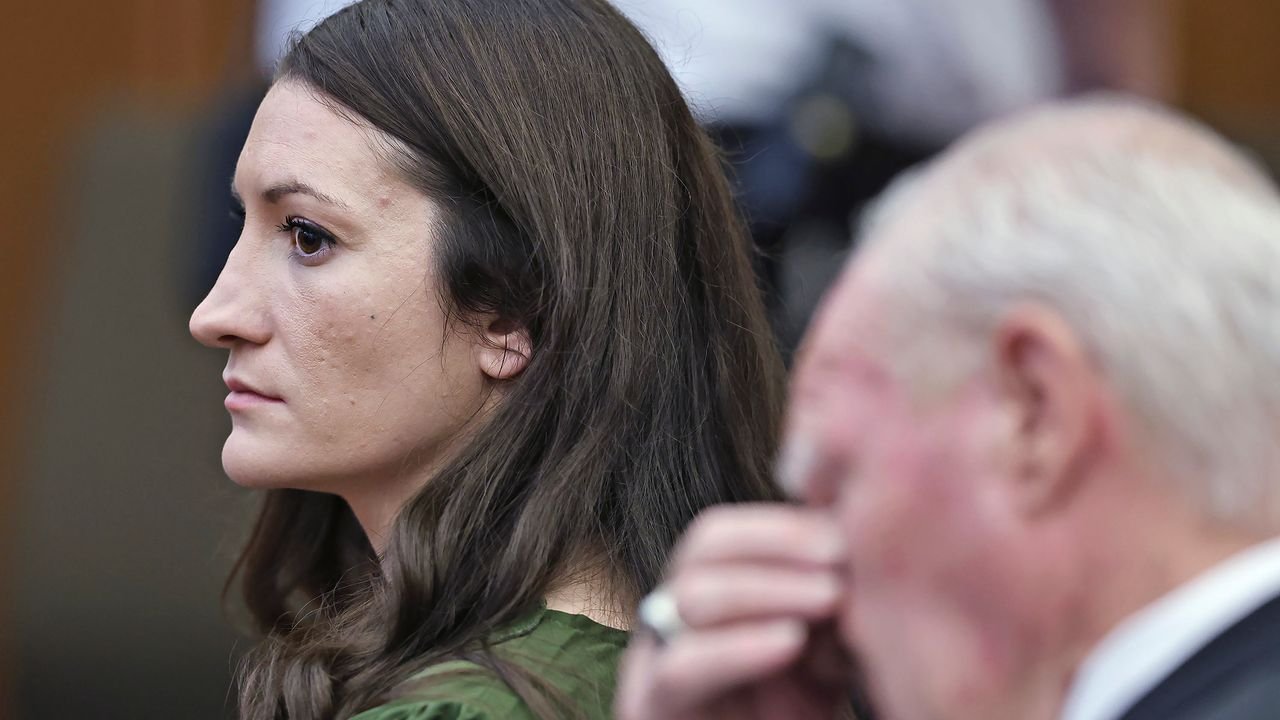
Some sort of resolution to the Lindsay Clancy trial seemed finally within reach on Thursday afternoon when, after six days of deliberations and two reports of deadlock, word came from the jury room. It wasn’t a verdict but an apparent complaint about a holdout. The foreperson wrote that a single juror was refusing to follow instructions from the judge, William Sullivan, on the standard for proving guilt beyond a reasonable doubt. Clancy, who was on trial for murdering her three young children, had pleaded not guilty by reason of insanity. The note itself wasn’t made public, but Kevin Reddington, Clancy’s defense attorney, said that it “clearly and unequivocally” showed an 11–1 split, with the lone juror blocking an acquittal. Reddington immediately asked Judge Sullivan to remove the dissenting juror, and a long, heated scrum followed at the bench. As lawyers crowded in, Reddington could be seen slapping down a sheaf of papers. Clancy, who was left paralyzed by a suicide attempt that followed the killings, was brought forward in her wheelchair to listen. Prosecutors argued that the jury’s dispute reflected not misconduct but a legitimate disagreement over the evidence. Judge Sullivan questioned the jurors one by one, removed none, and, on Friday morning, over the defense’s objections, refused to investigate further. Shortly before noon, after thirty-eight hours of deliberation, the jury returned a final message. “With a heavy heart,” it read, they still had not managed to come to a verdict. Reddington filed an emergency appeal seeking to block a mistrial, but the effort failed, and Judge Sullivan declared one anyway.
It should come as no surprise that the jurors had trouble reaching unanimity. Five weeks of nationally televised testimony, from more than eighty witnesses, did not settle the central question: What was going through the defendant’s mind when she killed her kids? The prosecution and the defense never disagreed about the case’s basic facts. One evening in January of 2023, after sending her husband out to pick up dinner, Clancy fatally strangled Cora, who was five, Dawson, who was three, and Callan, who was eight months old, in the basement of the family’s home in Duxbury, Massachusetts; then she cut her neck and wrists and jumped from a second-floor window. The jury was asked to determine whether Clancy, a labor-and-delivery nurse who’d been in the midst of a well-documented mental-health crisis, should be exempt from criminal responsibility under Massachusetts law, either because she lacked the capacity to understand that what she was doing was wrong or because she was unable to stop herself from doing it.
Day after day, Judge Sullivan ordered jurors to ignore press coverage and commentary on social media, where self-appointed sleuths combed through testimony, diagnosed Clancy from afar, and seized on minor inconsistencies to construct a baseless theory that her husband was the culprit. The jury could hardly have missed the divisive displays outside the courthouse. Pink-clad Clancy supporters gathered by the dozens, holding up placards that read “COMPASSION BEFORE JUDGMENT” and “LISTEN TO MOTHERS,” while a smaller counter-presence carried signs of its own: “REMEMBER THE REAL VICTIMS”; “KIDSLAUGHTER.” As testimony came to a close, the judge granted a request from the defense to include involuntary manslaughter as a possible verdict, giving jurors an option in between convicting Clancy of murder and finding her not guilty by reason of insanity. In the end, though, there was apparently no compromise to be found.
In most states, defendants bear the burden of proving their insanity. In Massachusetts, it falls to prosecutors to prove criminal responsibility beyond a reasonable doubt. Leading the prosecution were Jennifer Sprague and Shanan Buckingham, a pair of stolid assistant district attorneys in structured suits and dark rectangular glasses. During opening statements, Buckingham, who wore her hair pulled back with the sort of bow that she said Cora had loved, promised to reveal an “extremely controlling, meticulous, and manipulative” version of Lindsay Clancy, a sinister inverse to “pictures you’ll see of the doting mother, the dedicated nurse.” But in the course of the trial this portrait never materialized. Many of the state’s own witnesses—a pediatrician, a preschool teacher, a colleague of Clancy’s, a local friend—supplied favorable character evidence for the defense, sometimes even before Reddington rose to cross-examine them. Elaine Rossi, the family’s nanny, repeated what she’d told the state police: “I observed a wonderful mom who loved her kids.”



