
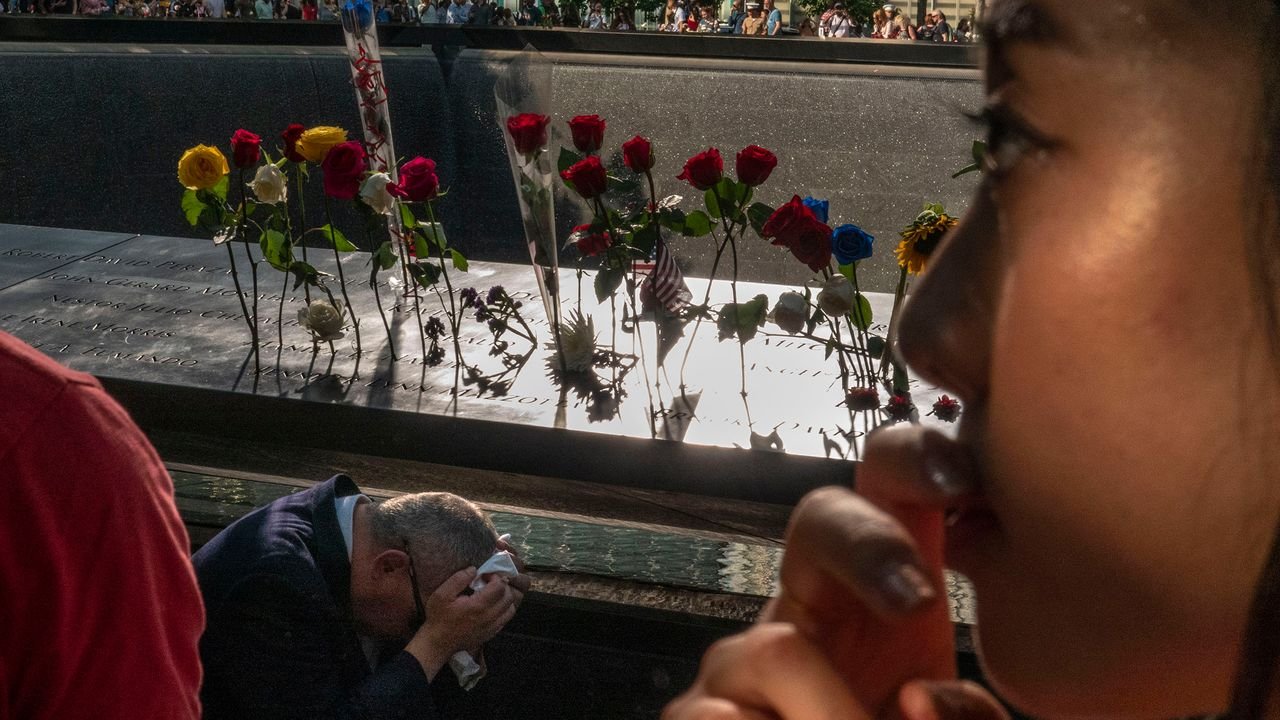
The dislocation and disorientation of those first days in the city, and of the weeks, months, and even years that followed, are hard now to redescribe adequately, even for those who lived through them. Grief rose like wildflowers. No one who walked Manhattan’s streets then will forget the most heartbreaking spontaneous memorial of the time: thousands of small homemade posters plastered on walls, all sharing the same unplanned format and elegiac mode—a picture of someone lost, with the word “Missing,” and often a gentle appended annotation, noting a tattoo, or a religious medal, or simply “Had no beard that day.” Everyone—including, surely, the people who had so delicately made the handbills—came to understand that nearly all those pictured were among the almost three thousand who were gone. Yet the posters remained in place, understood less as messages meant to find the missing and more as signs of mourning. (An exhibition of a hundred and forty-four photographs of those posters opened this week at Most Holy Trinity-St.Mary Church, in Williamsburg.)
We lived through a lot. The anthrax attack that followed—in which, beginning a mere week after September 11th, letters laced with the spores were sent to media outlets and politicians, eventually taking five lives—seemed like a second wave of similar terror. (The F.B.I. later reported that it had been preparing a criminal case against an American scientist, who died by suicide before charges could be filed.) Then came the much publicized and yet shadowy fear of a “suitcase nuke” in Times Square. We entered a state of constant jumps. We called what had happened unimaginable, even though, in the years of plenty that preceded it, our movies and our minds had been filled with grim images of civic destruction, mostly the work of aliens or earthquakes. The truly and newly unimaginable part was the sheer cruelty and madness of the terrorists, setting out to murder so many and engulfing themselves in the act.
Yet there was also the beautiful persistence of the city. The heroism of the first responders—some four hundred of whom died that day—remains legend, their names still rightly honored on the façades of the firehouses and police stations where they worked. Meanwhile, civil servants who had long been charged with mapping the city, displaced from their offices at 7 World Trade Center, regrouped at Pier 92 and began producing the maps that rescue workers needed in order to know what ran where and how to get down to where they needed to go. More unsung heroes and heroines abounded at the devastated site—in retrospect, working at undue risk from fumes and noxious chemicals—who went about the terrible business of recovering bodies and clearing the scene. Yet the oddity was that so much of the normal life of the city—the everyday busyness of schools and offices and coffee shops and subways—went on, either fearlessly or recklessly, depending on your point of view. We found, as people in a blitz will, ways to insulate.
The question of action, of course, rose along with the summit of grief. What to do? The art historian Kirk Varnedoe, wise in the dialogue of what we look at and how we think of it , said that we could choose to see what had happened either as imagery or as injury. To see it as injury—tragic, horrible, but also specific and local and far from the worst case we could imagine—was to see it as a manageable fact. To see it as imagery—an endlessly repeated loop of fire and destruction—was to be trapped in it for good.
Yet many found such wisdom too mild. The loop of imagery won out, and a militant response became the only acceptable one. We were at a crossroads of world order! We had to end our decadent taste for irony! We had to overcome our narrow materialism! A clash of civilizations was approaching. The clash, however, turned out largely to be within our own civilization: between a politics sustained by proportion and historical memory and one fuelled by fear of apocalyptic possibilities. A desperate need for reassurance through revenge governed too many minds.
The disasters of the militant response unspooled. The war in Afghanistan became the longest in American history and ended with the Taliban back in power. Then there was the invasion of Iraq—where the weapons of mass destruction invoked by the White House proved not to exist—and the disgraceful abuses of Abu Ghraib. There were successes along the way, including, eventually, the finding and killing of bin Laden. But the larger lesson of the years after September 11th was how easily the demand for perfect safety could become a license for calamitous action.



