
Last quarter, two people on the same leadership team turned on the same AI tool. One had a stalled project and asked the tool to draft a status update that downplayed the trouble. He received a clean, confident response that read as finished. The dashboard interpreted it as complete and the trouble vanished.
The other leader was weighing a hard call. Her team named the risks, bad numbers, objections, and the parts that weren’t working. She handed the tool an honest picture of the decision, and it compressed what used to take three weeks of meetings into a single afternoon because everything it needed to be right was already on the table.
They were using the same technology inside the same company in the same week. What came out of each of their hands was simply whatever had already been running underneath, long before the tool arrived.
Every major technology leap forward has done the same thing. It took whatever was running inside the leadership and made it faster, more visible, and much harder to hide. AI is just the quickest, least forgiving version.
A LEADER’S SOURCE CODE
Most AI conversations happening in boardrooms are technology, budget, and competitive positioning conversations. It’s almost never a discussion about what is generating the results underneath all of it.
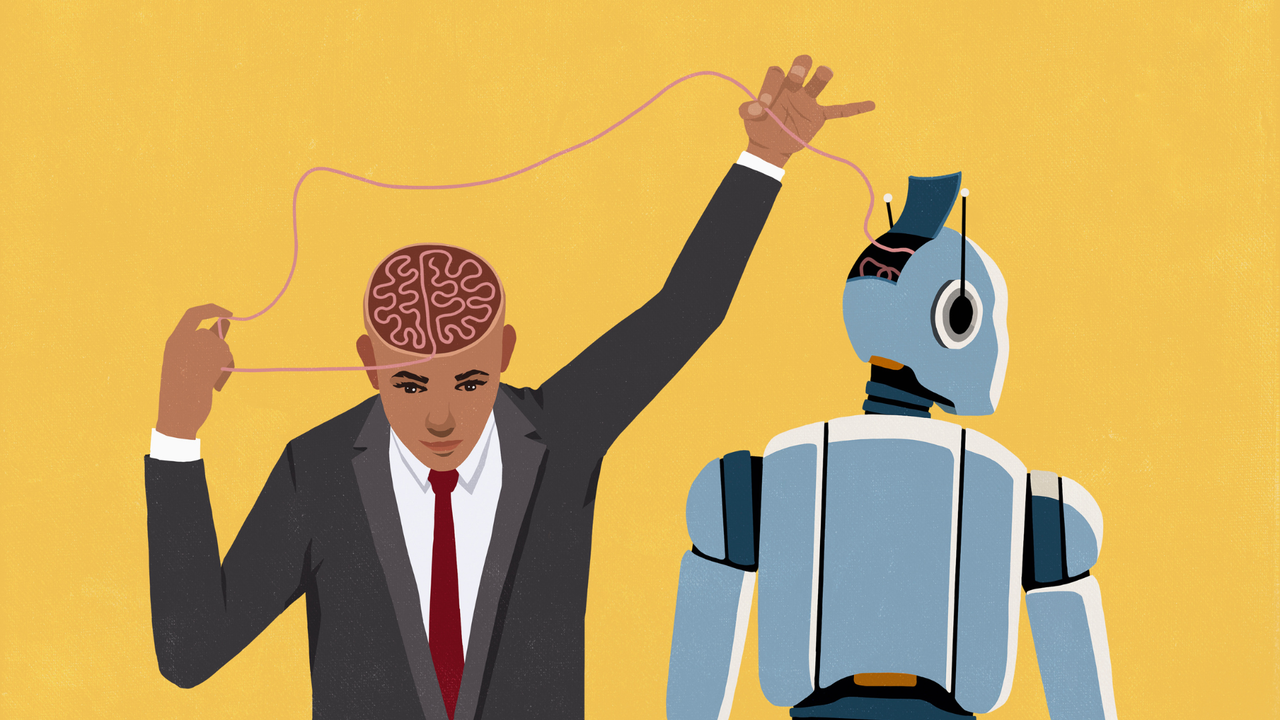
After two decades inside founder-led companies, I call this the leader’s source code. When I talk to leaders about their source code, I’m talking about the automatic pattern running underneath how they lead: how they process uncertainty, where their attention goes under pressure, what they reward and avoid without meaning to. Your team learns your source code by watching what gets rewarded and what gets punished, and they build the real system around it. Whatever technology your company adopts simply plugs into that system and runs on it.
You can see this in something as ordinary as a meeting summary. Put an AI notetaker in a meeting where disagreement gets smoothed over before anyone says it plainly, and it will faithfully capture the smoothed-over version. The Monday summary reads, “team aligned on Q3 priorities.” But three people in that room weren’t and they said nothing. Two weeks later the initiative stalls, and the summary gets cited as proof everyone signed on. The friction resurfaced as a decision nobody remembers making and nobody feels responsible for it.
Or take decision automation. A founder automates approval routing to free up their own time. Six months later, every approval still lands on their desk, because the workflow was built around their sign-off in the first place. The bottleneck didn’t go away. It got faster, and harder to see.
BUILD THE FOUNDATION FIRST
The pressure to adopt is real, and it isn’t letting up. A Bloomberg survey of more than 300 senior financial services leaders found that nearly half believe their firm risks losing market share if it falls behind on AI. McKinsey’s most recent workforce research found that trust in leadership is one of the strongest indicators of whether people feel ready for AI. Yet about one in five employees say AI-related changes at work make them anxious.
Leaders can quiet that anxiety for a moment by promising that no jobs will be lost, but if roles later disappear, the promise becomes evidence that people were not told the truth. Trust and fear can exist at once, inside the same building, often inside the same person. That tension is the product of a leader’s source code, and it’s what AI is about to run on top of.
This is the part most AI rollouts miss—an established, healthy source code where authority was distributed and the truth moved fast before the tool arrived. The highest leverage move before your next deployment is knowing what your own source code is currently running.
So how do you read your own source code before the next tool scales it? These three tests will show you.
- The empty-room test. Watch what happens to decision speed when you leave the room. If things slow down or stall until you’re back, authority isn’t distributed. Automate on top of that and you make the bottleneck faster and harder to see.
- The bad news test. Notice whether problems get named or routed around. A team that brings you bad news early has built trust. A team that works around what’s broken has learned that naming it costs more than hiding it does. Whichever pattern you have, your next tool will scale it faithfully.
- The early warning test. Ask yourself when you find out something has gone wrong, at the first sign of trouble or only once it’s past the point of no return. That gap is the clearest read available on what any tool you adopt next is about to amplify.
None of these shows up on a dashboard. These appear in what your organization does automatically, under pressure, when nobody’s performing for the room. AI won’t interrupt that pattern. It will run on it, faster than any team can correct if the pattern wasn’t healthy to begin with.
FINAL THOUGHTS
Strategy is hard to change, and markets are impossible to control, but your source code is the one thing you can genuinely update. When the leader updates, the system updates.
So, before the next line item is added to the AI budget, explore whether the source code it’s about to scale is one you’d stake every decision, hire, and workflow on. If it isn’t yet, that’s your work. And it’s the one thing the tool can’t do for you.
Elaine Mak is the CEO of Elaine Mak & Co.



