
In 1964, Italian filmmaker and poet Pier Paolo Pasolini embarked on an ambitious project. He wanted to make a movie that told the story of the New Testament’s Gospel of Matthew, but through an Italian Neorealist cinema lens. All the actors would be untrained amateurs, the story would unfold with the confusion and awkwardness of real life, and it would be shot in locations across Southern Italy.
Puglia and Sicily provided the settings for the grand, dramatic scenes from the life of Christ in Jerusalem, but for his birth and childhood, when Jesus lived humbly with his parents, Pasolini needed somewhere that looked not just ancient, but mystical. For that, he scouted the region of Basilicata and found the town of Barile.
More than six decades since Pasolini was there, The Gospel According to St. Matthew is still the first thing winemaker Lorenzo Piccin tells me about Barile. “Pasolini shot [the film] here—that’s all you need to know to understand it,” he says. The director was drawn to Barile because of how compelling and otherworldly it is.
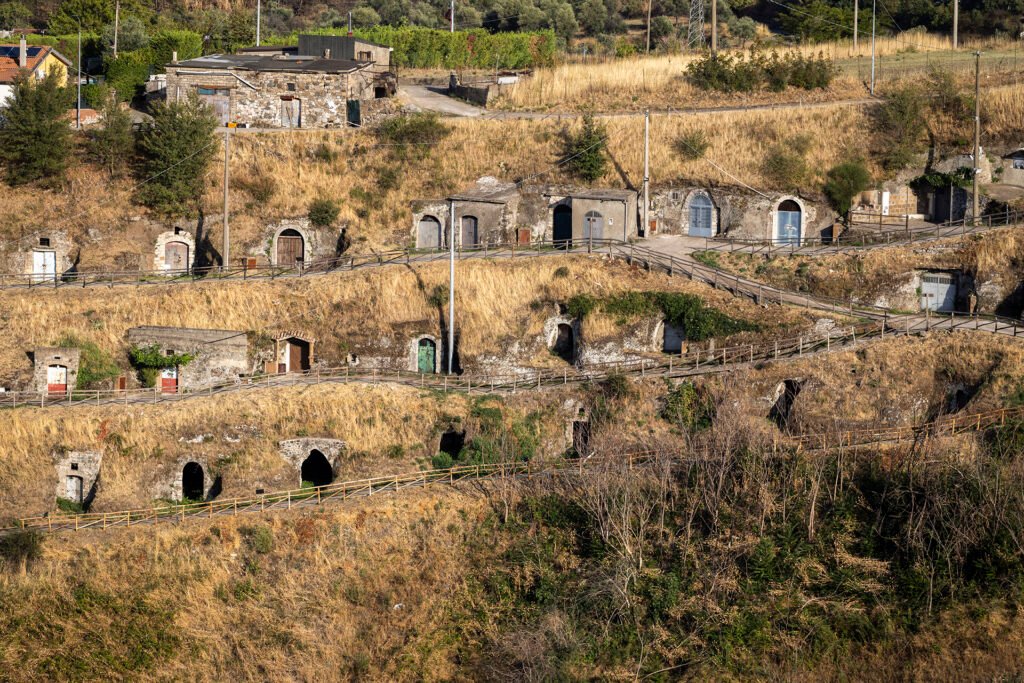
Located in the arch of Italy’s booted foot, Barile occupies two hilltops composed of the tuff from an extinct volcano. The town is a living testament to a unique piece of Italian winemaking history unknown to most of the world: the Arbëreshë wine caves.

The caves maintain the perfect temperature and an ideal level of humidity all year, so there couldn’t have been a better place for storing wine, cured meats, and cheeses.
Lorenzo Piccin, co-owner and winemaker at Grifalco
While Italy likes to bill itself as a homogeneous country that has only recently experienced an influx of refugees, the peninsula has, in fact, seen moments like this many times before. The mountain towns stretching from Calabria through Basilicata and into Puglia have been inhabited by Albanian refugee communities since the 16th century. These people, known as the Arbëreshë, settled in Italy after fleeing from the encroaching Ottoman Turks in their homeland. And like so many populations who have arrived on this peninsula, from the Phoenicians to the Greeks to the Armenians, they brought with them their practices for making verë (wine).

The Arbëreshë dug out a vast network of caves, called sheshë in early modern Albanian, in order to make and store wine. More than 100 of these grottoes still dot the hillsides in Barile today. When Pasolini stumbled upon them, he determined they were the perfect setting for ancient Palestine.
The tuffaceous soil is easy to dig out, so excavating the caves and turning them into wineries and cellars was a surprisingly practical solution. “The caves maintain the perfect temperature and an ideal level of humidity all year, so there couldn’t have been a better place for storing wine, cured meats, and cheeses,” says Piccin, who runs Grifalco, an estate in Basilicata that makes elegant wines from the region’s native red grape, Aglianico del Vulture. These grottoes remained active sites of wine production and aging for centuries, with many of them even serving as homes for the winemaking families.
Over the past few decades, a struggling economy that has driven young people to seek work elsewhere, combined with the hygienic and logistical challenges of producing wine commercially in caves, has left most of the sheshë abandoned.

Today, only one winery, Basilisco, operates entirely within the grottoes. Winemaker Viviana Malafarina lives and breathes this place, confronting the challenges of limited space and maintaining cleanliness with admirable agility. She sources grapes from organic, sustainably maintained plots, like her Storico vineyard, where ungrafted, 80-year-old vines are trained in the traditional capanno method and grow alongside olive and fruit trees.
Malfarina is undeterred by the complications of making wine in the caves. “There is a treasure of enormous value here, both in terms of what has been and what might be,” she says. Her cru project, which offers four strikingly sophisticated Aglianico expressions, suggests there is much to be gained by giving the territory its due. The wines are sanguine and earthy, coiled with latent energy—a sort of vinous equivalent to Plato’s myth of the cave.
While other producers don’t do all their work in the caves, their wines still speak to singular Arbëreshë traditions. Elena Fucci, whose winery Azienda Agricola Elena Fucci brought international fame to the region’s Aglianico, employs Arbëreshë winemaking techniques with an eye toward sustaining the local farming community and maintaining these practices for posterity.

Using grapes from a pre-phylloxera vineyard, Fucci created a line of wines called Sceg, or “pomegranate” in Arbëreshë. Sceg is fresh and linear, but with a purity and concentration rooted in the past. “The sheshë represent the historical memory of this place, where wine has always been an integral part of the culture, from the very first people who arrived,” Fucci says. “It’s a point of reference that allows us to recount our story to new generations—the caves literally hold our history.”

Fucci ages her Aglianico riserva and superiore in one of the caves, where the bottles enjoy 360 square meters of perfect climatic conditions. Like the original excavations, this was a practical solution for her, as she actually needed more space in her growing winery. If an opportunity arises to restore and occupy another cave, she hopes to turn it into a tasting room where she can tell the story of these wines in the place best suited to it. As she puts it, “Why not tell the history of the place in the place that tells its history?”
This article originally appeared in the November 2026 Best Buys Issue of Wine Enthusiast magazine. Click here to subscribe today!
The post The Otherworldly Wine Caves of Italy’s Basilicata Region appeared first on Wine Enthusiast.



