
Published September 27, 2026 03:56PM
SUMMARY
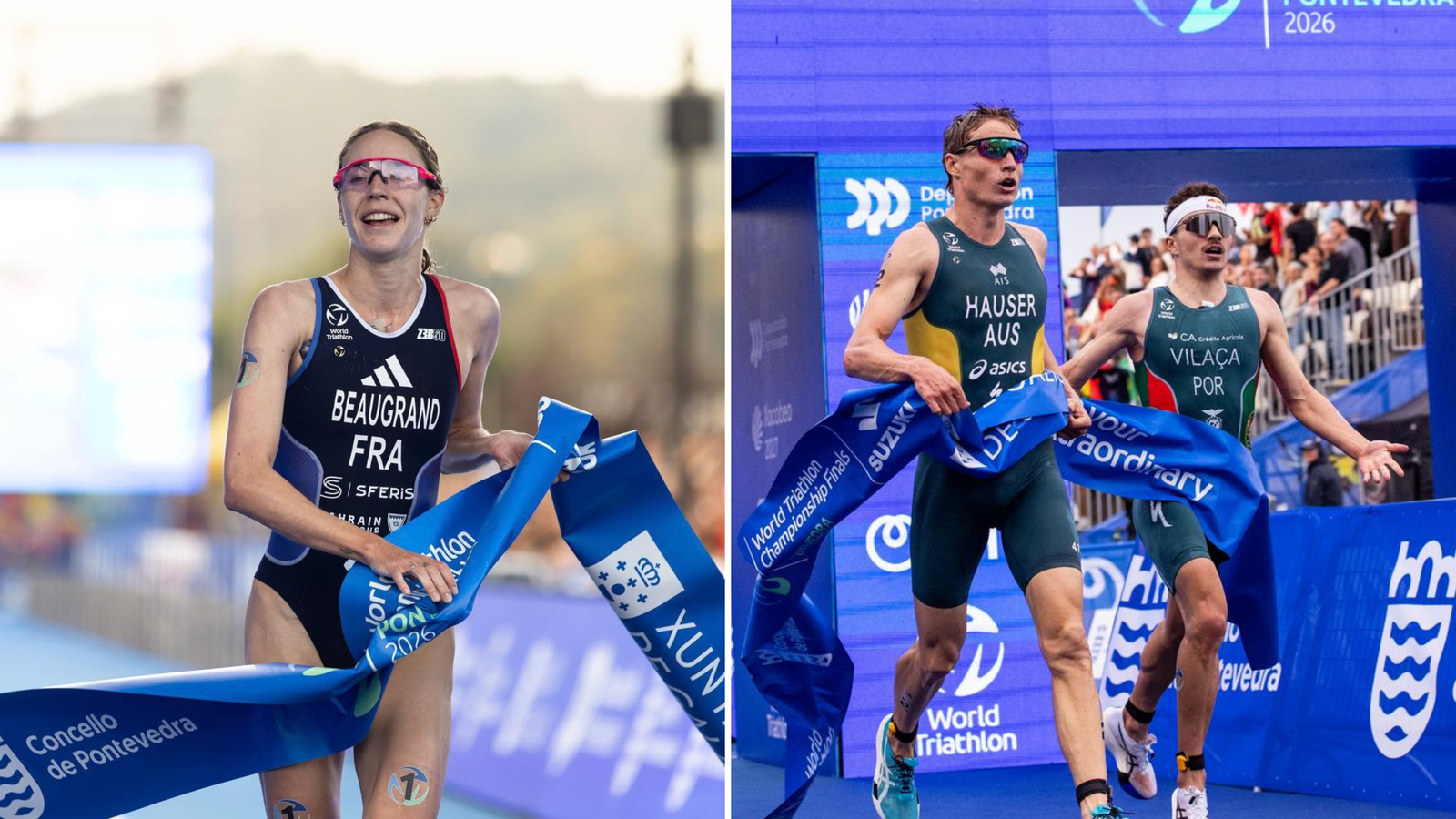
- Cassandre Beaugrand won the 2026 World Triathlon Championship Finals, completing a clean sweep of all five World Triathlon Championship Series.
- In a sprint to the finish, Matt Hauser edged out Vasco Vilaça for the win, but Vilaça still took home the men’s series.
- Great Britain had a strong showing with several athletes in the top five in the race and the series. Georgia Taylor-Brown finished second in the race, Beth Potter took second place in the overall series, and Alex Yee took third place in the men’s race.
Pontevedra provided the perfect denouement to the perfect season for French star Cassandre Beaugrand, who, just as in 2024, won every World Triathlon Championship Series race she entered; a clean sweep; five for five.
In the men’s equivalent, Vasco Vilaça won his first world title. The Portuguese was just edged out by defending world champion Australian Matt Hauser in another epic sprint finish, but achieved his objective of finishing in the top five to win the series.
Women’s race
This year there was no Olympic gold on the streets of Paris to celebrate, but following last season’s surprise disappointment in Wollongong, the cobbled streets of northwestern Spain were the stage to put an emphatic stamp on Beaugrand’s status as the No. 1 women’s short-course triathlete in the world.
“I think it was my best year ever,” the delighted 29-year-old said, having, frankly, left the field – including two former world champions – for dust at the start of the final 10-kilometer run that, despite three ascents up and through the old town and winding down for the finish, she ticked off in a race-best 32:35.
Training partner Georgia Taylor-Brown, building on her first World Triathlon Championship Series win in three years in Karlovy Vary, rushed over the line in second place and into a warm embrace. “I race with my heart not my head, but I’m just so happy and emotional to go one-two,” she said, having been the aggressor on the bike. “I’m sure our coach will be very happy with that.”
In third place was another Brit, Kate Waugh, the reigning T100 World Champion, who only rolled onto the start list 10 days ago, having been mainly focused on the longer distance this summer, and behind her – following the unfortunate disqualification of Hungary’s Márta Kropkó for inexplicably hopping on her bike too early in transition – was Beth Potter. It made it three British triathletes in the top four on the day and sealed Potter’s second place in the series, as Taylor-Brown jumped from seventh to third.
The irony of Beaugrand’s success was that she started the year by saying she wasn’t even targeting the World Series.
“I’m genuinely not joking when I say that I don’t care quite as much about my result in the series this year,” she said in August. “Of course, I want to be world champion, but will it change my life if I become world champion or not? Probably not. I’m simply going to enjoy myself.” And with the early evening sunshine on her back, enjoy herself she did.
With the race not starting until 6 p.m., Beaugrand looked comfortable from the moment they dived into the Lérez River from the pontoon for the two-lap, 1,500-meter swim. Just like last year in the Wollongong series final, British youngster Tilly Anema led out, and with Italian Bianca Seregni on her feet, the duo carved out a not-insignificant 25-second gap coming into transition.
Unless disaster hit Beaugrand, 2023 world champion Potter, who clinched that title on this course three years ago, was the only realistic challenger for the series win, and even then the Brit needed to take the tape and for Beaugrand to be off the podium.
Both were in an initial front pack of 17, and with Seregni immediately sitting up, it was just a few minutes before the one-woman breakaway of Anema was reeled in too. Taylor-Brown, with four fellow Brits for company, made her intent clear by attacking the hill of the old town with gusto through the early circuits, and the group – that included USA’s Kirsten Kasper and Taylor Spivey – quickly whittled down to a handful of contenders as the gap to the chase packs extended.
On the third lap, Poland’s Roksana Slupek caught the wheel of Germany’s Laura Lindemann, and as she went down, took out Britain’s Sophie Evans, with Evans out of the race and requiring medical treatment. Reigning world champion Lisa Tertsch was also caught up in the incident and lost contact with the leaders, as Spivey and Belgium’s Jolien Vermeylen were dropped too, leaving a front group of 10.
The attritional nature eventually proved too much for Anema and Germany’s Selina Klamt, who lost contact on lap five, and while 23-year-old Hungarian Kropkó was having the race of her fledgling career, a rush of blood meant she had mounted her bike way before the mount line in transition, and that even though she would go on to cross the line in fourth place, it would be a disqualification, not a stand-down penalty.
The run was all about Beaugrand. Given she’d set national records at 3,000m, 5,000m and 10,000m this summer, it was fitting that she made the break immediately out of a transition zone and onto a running track. From here the result seemed an inevitability, and despite long stretches beside the riverbank, she was already out of sight by the time she started the second lap of three.
Taylor-Brown was looking better than she had for years, and Potter, who faded badly in the early part of the run, fought back to overtake Kasper and Lindemann to place fourth.
Kasper, two weeks after placing 19th in the Ironman 70.3 World Championship in Nice, was the leading U.S. athlete in sixth, but the evening belonged to Beaugrand, and as she headed into the stadium, onto the running track, and down the blue carpet one last time, commentator Will McCloy wasn’t wrong in her assertion: “All hail queen Cass!”
The victory margin was over a minute as she eased up. “I wanted to win the race because it’s even better to win the race and then win the world title,” Beaugrand said. “I’m not going to lie, it will be hard to do better next year. I’m just gonna take everything from this year and enjoy it.”
Men’s race

Despite nine podiums, Vasco Vilaça hadn’t won a World Series race until April this year. But with a 2026 record that reads: first, first, second, second, second, it was a level of consistency that meant he justly finished the season as world champion.
There was another second place to add to that list after losing out to Hauser in a sprint finish in Pontevedra, as he had done in Hamburg and London – this one being the tightest yet – but it wouldn’t wipe the smile from his face.
“What got me through was staying in the moment,” Vilaça reflected. “It was just another great show together with Matt. One of the closest sprint finishes. I want to thank everyone who has been at my side the whole year. The people close to me know it hasn’t been the easiest year and I’ve had to go through some pretty rough moments, although maybe that’s not what you see at the races.”
Olympic champion Alex Yee almost stole the victory, but the effort it had taken to run himself through the field and make up 40 seconds leaving transition told in the final yards, and he had to settle for third.
Vilaça’s compatriot Ricardo Batista finished fourth, which was enough to take third overall in the series behind Vilaça and Hauser. “What a dream, having a teammate like that, someone I grew up with, running at the front of the World Series and now first and third in the world,” Vilaça added.
The biggest drama in the 1,500-meter swim was the scramble to get back onto the pontoon at the midpoint Australian exit. It appeared that the ramp had collapsed, which stalled the athletes’ attempts to get to their feet and created a bottleneck behind.
By the time they’d swum around for the second lap, officials were in place to help them out of the water. None of which seemed to overly bother Devay and Kropkó, who were first into transition, both wearing the colors of Hungary, a nation quietly turning into a triathlon powerhouse.
Hauser was in close contention, along with a usual French contingent, but the pace wasn’t enough to distance Vilaça, who sped through transition to make sure he was part of a 13-strong front group.
The gap initially extended to the two chasing packs, the first of which included USA’s Seth Rider and Jamie Legg. But as the bike leg developed, it was the next pack, mainly driven by Hayden Wilde – racing for the fourth time in four weeks following Supertri, the Ironman 70.3 World Championship and T100 French Riviera – that threatened to pull back the deficit.
Heading into the final two laps of nine, the chase packs had come together, but the extra manpower didn’t help as the gap to the front remained stubbornly at around 40 seconds.
Hauser was first in and out of transition, with Vilaça, Batista and Dorian Coninx – who had won the world title in a sprint finish on this course three years ago – tracking the Australian, and further back there was the familiar sight of Yee and Wilde running in lockstep, but this time chasing the front of the race rather than leading it.
After the first of three laps, Yee was already up to seventh place and had pulled clear of the Kiwi, and having made up almost 10 seconds per kilometer on the leaders. By the time he’d completed the second lap, Yee was with the front three of Hauser, Vilaça and Batista, but wasn’t able to run straight past.
Having run the descent from the old town for the final time, the sprint for the win seemed to start with a kilometer still to go. Vilaça, who had been pipped twice by Hauser in similar circumstances this year, was determined not to let it happen, but onto the blue carpet and the Aussie put on the burners one final time to just squeeze through and take the win.
“I was just telling myself: I can’t lose this one, I can’t lose this one,” said Hauser at the finish, who took four WTCS wins. “Firstly, credit to Vasco, what a champion. Apologies to him; I was just that desperate to get to the line first.”
Women’s 2026 World Triathlon Championship Finals results
| Swim | Bike | Run | Overall | |
| 1. Cassandre Beaugrand (FRA) | 00:19:46 | 00:56:54 | 00:32:35 | 01:50:52 |
| 2. Georgia Taylor-Brown (GBR) | 00:19:52 | 00:56:48 | 00:33:41 | 01:51:57 |
| 3. Kate Waugh (GBR) | 00:19:56 | 00:56:43 | 00:34:05 | 01:52:23 |
| 4. Beth Potter (GBR) | 00:19:48 | 00:56:53 | 00:34:38 | 01:52:55 |
| 5. Laura Lindemann (DEU) | 00:19:50 | 00:56:49 | 00:34:46 | 01:53:05 |
| 6. Kirsten Kasper (USA) | 00:19:49 | 00:56:53 | 00:34:48 | 01:53:10 |
| 7. Diana Isakova (AIN) | 00:20:13 | 00:58:12 | 00:33:18 | 01:53:21 |
| 8. Leonie Periault (FRA) | 00:20:10 | 00:58:21 | 00:33:35 | 01:53:47 |
| 9. Lisa Tertsch (DEU) | 00:19:47 | 00:58:43 | 00:33:48 | 01:53:52 |
| 10. Tanja Neubert (DEU) | 00:20:12 | 00:58:16 | 00:34:02 | 01:54:08 |
Men’s 2026 World Triathlon Championship Finals results
| Swim | Bike | Run | Overall | |
| 1. Matthew Hauser (AUS) | 00:16:53 | 00:51:31 | 00:29:33 | 01:39:31 |
| 2. Vasco Vilaca POR) | 00:17:04 | 00:51:26 | 00:29:22 | 01:39:31 |
| 3. Alex Yee (GBR) | 00:17:35 | 00:51:38 | 00:28:46 | 01:39:35 |
| 4. Ricardo Batista (POR) | 00:16:54 | 00:51:33 | 00:29:26 | 01:39:36 |
| 5. Hayden Wilde (NZL) | 00:17:44 | 00:51:27 | 00:29:39 | 01:40:26 |
| 6. Dorian Coninx (FRA) | 00:16:58 | 00:51:29 | 00:30:29 | 01:40:36 |
| 7. Dylan McCullough (NZL) | 00:17:00 | 00:51:30 | 00:30:30 | 01:40:38 |
| 8. Roberto Sanchez Mantecon (ESP) | 00:17:49 | 00:51:21 | 00:30:07 | 01:40:55 |
| 9. Connor Bentley (GBR) | 00:17:08 | 00:51:20 | 00:30:57 | 01:41:07 |
| 10. Yanis Seguin (FRA) | 00:17:02 | 00:52:02 | 00:30:20 | 01:41:08 |



