
Updated September 25, 2026 08:41PM
SUMMARY:
- For the first time in seven years, men and women will be able to race Kona alongside one another.
- While each couple we spoke to approaches the sport differently – one couple trains and races together, the other trained around work schedules and childrearing – these couples made it a priority to qualify and race together.
- Sharing the championship experience allows them to celebrate their decades in the sport together while knowing that they are both working toward the same finish line.
For most of their 21 years in triathlon, Jeff and Wendy Fejfar treated Ironman less like a couples’ activity and more like a relay.
“You do an Ironman this year, I’ll do one next year,” Jeff tells Triathlete of the arrangement they settled into for much of their marriage. “It’s always been a tag team.”
Jeff’s job as a FedEx pilot meant frequent travel, and Wendy explains that she effectively single-parented much of their son Dylan’s childhood. Her training usually fit between 9 a.m. and 3 p.m., while he was at school. Jeff chased Kona. Wendy supported him. When life allowed, Wendy raced too.
Joanna and Sebastian Borowik approached triathlon differently. From the outset, it was a joint venture. They shared a coach, followed essentially the same training plan and chose races together.
“It was always kind of a family gig,” explains Sebastian. “We’re pretty much doing all the races together and planning our season together.”
After moving from Poland to Omaha, Nebraska, in 2018 without knowing many people, triathlon helped them build a community. They found local clubs, training partners, and friends. The sport became part of how they established a new life in the U.S.
Two marriages. Two different ways of making triathlon work. Yet after 2019, Kona presented both couples with the same problem. Men and women no longer raced the Ironman World Championship together on the same day. In 2022, the championships were held on separate days in Kona. Thereafter, the championship split geographically, with men and women alternating between Kona and Nice.
For seven years, men qualifying alongside women and racing Kona on the same day was impossible. In 2026, it is back.
Ironman does not know how many couples will take advantage of it. The organization confirmed to Triathlete that it does not collect data identifying registered athletes as spouses or partners, so there is no official count for this year or historical comparison.
For the Fejfars and Borowiks, though, qualifying together has made this Kona different.
From taking turns to the same start line
Jeff got into triathlon first after the couple moved to Memphis in 2005. Neither had much swimming or cycling experience. Wendy bought a road bike when Jeff bought his first tri bike, and she eventually followed him into long-course racing, completing her first Ironman at Florida in 2012.
Jeff became the more persistent Kona chaser, racing there in 2014, 2017, and 2022. Wendy was less interested.
“I was like, ‘That’s great. I’m proud of you. This is fun. I get to vacation in Hawaii,’” she laughs.
For years, a serious Kona attempt simply didn’t fit her life.
“I don’t set goals unless I know I can actually try to work towards them,” Wendy explains.
Her own trajectory had also been interrupted. After beginning to develop into a competitive long-course athlete, Wendy suffered a bad accident in 2018 and spent the following years dealing with injuries. Her return was gradual: first seeing whether she could complete a 70.3 again, then whether she could race competitively, and eventually whether Kona could be realistic.
By the time the World Championship separated the men’s and women’s races, Dylan was older, and she had more room to train seriously. Wendy also had seen friends qualify for and race the women-only Kona.
She had previously raced an all-women field at the Ironman 70.3 World Championship in Chattanooga and remembered loving the atmosphere. Seeing friends experience something similar in Kona triggered a reaction she hadn’t expected.
“That looks fun,” she recalls thinking.
More significantly, she realized she might regret never trying.
So, Wendy went to Jeff and Dylan, then a junior in high school, and told them she wanted to make a genuine attempt at qualifying. But if she was going to create the time required to prepare for an Ironman, she needed them committed too – to help with the dogs, the house and the countless other things that still had to happen while she trained. They agreed. Their support gave Wendy the space to chase the goal, and she eventually qualified for the 2025 women’s World Championship.
“It was so cool,” she says of an all-women field. “It’s such a different atmosphere.”
As a strong swimmer and cyclist, she enjoyed not having men constantly coming through the field and found the swim less intimidating.
“I just enjoy women’s empowerment and people lifting each other up,” she says. “I think that is more prominent when you have an all-women’s field.”
She carried that enthusiasm into the last women’s-only Kona in 2025 and came away having loved the experience.
It’s important to note that this complicates the idea that bringing everyone back together is automatically better. Wendy loved her women-only Kona experience in 2025. But separating the championships also made life harder for a household containing two serious Ironman athletes.
Jeff experienced that problem firsthand. When he earned the opportunity to race in Nice after Ironman Arizona, he turned it down. Wendy had already qualified for Kona, and he could see little sense in scheduling a second World Championship trip while she prepared for her own.
“Logistically, it made zero sense,” he explains.
The return to one day in 2026 has changed that equation. Jeff entered Ironman Florida in November 2025 hoping to qualify for Kona. Wendy had raced Kona only three weeks earlier but decided to race too. Their hotel was already booked, and after years when family logistics prevented her from racing Ironmans close together, she was curious to see what she could learn by immediately applying lessons from Hawaii. There was also a simpler reason.
“I’d much rather be doing something,” she jokes about spectating another Ironman.
She came off the bike in second overall, won her age group comfortably, and earned another Kona slot. Jeff finished third in his age group and also qualified. Suddenly the tag-team couple had both punched tickets to the same “big dance.”
“It’s really cool that we get to go together,” Jeff says. “Even though race day, we’re not together, I think it’s super cool that we’re able to do it on the same day and kind of celebrate all the work that goes into it.”
The timing feels fitting. Dylan is now 19 and in college. After years of working Ironman around parenting, work, and one another, Jeff and Wendy finally have more freedom to chase the same goal on the same day.
It won’t necessarily be the Kona either imagined when they qualified. Both have been dealing with injuries heading into Kona, and Wendy freely admits she isn’t as competitively prepared as she would like. If this were another race, Jeff says, they would probably consider deferring. But Kona is different.
“I’m going to have the best day that I can for that day,” she smiles.
After two decades of taking turns, getting there together has become part of the point.
Together, or not at all
For Joanna and Sebastian Borowiks, doing triathlon separately never made much sense. Both qualified for the Ironman World Championship at Ironman Tulsa in 2021, then raced the World Championship in St. George and Kona the following year. But for the Borowiks, Kona wasn’t truly shared. Joanna competed Thursday and Sebastian raced Saturday.
“It was a pretty cool experience,” reflects Sebastian, “but from my perspective, spectating on Thursday and racing on Saturday was not really fun.”
Both had also contracted COVID several weeks beforehand. Joanna backed off her training. Sebastian tried to train through it. He paid for the decision on race day, suffering a hip stress fracture during the race.
“I definitely have some unfinished business on the Big Island,” he says.
The experience also helped clarify what they wanted from future World Championships.
In subsequent years, both continued to earn World Championship qualification but chose not to go. Nice might have offered a new destination and Kona retained its pull, but neither was interested enough to reorganize their shared life around a championship the other wasn’t racing.
“If somebody qualifies, nobody goes,” Sebastian explains. “We will not jeopardize that.”
For them, triathlon was something they had chosen to do together. A World Championship wasn’t important enough for one spouse’s opportunity to disrupt the other’s season.
So, when Ironman announced that everyone would return to Kona together in 2026, they built their season around getting there. The plan was straightforward: race Ironman Texas, qualify together, and head to Kona. Only half of it worked. Sebastian qualified in Texas. Joanna didn’t.
Normally, that might have triggered their rule; if both didn’t qualify, neither would go. But Joanna had no intention of making Texas her final attempt. Sebastian accepted his slot because she was already determined to find another race, and both believed she was capable of earning one too.
On the way home, Joanna made a new plan. She deferred entry to Boulder 70.3 and entered Ironman Jacksonville four weeks later instead. Asked whether Jacksonville felt like an all-or-nothing race, Joanna dismisses the idea.
“No,” she says. “Every race, for me personally, is for fun.” Then she adds: “It’s like a gift for me.”
Four weeks after Texas, she secured qualification in Jacksonville.
For two athletes approaching 50, the attraction is increasingly about more than a finish time. They are still improving and still learning sports neither grew up doing.
“Even at 50,” Sebastian says, “we are perceiving this to still be a journey, not just participation.”
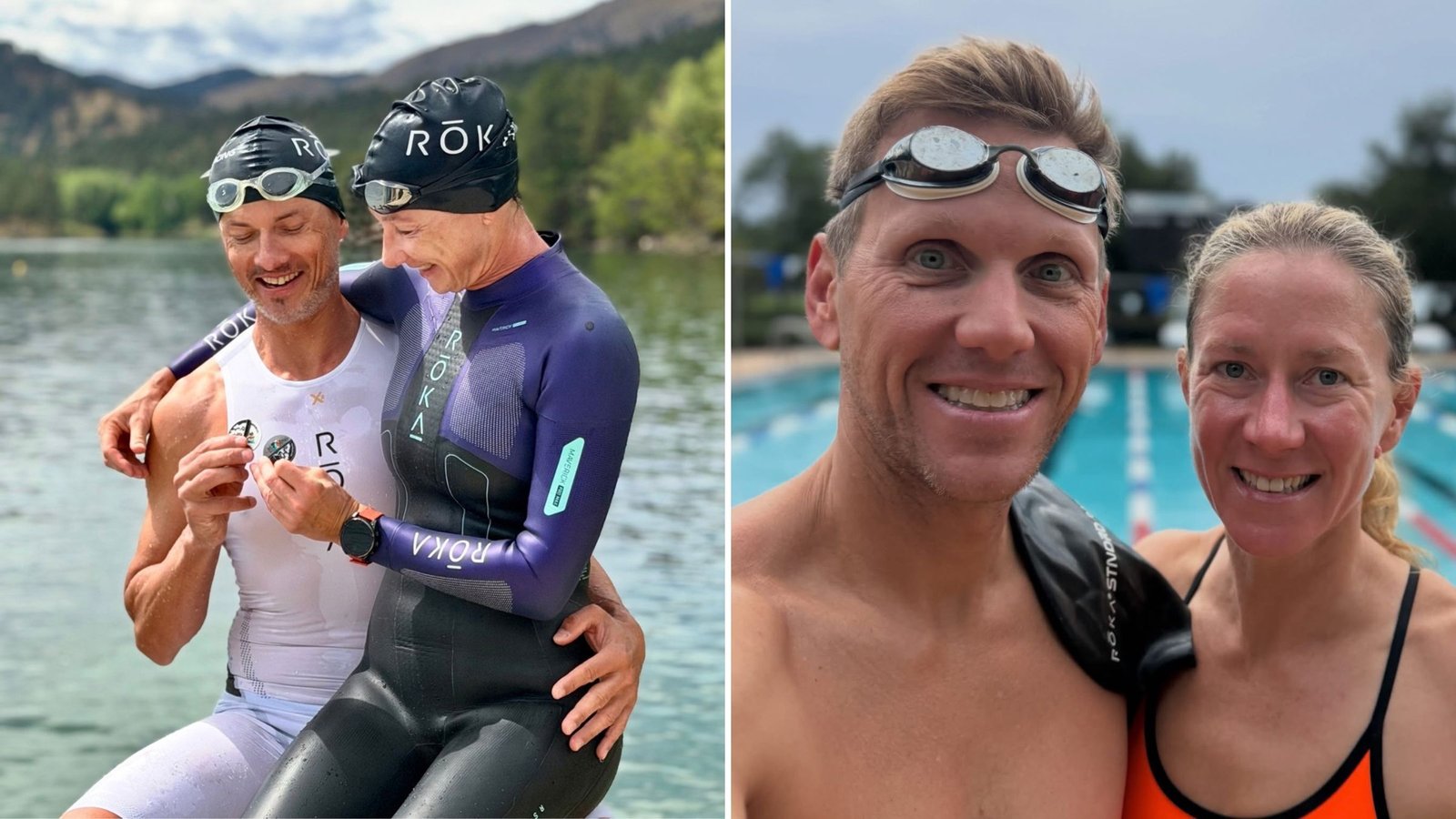
For the Borowiks, this Kona will also be about more than just the two of them. Sebastian and Joanna race with the Roka Standard Racing Team. Several teammates, including Jeff and Wendy, will be in Kona with them.
For Sebastian, that makes the return to one day feel bigger than simply putting husband and wife on the same course.
“It’s way bigger than just us,” he explains. “It’s the team, the team experience, but also just being there together on race day.”
And once everyone has made it to the finish line, there is another priority. The post-race party.
Racing alone, together
Being in Kona together does not mean either couple expects to spend October 10 side by side along the Queen K.
Wendy and Jeff joke that there isn’t much point competing over overall times because Jeff is faster. Instead, other categories are fair game: transition times and age-group placings.
“We’ll skew the data the best we can to make it competitive,” laughs Jeff.
Joanna and Sebastian describe themselves as similarly uncompetitive on race day. The more spirited discussions tend to happen before the race, particularly around training plans and how sessions should be approached.
Come race day, the main concern is simply seeing each other.
“When I see her on the bike, I think it’s like, ‘OK, she’s safe,’” Jeff says.
An Ironman is too long and draining for much more. There might be a high five on the run or a quick word of encouragement. Mostly, each has his or her own race to manage.
Joanna and Sebastian understand the reassurance of seeing each other on course especially well. At a race in Chattanooga, Sebastian crashed on the bike and broke several ribs. Their race numbers were close enough together that she might have recognized his belongings sitting untouched in T2. Before heading for medical care, he asked race staff to remove his run gear so Joanna wouldn’t see it and realize he had abandoned it.
“I was thinking that may break her race,” he recalls. “I wanted her to finish.”
Joanna still sensed something was wrong. Normally they looked for each other on out and back sections. Sebastian was nowhere to be seen.
“I saw many people, but not my husband,” Joanna recalls. “Where is my husband?”
Only after she crossed the finish line did she learn he was in the hospital.
That, perhaps, is what racing Kona together means: not spending 140.6 miles alongside your spouse, but just knowing they are somewhere out there, too.
Two pieces of the same Kona

One object in Joanna and Sebastian’s home captures the idea neatly. Men and women who qualified for the 2026 Ironman World Championship received different Kona qualification coins. The two pieces fit together.
Sebastian held theirs up during our interview and showed how they interlocked. For a couple who had spent several years declining World Championship opportunities rather than experience them separately, the symbolism was hard to miss.
Ironman confirms it was intentional. The men’s and women’s artwork was designed to be cohesive, with the pieces deliberately made to interlock. The concept ties into the 2026 World Championship theme, Ho’olōkahi, representing unity, harmony and peace.
For the Borowiks, the meaning is simpler.
“It was an awesome idea,” Sebastian says. “Men and women, they should always be together, and we are together as a couple.”
He holds the two pieces. “We can be there together.”
For the first time since 2019, so can every other man and woman who managed the unlikely feat of qualifying for Kona in the same year.



