
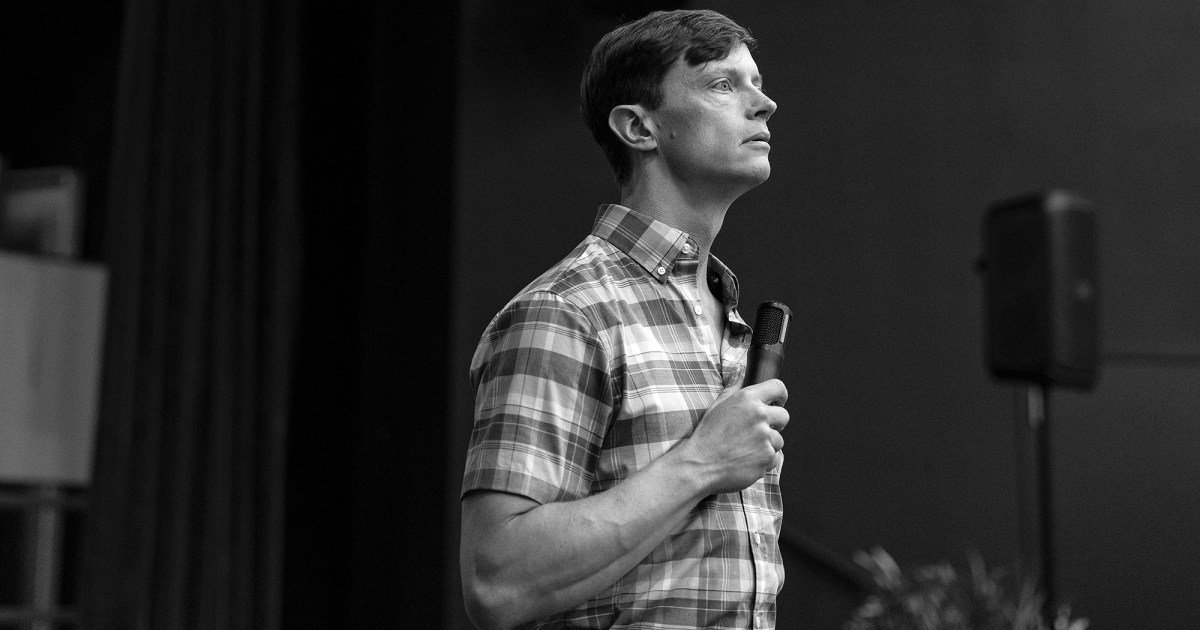
The most unusual ritual in American politics in the scorched and cynical runup to the 2026 midterm elections takes place as often as five times a day—in restaurants and breweries, in rec centers and old churches, in train depots and art spaces, and in at least one possibly haunted pioneer museum—when Rob Sand, the 44-year-old Democratic nominee for governor of Iowa, asks someone in the audience to hit a note.
“It starts, ‘Oh beautiful, for spacious skies,’” Sand reminds them. “I will not kick us off.”
He has been building up to this moment since he first grabbed the mic. Sand, a trim and uncannily youthful state auditor with a shock of light brown hair, starts every appearance on his 99-county tour with an invective against the “two private clubs” that dominate politics. The major parties win by convincing us to “be scared of our neighbors,” he says. So he leads a round of applause for the Republicans in the room, and for the independents and Democrats, too. Finally, to “show each other that we can actually work together,” he invites everyone to sing the first verse of “America the Beautiful.”
Someone might whisper “Vicky!” or “Amy!” a little too loudly, and then someone else (Vicky? Amy?) gets it going. Some people close their eyes. Some look around. But by the end—in two-stoplight towns and urban satellites alike—they are starting to sound alright. In the back room of a speakeasy-themed bar on a courthouse square in a Missouri River county that Donald Trump carried by 39 points, an older man in a shirt that says “Iowa: We all are going to die” tells the candidate that he and his wife have “been harmonizing for 43 years,” and Sand, after savoring the moment, poses a variation of the same question he often asks:
“What if politics just felt like that all the time?”
You may have noticed that it does not.
Set aside the constitutional crises and the democratic backsliding and the corruption, and just consider the vital signs: Trust in Congress is at a modern low of 9 percent; just 17 percent of Americans believe elected officials care what voters think; more than a third report losing relationships with friends or family over politics. If this civic miasma has left the country grimmer and scarier, sleepless and vengeful and suspicious and just generally feeling bad, well, it has also done a pretty poor job of addressing the actual problems that make people feel even worse.

When I tagged along for 10 campaign stops over three days just ahead of the nation’s 250th birthday, the subjects Sand was asked about most often were toxic water, cancer, data centers, and a succession of healthcare horrors. Iowa is No. 2 for cancer-rate growth and 48th in economic growth. It has been teetering on the edge of a recession for more than a year, battered by a trade war with the world and a not-a-war with Iran. Its public schools, once memorialized on the state quarter, are sliding down national rankings, as teachers battle book bans and legislators drain the budget to pay private school tuition for kids who already attend one. Farmer bankruptcies are rising. The population in much of the state is shrinking. Iowa is dead last in OB-GYNs per capita, and one of the nation’s most restrictive abortion laws is keeping it that way. For these reasons and many more, 49 governors had a higher approval rating last year than Iowa’s retiring Republican, Kim Reynolds. The state was once synonymous with participatory democracy. Now its politics is stagnant and beginning to stink—an algae bloom where a reflecting pool once stood.
His tone may be pitch-perfect and his policies may strike a balance between doable and desirable, but Sand is above all an uncommonly disciplined politician trying not to get burned.
Sand doesn’t talk much about what’s happening in Washington. But he argues that Iowa’s leaders have prioritized power grabs and culture wars over problem-solving and that it’s time to “rotate the crops” after nearly a decade of one-party rule. Voters seem ready to give divided government a try. This November, Democrats expect to finally break the GOP supermajority in the state House. The race for US Senate is an unexpected toss-up. And Sand has a narrow edge in his bid to be the first Democrat to be elected as Iowa governor in 20 years.
But that’s where it gets a bit more complicated. Because if Sand is on familiar ground in his indictment of Republican governance, he and his fellow Democrats are more divided on how to turn the page. Much of the left, in much of the country, is fixated on payback and power—governing trifectas and sweeping reforms. Even mild-mannered 77-year-old Sen. Ron Wyden of Oregon is promising “Nuremberg 2.0.” Sand strikes a different chord.
For much of his career, Sand has been discussed, often outside Iowa, as a kind of electoral cheat code—a bowhunting, churchgoing, small-town Democrat whose background and congeniality could reclaim the party’s beating heartland: “The Democrat Who Republicans Fear in Red-State America,” as The Wall Street Journal once called him. And in a key sense, they’re right; he has two statewide wins to prove it. But for even longer, Sand has been, sometimes quietly and sometimes very publicly, arguing for something else. Temperamentally evenhanded, he is a zealot about polarization. Sand does not want to turn a red state blue, he insists. He wants to be the candidate who gets you to stop thinking like that altogether.

Sand grew up in Decorah, a college town of about 7,500 in the state’s far northeast corner, nestled amid rolling hills on the outdoor enthusiast’s paradise of the Upper Iowa River. Decorah is scenic, fairly liberal, and famously Norwegian—a place where people joke about being in mixed marriages because they ended up with a Dane. Sand’s mother was a physical therapist. His father was a doctor. Before I could ask the mayor, Andy Carlson, how he knew the family, he told me that Dr. Sand had delivered him.
As a teenager, Sand dabbled in improv and caught capons at a poultry barn for $5 an hour. He sometimes tells crowds he learned the power of democracy as a skateboarder. “He’ll probably get mad at me for saying this, but they were, like, skating off Darin Peterson’s roof,” Carlson recalls. (“It was a low roof,” Sand told me.) Sand met with the parks and rec director about building a skate park, pitched the city council, and got buy-in from local businesses tired of kids loitering on their curbs. The experience, he says—using words no one has ever used to describe a quarter pipe—fostered “a belief that our system of self-governance can help us solve problems together.”
This appeal to common ground is impossible to miss at Sand town halls. Every line on his résumé becomes a lesson in unexpected harmonies. There was his decision to re-register from an independent to a Democrat (in part because President Bill Clinton balanced the budget with Republicans). The decision to name his second son Axel (it means “father of peace”). And his decision to leave the Iowa attorney general’s office to run for auditor (because CPAs could use a prosecutor in the office).
Notwithstanding the skateboarding-off-roofs thing, or maybe because the skateboarding-off-roofs thing comes wrapped in a Tocquevillian gloss, Sand has acknowledged that “some people think of me as a bit of a square.” That includes his brothers-in-law, who nicknamed him “Baby Jesus,” and his wife, Christine, who compares him to Mr. Rogers. He is a teetotaler from the Upper Midwest who went to Brown University and never smoked pot. Sand’s TV ads over the years have leaned into this affect, depicting him as a paragon of Nordic efficiency, turning off the lights on his showering wife and holding a stopwatch as he chops onions.

But looks can also deceive. A Brown professor from that time, John Tomasi, recalled his first impressions: “tall, skinny, huge blue eyes, the worst hair I ever saw in my life.” Tomasi thought Sand’s mother had cut it with a bucket over his head, only to discover that Sand had been moonlighting as a model in Europe and that the mop was the work of a renowned stylist “with a single name, like ‘Chago’ or ‘Chara.’” Sand began modeling shortly after arriving at Brown, looking to make a quick buck. He graced the pages of Arena Homme+ and Vogue Italia and posed for Terry Richardson in an ad called “Adole-scents.” Sand, in his book, wrote that such experiences “taught me about where I feel at home.”
The origin story of overcoming differences came at Brown, where Sand went door to door to introduce himself to the entire freshman class and penned a generally liberal column for The Brown Daily Herald. One day during his sophomore year, Tomasi arrived at his office to find Sand waiting with another classmate—Stephen Beale, a founder of the conservative Brown Spectator.
“It was the most unlikely couple I could have imagined on campus,” Tomasi recalls. “What they said to me was that they never had a course at Brown that would help them understand why an intelligent person could be a Republican.”
The result was a student-led seminar on contemporary conservative thought. A draft syllabus Beale shared with me featured readings from Edmund Burke and Friedrich Hayek, but also Pat Buchanan and the founder of the anti-immigrant website VDARE, Peter Brimelow. “What made [Sand] distinctive was his desire just to understand the other side,” said Beale, who could recall only one session that sparked a heated argument: their discussion of The Bell Curve, the 1994 book purporting to link race and IQ. “He really criticized that.”


There was a part of me that wondered, as I watched every aspect of his life story become a parable for common ground, if Sand wasn’t laying it on a little thick. Iowa Republicans certainly think so. But flip over any rock and you find the same bugs. He used his college thesis to argue that public financing of elections could transcend ideological divides. At 22, he wrote a letter to The Gazette in Cedar Rapids making the case for “honest, straightforward discussion” to overcome polarization. And for one month in 2007, while building houses in post-Katrina New Orleans, Sand kept a blog.
It was in many ways a twentysomething’s chronicle of a twentysomething’s pursuits. But a familiar tone poked through. He was eager to answer questions, “even especially the antagonistic ones!” Sand pored over news reports and policy papers and concluded that the cure to the storm-wracked city’s ills lay in electing “problem-solvers instead of politicians.”
As the 2008 Iowa caucuses loomed, Sand, now in law school, made his debut in the national media as an electoral talisman. He was a “typically overscheduled twentysomething,” Newsweek reported—an exemplar, the magazine noted in a follow-up story, of a voting bloc “theorists call ‘millennials.’” While Sand had chosen to model in Milan four years earlier instead of caucusing for Vermont Gov. Howard Dean, he was determined not to miss out on the caucuses again.
“Dean was polarizing,” Sand explained. “Obama brings people together.”

In hindsight, Barack Obama might have given a lot of people the wrong idea. The 2008 caucuses were the springboard for hope and change and turned Iowa into a fleeting symbol of bridge-building possibility. Obama carried the state twice, handily. Sand is the only Democrat to win an open statewide race since, and presidential results have not been close. Some of the biggest rightward shifts anywhere in the Midwest came in Sand’s backyard. While Decorah went nearly 2-to-1 for Kamala Harris, its county swung from Obama +23 in 2008 to Trump +9 in the last election.
Sand sometimes addresses this change by asking his interrogator a question of his own: What did Obama and Trump have in common? His answer is that they rejected the status quo. This can take you only so far. (How similar are Reconstruction and Jim Crow?) But it underpins a deeper argument—that Iowa was never as “blue” as Obama made it seem, nor as “red” as Trump’s successes might suggest. Its true heritage, Sand argues, is a culture of give-and-take: Tom Harkin and Chuck Grassley; divided government; independent redistricting; public town halls where a voter can stand up, like the man in the Norman Rockwell painting, and tell a gubernatorial candidate that it is time to create a special hunting season just for crossbows. Iowans still don’t feel served by the status quo, Sand believes. His events are crafted to make them feel at home.
At the town halls, after the group finishes singing, Sand speed-runs through the rest of his unlikely-bedfellows story. There was his career as a white-collar prosecutor (mentored by a Republican) and his successes as auditor, in which he started a government efficiency program that was copied by a Republican in Mississippi. (It is nothing like DOGE; Sand delivers homemade pies to school districts and local governments that find innovative savings.) Then partisanship struck.
Following Sand’s 2022 reelection, wary of his ambitions or maybe just tired of his investigations, GOP lawmakers gutted the auditor’s power to conduct oversight of state agencies. Sand says he is running now in part because they left him with little to do. Republicans, anticipating he will win, have already moved to limit the next governor’s powers. This is emblematic, he argues, of a decadelong trend of Republican leaders in Des Moines using their power to consolidate even more of it, usually at the expense of other governmental bodies.


“Power corrupts,” he begins, “and absolute power—”
The choir finishes the sentence: “corrupts absolutely.”
Early signs look promising for Iowa Democrats. Last year, the party flipped a state Senate seat in a district where Trump won by 11 points, breaking a GOP supermajority. Doug Gross, a former chief of staff to Republican Gov. Terry Branstad, told me Sand was Democrats’ most impressive candidate in years—someone who could speak to voters’ “dissatisfaction” while bridging cultural divides. In Council Bluffs, I met the kind of voter Sand’s campaign dreams of: a young Republican who brought his mother to the event after listening to Sand talk about tracking a 206-inch buck through Des Moines on a podcast called MeatEater; he liked what Sand said about partisanship. J.D. Scholten, a populist state representative who nearly flipped a deep-red congressional seat in 2018, calls Sand a “model of how to run in the Midwest area right now.”
Most of Sand’s proposals, such as his promise to reverse Medicaid privatization or to require private schools that accept voucher funds to open their books to auditors, are not revolutionary. That’s the point. He wants people to make peace with divided government and acknowledge that the “broken clocks” in their communities are still right twice a day. If Trump 2.0 represents the culmination of an era of declining political trust, Sand offers a vision for how to get it back. It means mandatory prison time for public officials who steal public funds and mandatory town halls for every statewide politician.

The only time you’ll catch Sand calling for radical structural change concerns the partisan electoral system itself. Sand recommends a 2020 book called The Politics Industry, by Katherine Gehl and Michael Porter, which argues that the two-party duopoly drives toxicity and inaction by warping incentives for cooperation. The book proposes a two-tiered reform: The top five candidates advance from an open primary, and voters use a ranked-choice system to sort the finalists in the general election. It’s similar to the system currently used in Alaska—an oasis of power sharing and independents.
Sand’s favored variation—when we first met, he described it as “a piece of what Alaska does and a piece of what Fargo, North Dakota, was doing”—would see the general election conducted under what political scientists call “approval voting.” Vote for every one of the five you’d be okay with; the most-approved candidate wins.
“If you made me king for a day…that would be it,” he says. “When we have a political system that actually is oriented to solve problems, we will have fewer problems.”
Sand’s talk of “two private clubs” can make for a sometimes-awkward arrangement with the one he is ostensibly leading. At many of his events, a field organizer who says she met Sand after forming a college study group devoted to cross-partisan news analysis (there is a Rob Sand on every campus) invites attendees to volunteer with the Iowa Democratic Party’s coordinated campaign. Then Sand takes the mic and says parties are ruining America.
Sand told me he intended to pull his weight with party fundraising but wasn’t going to lighten up. “I think there’s a lot of people—and I’ve heard from some of them multiple times—who don’t like the way I talk about the system,” he says. “They don’t like some of the phrases that I use, and so they tell me that. But I take their calls and I answer their text messages. I treat them the way that I would want to be treated, and it’s okay for us to have disagreements. At the end of the day, there are some people who want me to be, quote unquote, ‘more of a Democrat.’ I am who I am.”
His tone may be pitch-perfect and his policies may strike a balance between doable and desirable, but Sand is above all an uncommonly disciplined politician trying not to get burned.
No one in Iowa expects Democrats this year to win a trifecta of the sort that has remade the politics of neighboring Minnesota and Illinois. But when I asked Sand whether he would like one down the road, he gave a long answer that included a description of the class he designed at Brown and a leadership seminar he once attended but did not include the word “yes.” Even when he is being a company man, he can go to great lengths to avoid sounding like one. In 2020, worried that Republicans might tamper with the state’s independent redistricting system, Sand encouraged people to vote for Democrats “to stand up for nonpartisanship.” When he talks about downballot races this year, he says Republican leaders have told him that they want smaller majorities.
“I’m not someone that runs around saying that the answer to 10 years of one-party control is to give the other party 10 years,” he tells voters. “If you think that that’s the answer, I invite you to visit California or New York. There, you will find problems. Some of those problems are different because the parties are different, but many are the same because human nature is the same.”
Although he does not spend all that much time punching left, it is not hard to find areas of significant friction. While Sand has vowed to veto any “culture war bill” that comes to his desk, like California Gov. Gavin Newsom, he’s on board with barring transgender athletes from participating in girls’ high school sports in the name of “fairness”—something Iowa’s Republican leaders have already done. He does not think soda and candy should be covered under food stamps and said at one town hall that “I don’t understand why people in my party ever wanted to ban private health insurance.”

For his running mate, Sand picked Dave Muhlbauer, a cattle and hog farmer from a big Democratic family who serves as supervisor in a county that went 71–28 for Trump—a “bridge builder,” Sand says. But he sometimes tells crowds that he thought seriously about picking a Republican or an independent. When I asked what the sticking point had been, he said, “I don’t want to get super into it” and sort of looked up at the ceiling for 10 seconds, as if trying to decide whether he really did. Sand eventually asked to go off the record. On the record, he’s said it was “hard to do, given some of the issue divides in the parties,” and there was difficulty in finding “folks where you have a demonstrated record on an issue, where there is still overlap.” The parties, after all, are different.
The one thing voters across the political spectrum seem to want to talk about in Iowa right now is whether their water is slowly poisoning them. For years, the state’s cancer rates have been rising while its water quality has been deteriorating. Researchers have placed at least part of the blame on industrial agriculture, which spreads nitrates, forever chemicals, and pesticides into the air, soil, and streams.

“It’s killing all of us—everything, not just our children, our animals,” a woman told Sand in Council Bluffs. A voter at the same event told me, “They took away all the sensors so we don’t know what’s in the water,” which sounds conspiratorial but more or less happened: As the water crisis intensified, Reynolds and the legislature slashed funding to the University of Iowa’s monitoring system, forcing nonprofits and counties to pick up the bill. Test no nitrates, see no nitrates.
More than just a public health threat, the loss of something so elemental represents a massive failure of self-governance. The election could hinge on what kind of solution Iowans want. Sand, when discussing the state’s years of inaction, evokes Jesus confronting the money changers: “I would love to flip some tables over on water quality in the state of Iowa.” But he has not been the loudest voice on the issue. During the year Sand spent developing a policy, the ultra-MAHA Republican nominee, Zach Lahn, was explicitly linking cancer with monopolistic corporate agriculture. Sand doesn’t call out Big Ag, nor is he picking a fight with the Iowa Farm Bureau by floating punitive measures. When cancer comes up, he acknowledges the toxins in the water but often broadens the list of culprits to include alcohol, smoking, and radon. Sand’s most ambitious idea to clean the water is to provide more incentives for farmers to participate in conservation programs like wetlands restoration. Cooperation.

This is a neat distillation of Sand’s long-standing approach to most structural problems. There is an aversion to bluster, an emphasis on deliverables, a belief that stakeholders often accused of standing in the way would work collaboratively if politicians would let them. It also happens to be the area where Sand’s biography is most vulnerable to a populist critique. His current campaign, like all of his previous ones, is heavily financed by his wife and her family, the Lauridsens—owners of an Iowa conglomerate that makes additives for soup stock and pet food, among other things, and that Christine Lauridsen Sand currently runs as CEO. The Lauridsens have contributed $11.5 million to Sand’s gubernatorial run, including $7 million before he officially announced. In a 2022 contest that he survived by 2,893 votes, family money helped Sand outspend his opponent 40–1.
Lahn, who upset a Trump-backed congressman in the primary by castigating hedge funds and corporations, told voters at the Iowa State Fair that Sand had been “coronated” because of his wealth and was propped up by a company “which, by the way, makes a lot of the products that end up in our streams and are causing sickness in our state.” The Lauridsen Group declined to comment, but Sand, challenged by a voter at a recent town hall on this idea that his secret ingredient is literally a company that makes secret ingredients, argued that the firm reduced the industry’s excesses by turning waste products into commodities. The family’s money was real, but so were his grassroots contributors; at last count, Sand pointed out, he even had more small-dollar Republican donors than Lahn. Ultimately, it was about trust.
Could Sand, the voter demanded, really separate his family from his responsibilities? “Watch me,” he said.
These questions of who is really what they claim to be hang over the race. Lahn maintains that Sand is using an agreeable disposition and affinity for gas station pizza to mask a secret California-style liberalism. Sand’s most persistent argument against Lahn is that he is an interloper, a “part-time Iowan” who commutes by private plane from Wichita, and in fact has poured his own considerable fortune into the race. (Sand does not generally add, but could, that Lahn moved to Kansas after fighting Medicaid expansion in Montana on behalf of the Koch network, then founded a private school funded by fertilizer magnate Chase Koch and later—after both men divorced—married Koch’s ex-wife.) Sand’s Derek Zoolander era has also come in for a critical reappraisal. At a community center in the town of Harlan, as Sand asked for donations to combat negative ads, an elderly lady in the front row interrupted to ask very nicely if he had really been “a European underwear model.”
“For starters, I’m American,” he said. He changed the subject to volunteering.

Listen to Sand for long enough and you might start to notice that something important seems to be missing from his diagnosis of America’s fraying civic culture. Perhaps some larger force, or figure, pushing people toward cruelty and division. Across the 10 events I attended, Sand spoke for more than nine hours and mentioned Trump zero times. When I asked him about it, he looked at me like I had grown a rack of antlers.
“Why would a guy who is the state auditor, who is running for governor, talk about the president?” Sand says. “Like, this is one of those really big-picture things where I think, again, I’d really like all of us to totally hit the reset button.”
In fact, Sand does talk about how policies in Washington are hurting Iowa. Lahn’s practically giddy support for DOGE, and its attendant slashing of cancer research and food assistance, seem to be fair game. The One Big Beautiful Bill Act, which is throwing rural hospitals into further crisis, is toxic, too. But he insisted to me that the man behind it wasn’t worth his time: “People know who the president is—I don’t need to remind them.”
In an era when the stench of national politics has seeped into every facet of life, it is jarring to go to a political event that avoids it entirely. But it wasn’t just Sand. The singing seemed to have an effect. The closest anyone came to uttering Trump’s name was a woman who brought up the “dictator-friendly Republican Party.” Sand gently cut her off. “I want to bring a lot of people in, and we’ll just talk about Iowa,” he said. That was that.
But if Sand can avoid talking about Trump on the trail, he would find it harder to avoid dealing with him in office. The administration has subjected Democratic governors to federal investigations, blocked their projects, denied their requests for disaster relief, and sicced masked agents on their communities. Sand speaks about the administration’s militant crackdown on immigrants sparingly. Would he cooperate with ICE like the current governor? Sand didn’t want to compare himself to Reynolds, he told me: “I’m happy to cooperate in doing good things. I’m not going to cooperate in doing bad things.” I brought up the mass deployments to Illinois and Minnesota. What, I wondered, had Sand learned from that experience?
“I guess if we had those situations here in Iowa, I’d just be interested in assessing them as they are happening here, assuming they would be the same,” he told me. “Obviously, the tactical decisions at the federal level have changed a lot since then, and so I don’t think that we would find ourselves redoing what happened there, and I don’t want to prejudge what might be happening in Iowa later based on what happened there.”
Sand wants a chiller civic life. A politics you can escape from at Thanksgiving, rooted in the idea that more of us would be singing the same tune, more of the time, if the incentives were simply better aligned. Sometimes he’ll literally just offer the mic to a Republican in the room to say whatever they want. And, as if to prove his point, it’s often kind of boring.

But it is also hard to avoid the sense that one reason Sand so studiously avoids touching the stove is not because the stove is a construct we really need to get away from or because Iowans really aren’t that interested in the stove, but because the stove is actually very fucking hot. His tone may be pitch-perfect and his policies may strike a balance between doable and desirable, but Sand is above all an uncommonly disciplined politician trying not to get burned.
At the last stop on my tour, a reporter asked him about the Supreme Court’s decision that week to uphold birthright citizenship. It had been the correct decision, Sand said, but it should not have come to that. The reasons it did get so far are worth acknowledging, though. Surely someone who has read Pat Buchanan and Peter Brimelow understands that there is a powerful political movement that doesn’t want to play nice and doesn’t want to harmonize. How, I asked Sand, could he expect to overcome these forces without confronting them?
“I don’t think that reflects most people, I truly don’t,” Sand says. “I think that the vast majority of people, they’re supporting the party they’re supporting because they agree with it more—but that doesn’t mean that they’re thinking that it’s doing a bang-up job.”
And then, just like that, he returned to a more comfortable space. “Look at how low the Democratic Party’s approval ratings are,” he says. “A lot of that’s from Democrats. Why? Because our two-party system sucks at solving problems. People want results.”
If you are a podcast-ready, 44-year-old white male pushing a New Kind of Politics, people are inevitably going to start to talk about what comes next. The chatter has followed Sand since college, when friends speculated that their buddy would run for president. Twenty years ago, when Sand ran Denise O’Brien’s campaign for Iowa ag secretary, she says she believed even then “that Rob would be our governor.” In his first year as auditor, he was already being followed by a Republican tracker. In May, The New York Times included Sand on a list of possible 2028 presidential candidates. Sand is, depending on the publication, “the most dangerous Democrat in Iowa,” the party’s “bowhunting influencer,” or maybe even “Kennedyesque.” Sand is also, according to Sand, kind of tired of being talked about like this.

“People from somewhere else talk about it like they’re from somewhere else—I’m the state auditor in Iowa, I’m running for governor,” he protested when I asked about his national reputation.
Some of the frenzy of interest and speculation, however, is self-inflicted. It was Sand who pitched a profile of himself to the Times after he was elected and took the reporter bowhunting. One supposes a reporter for The Atlantic did not end up sitting shotgun in his truck three years ago after a day of hitchhiking.
“I know that there’s a lot of people who pay attention to all this stuff, and they get excited about it, even if it has no impact on their life because it’s half a country away—I probably would have described myself that way a long time ago,” he says. “But as I have gotten more and more responsibility, I’ve had to narrow my focus of the things that I read about or care about, because I really can have an impact if I know a lot about stuff that’s happening right here.” Politics is “a hobby for a lot of people,” Sand says; Iowa is life.
But if the job he really wants is indeed the one he’s running for right now, his story resonates outside the state because of the question Sand invites people to answer. It is one that Democrats have been asking for 10 years, and forever—both in Iowa and about it. It is not really so different from the impulse that once compelled a 25-year-old law student from Decorah to triumphantly email a Newsweek reporter hours after Obama won the caucuses and promised to move “beyond the bitterness and pettiness and anger.” It is the dream of a Different Kind of Democrat, someone strong in the ways people think of them as weak, a unifying figure from the heartland who can clear away the fog and leave you wondering, if only for a moment, What if politics just felt like this all the time?



