
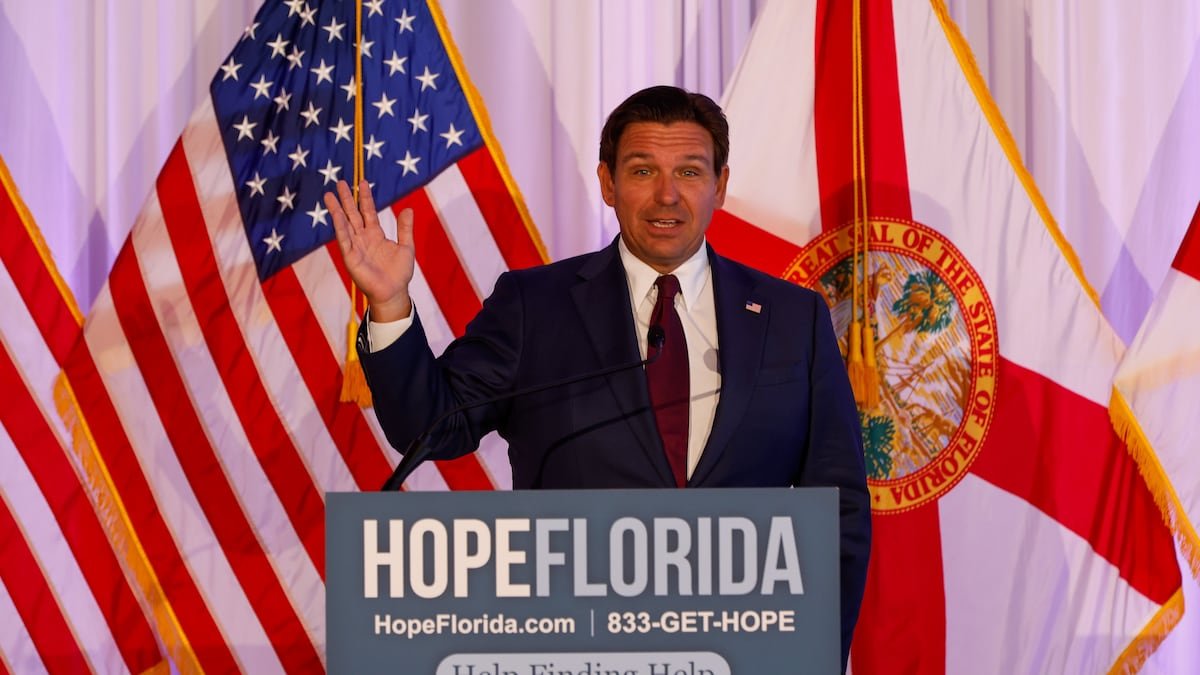
TALLAHASSEE — A Florida appeals court on Wednesday issued an opinion lambasting a Tallahassee grand jury’s report on Hope Florida, with the appellate panel declaring the jury inappropriately accused people of criminal behavior and the state violated confidentiality laws.
The 1st District Court of Appeal, in its opinion, sided with Gov. Ron DeSantis’ administration in the Hope Florida saga, which began after the state arranged for $10 million from a Medicaid settlement to go to the Hope Florida Foundation.
Most of that money quickly ended up in an anti-marijuana political committee controlled by DeSantis’ then-chief of staff, James Uthmeier. (DeSantis later appointed Uthmeier as Florida’s attorney general.)
The grand jury report, initiated by State Attorney Jack Campbell’s office, was filed under seal but later leaked. It said the $10 million transfer was “misappropriated” taxpayer money. But the jury declined to recommend charges against anyone it said was involved in a “sophisticated scheme.”
The appellate court pushed back in a majority opinion, saying the $10 million was “never public money,” and the transfer was a lawful executive action by the state.
The three-judge panel, made up of one judge appointed by DeSantis and two appointed by former Gov. Rick Scott, ordered that the report be expunged in its entirety.
On social media, DeSantis said the ruling was the “judicial equivalent of a death-by-firing squad to the Hope Florida Hoax.”
The court, in an opinion authored by Judge Lance Neff, said the report went beyond the grand jury’s authority and that its disclosure violated confidentiality rules. It also said the report was “inconsistent” and “error-ridden,” pointing to what the judges said were spelling and mathematical errors.
“A grand jury may investigate and report, but it may not declare conduct unlawful and then decline to charge it, and it may not condemn people by name without indicting them,” the appeals court wrote in its opinion.
The court took issue with the grand jury branding people as part of a “scheme” and identifying some of them as moving the money “all while conceding the grand jury lacked evidence to criminally charge anyone.”
Neff was appointed to his position by DeSantis in March 2026.
The governor’s office celebrated the decision as “Complete and Total Vindication” in a statement. Uthmeier’s office did the same, calling the report a “complete and total victory.”
Behind-the-scenes battle
The grand jury’s presentment was never made public by any Florida court. Instead, CBS Miami published the leaked report in late August.
State law requires that grand jury reports naming a person, but not indicting them, be kept confidential until an “individual concerned” can weigh in on whether they want the report suppressed.
According to the appellate court’s decision, on Jan. 28 and 29, the state attorney’s office in Tallahassee sent the report to “at least” 49 people it believed were entitled to a copy.
In July, a Tallahassee circuit court issued an order to expunge 112 pages of the 116-page report, according to the opinion. But it denied full expungement.
In August, a group of people named in the grand jury report appealed the decision to only partially redact it. On Aug. 25, the appellate court granted their petition, and prohibited State Attorney Jack Campbell from disclosing any grand jury matters.
The next day, CBS Miami published a copy of the report.
The appellate court said that some of the people who got the presentment in January from Campbell’s office should not have received the confidential document.
That included a recipient mistakenly included “who had nothing to do with the proceeding,” the court said, as well as state Rep. Alex Andrade, the Republican committee chairperson who investigated Hope Florida in 2025.
The court said the unredacted copy reaching the press “only confirmed the harm” by the office’s breach of confidentiality. That violation of the law, the court suggested in its opinion, was partly why it ordered the report be expunged.
Who wanted it secret?
The opinion doesn’t detail what, if any, arguments the judges heard before reaching their conclusion. The end of the appellate ruling lists the acting attorney general and the chief deputy solicitors general, who represented the state, as well as seven individuals and one group, indicating that they were involved in the legal fight.
That includes Uthmeier; Katie Strickland, the then-deputy chief of staff for DeSantis; and Jason Weida, the then-head of the Agency for Health Care Administration.
Others include two current judges, Andrew Sheeran, who was appointed by DeSantis to the 2nd Judicial Circuit; and John Guard, whom DeSantis appointed to the 2nd District Court of Appeal.
Mark Wilson, the executive director for a Chamber of Commerce nonprofit that received a $5 million Hope Florida grant, was also listed, along with Frank Walker, another member of the chamber’s political team and their affiliated organization, Secure Florida’s Future.
What’s next
The court’s decision is a victory for DeSantis, Uthmeier and their allies, who have long defended the state’s decision to move $10 million through the Hope Florida Foundation. The foundation was set up to support the Hope Florida program, a signature initiative for first lady Casey DeSantis that aims to connect residents with help from private community organizations instead of government services.
The ruling comes a month before November’s midterm elections. Democratic office seekers, including a challenger running against Uthmeier, have seized on the findings in the leaked grand jury report to criticize their Republican opponents.
The court’s opinion says the state’s actions were legitimate. Neff wrote that the $10 million was never the property of the state, noting that the money went directly from the company Centene to the Hope Florida Foundation.
The Legislature has “not made such action illegal, as the grand jury’s recommendations implicitly acknowledge,” the court said.
The grand jury report recommended that the Legislature “enact a law to prevent this situation from occurring,” which the appellate judges said was an admission that no law was actually violated.
Some Democrats still took issue with how the state handled the $10 million and the legal back-and-forth.
Rep. Anna Eskamani, D-Orlando, said Wednesday that the grand jury and the Florida House found the $10 million was “stolen from a Medicaid settlement and spent on political electioneering.”
“The everyday Floridian is struggling to just make ends meet; meanwhile the State of Florida is paying nearly $900 an hour to private attorneys in an attempt to change a narrative when the reality speaks for itself,” she said in a statement.
Democrats weren’t the only ones who criticized the DeSantis administration for the money transfer. U.S. Sen. Rick Scott and former U.S. Rep. Matt Gaetz had also previously voiced their concern.
But on social media Wednesday, DeSantis said the appellate court’s finding was “obvious to anyone with half a brain or not blinded by a political agenda.”
Times/Herald staff writer Liv Caputo and Tampa Bay Times staff writer Dan Sullivan contributed to this report.



