
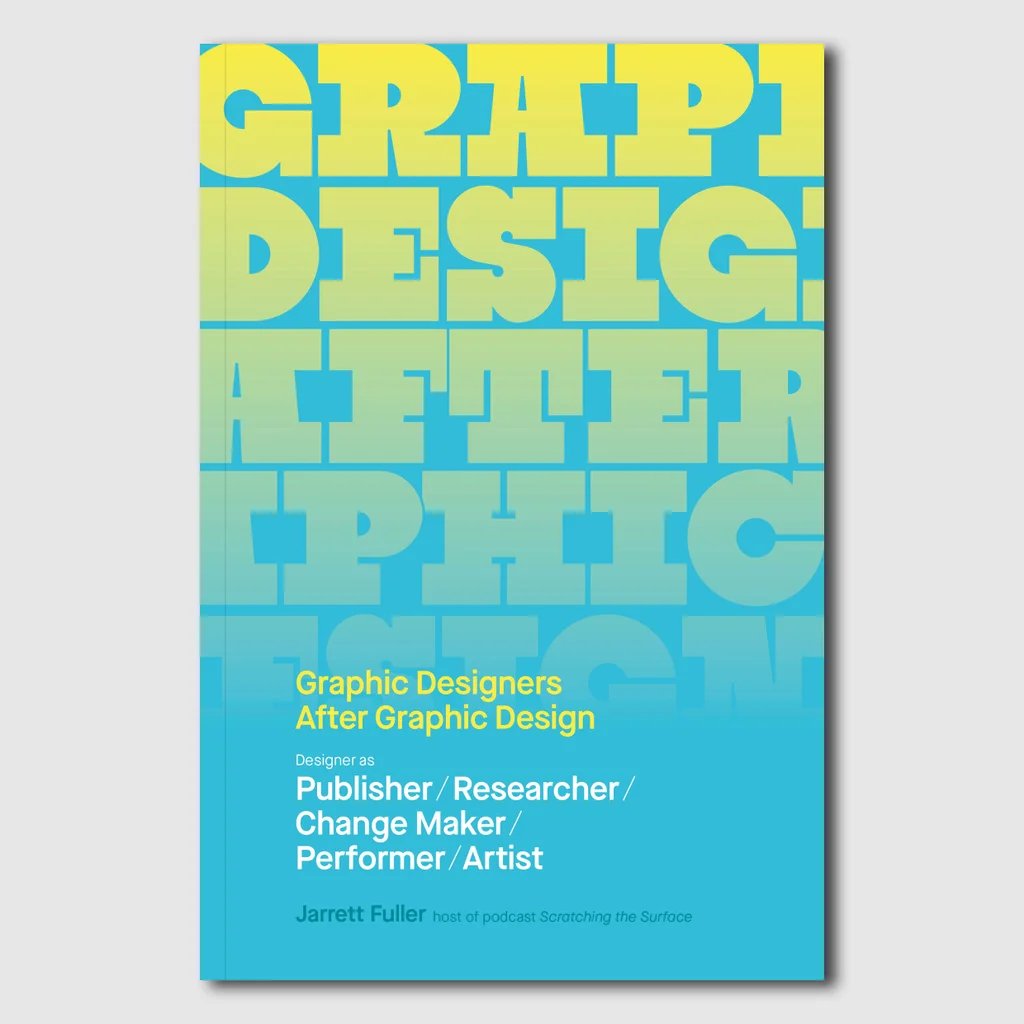
It’s a liberating time to be a graphic designer. You would think so, anyway, after reading Jarrett Fuller’s new book, Graphic Designers After Graphic Design, published this fall by Princeton Architectural Press.
Fuller, a designer, writer, podcaster, and professor at North Carolina State University, makes an optimistic case for an expansive definition of graphic design. Through conversations with practitioners working across publishing, research, changemaking, performance, and artistic practice, he argues that graphic design is much more than the production of posters, logos, and websites.
Coinciding with the 10th anniversary of his podcast, Scratching the Surface, which highlights practitioners overlapping with graphic design, the book turns its attention specifically to graphic designers with expansive, blurry, and very public practices.
As fellow design educators, Fuller and I caught up about what this broader understanding of design means for the current generation of graphic designers. As he puts it, graphic designers are inherently insecure about their discipline’s identity and relevance. But rather than trying to resolve that uncertainty, what if we embraced it? We talked about the confidence it takes to define a practice on your own terms, and the possibilities that open up when you do. Below is a conversation we had over Zoom, which was edited for clarity.
Nika Simovich Fisher: Congratulations on your book—I really enjoyed the expansive, blurry multidisciplinary model of all of the perspectives. I think it’s important to have an optimistic perspective right now.
In class yesterday, I had a sophomore student ask me if, in my opinion, right now is a good time to go into the interaction design field. I thought of your book immediately because it does a great job of encapsulating how design can be part of many different realms, and I responded in that way. But I also did hear her anxiety, and I was curious, how would you have responded to her?
Jarrett Fuller: Yeah, I mean, look, that’s a great question, and not to make this too much about the book right away, because I know you’re asking generally. But I think one of the arguments that I’m making, and one of the very real experiences of my life, and I’m sure your life also, is that it’s kind of never a good time to go into design.
It’s always at risk. There’s always something that is threatening to kill it or to take it away from us. That’s the first thing I would say: There’s always an existential risk. There has always been an existential risk, but whatever that new thing is that’s supposed to kill it means that we get to make it something new. We get to find some new way to practice it.
One of the things—I think this is a line explicitly in the book—is that every generation gets to redefine design for themselves. The design of tomorrow is different from the design of yesterday. That’s really scary, and I’ve been there, but it’s also always been like that. So instead of trying to avoid that, let’s just embrace it. Let’s figure out what it could be together and where it could go next, as opposed to abandoning it.
I think that’s the optimism that you’re talking about. I feel like I’ve gone through all these cycles of grief for design, and I’m kind of just over it now. Let’s just make it what we want it to be. That’s so much more fun.
Absolutely. It’s very freeing in that sense. I have a research assistant this semester, and at our meeting today, she was wearing a shirt that she picked up at the Printed Matter book fair that said, “Print is dead.” It was really funny and brilliant because it’s this throwaway line that we’ve heard since we were in school. And yet here we are, talking about your book that came out in print just the other day.
Right. It’s true. I heard that when I was in school, which is 15 years ago now, and it persists somehow.
It’s an interesting answer, but it’s not the right question, I guess. It’s not about print, or design, going away or not, but things changing, knowing that they’re going to change, and having the skills to lean into that friction. That’s what I took away from a lot of the respondents in your book.
I want to add to that because I think you’re right. That is where the anxiety comes from: this sense that design is really hard to define and is always changing, always different. There are questions of, well, what is design history, and who gets to be included? Why are there not more venues to write about design? All of this is just laddering up to this thing of: Are we actually a real thing? Is graphic design a real discipline?
I actually think we should embrace that blurriness as opposed to complaining about it, living in fear of it, or trying to put walls up around it in some way.
I 100% agree, maybe that’s more honest, too. It’s noteworthy that we’re both professors at universities. At yours, you’re a professor of “graphic and experience design,” and I’m one of “communication design”—singular communication, not the plural, as you pointed out in the book. It’s interesting that we’re able to talk about the same things. We’re teaching similar classes and can trade notes, but technically they’re qualified in these other words.
Yeah, what is that? I don’t even know what all those different terms mean anymore. That’s another thread in the book: Because we don’t know what we are, we don’t know what we do, because we always feel like we’re at risk, we’re always trying to come up with new names. Maybe that’s the wrong question. Finding a term to define it doesn’t actually do anything because then that term is just at risk of all the problems of the last term in some way.
Once you claim it as something, then you’re kind of saying it’s not other things. But in this book in particular, you’re saying that publishing, research, change making, performance, and artistic practice are actually all parts of graphic design, too.
I really enjoyed those categories. Were there other candidates as well? How did you land on those?
That’s a surprisingly hard question. Yes, there were others, and those emerged through the writing process, through the research process, and through the interviews. As I was trying to figure out how to group people, those were really broad categories that could contain a lot.
One of the challenges in the book is that a lot of the people I feature could sit between those categories or could sit in different sections. So there was a lot of zooming in and out: How broad should these categories be versus how specific?
Early on there was a version with film and video, but then that fell aside. One thing I tried to avoid was including other design fields.
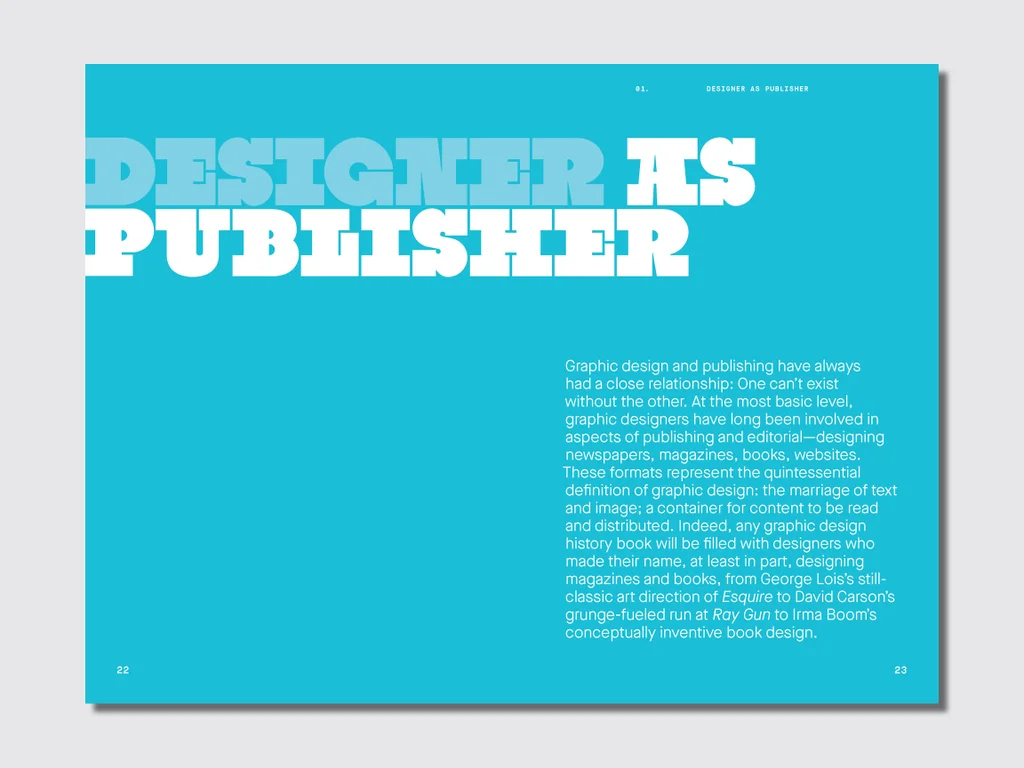
The final categories span the production process. It’s everything from the creation of original ideas all the way to giving that knowledge shape or form, to the distribution of those forms out into the world. It’s taking design out of that sliver of image-making or visual production, and it’s moving it to both sides: to the production of the ideas, and then also the distribution of those ideas. I think those together made for this nice process of communication, if you will.
I think you had written that in the book too, this idea of making it public becomes part of it. On that note, this morning I got your [email] newsletter. You were talking about releasing the book and how there’s this time gap between finishing writing the book and now seeing it come to fruition. Does it feel like a new chapter of this project?
Yeah, it does. When I saw the final PDFs, and then when I saw the printed one, it was like, great, this is the book now. Now on to the next thing. And now that I’m actually talking to people who have read it, it’s opening up new readings for me and helping me see the book in a new way. It is that idea of making it public, of putting it out into the world, and that actually continues the creative process in some way.
The other thing I was worried about—worried is a strong word—was, how is the world going to be different by the time this book comes out? When I knew it was done, and then when I saw what the publication date was, it’s like, is this still going to be relevant? Are these topics still interesting?
I think they’re more relevant than I realized. That existential threat that your student felt at the beginning of this conversation, I think that’s more front of mind for people. Not just for students, but also practicing designers and design professors are all wondering, what are we doing here, and how do we make sense of it? Hopefully this book is a way to give some shape, or some map, or some ideas of how to push some of these ideas forward in 2026, with everything going on in the world.
By distributing it in the format you did, it felt quite formal and educational, almost like a textbook. Was that your intention?
Yes and no. When I was working on it, I was really thinking, this is a book for students who are studying graphic design, to show them a really diverse range of practices that you can have with the skills that you’re learning.
There’s a really broad, diverse range of practices that one can do after they have studied graphic design, with the language and the methods and the skills of graphic design. In that sense, thinking about it as a textbook, sure, I like that reading. It’s very much a map of what you can do.
On the other hand, one of the reasons why I wanted to feature real designers who are all what I call emerging and midcareer—so they’re all [about] 40 and younger, basically a book of millennials—is that when you talk about the future of graphic design, or alternative ways of practicing graphic design, or what graphic design can be, that can get really theoretical and speculative really fast.
Especially when you talk to students about it and say, “Oh, you can do this kind of stuff, there’s no way to actually comprehend how you turn that into a practice.” I really wanted to root this in real people who are actually doing it and talk to them, some of them very candidly, about where the money comes from. How do you fund these projects? To show that this isn’t just an idea of graphic design. There are real people who are doing it like this today.
They all have active practices that fit into this discipline of graphic design that could be academic, but also is very much engaged with the public.
Right, exactly. You said it better than I did. I also wondered if a book was the right format for something like this. In some ways, I also wanted it to be a record of right now. Who are these people right now? How are they thinking about their work in this moment, in this generation? In the future, we can look at it and say, here’s how a bunch of people thought about graphic design in 2026. There’s also a historical thing that I think a book is still kind of the best at.
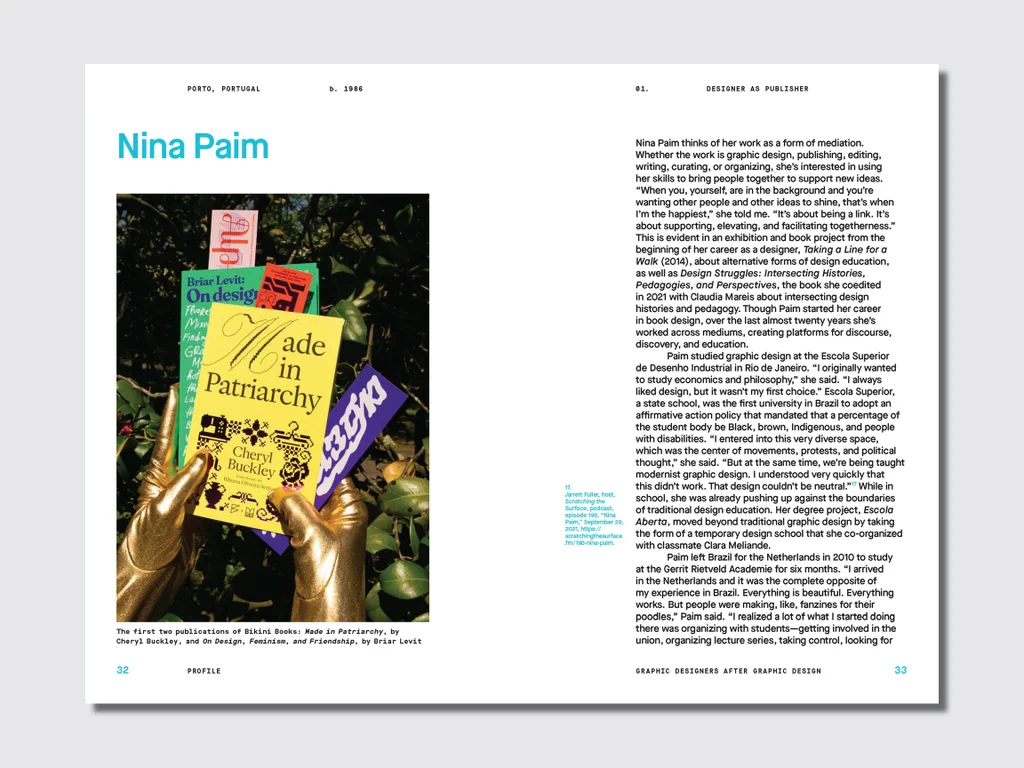
And with a book, you can notice little details within it. For example, I appreciated that the birth years of the interviewees were prominently listed in the margins. I think the oldest person was born in 1978 and the youngest in 1998.
Yeah, that was the thing. I pushed my editors on that. They weren’t totally sure they wanted to do that, and I was like, I really want this to be a generational argument. I want to show that this is a cohort of people who maybe don’t know each other, who are maybe not in dialogue with each other, but they all are coming through a similar system and are saying something about what it’s like to make graphic design right now.
Everybody who I’ve talked to about the book has commented on the birth dates in there. I’m really happy that you like that.
I do. I like that it’s not the traditional years for millennials or Gen Z. It’s a little blurry, which supports the argument.
Outside of their ages, something else all the people in the book have in common, is that they really are making a design career work. It was Silvio Lorusso who was talking about testing out design ideas and doing these speaking opportunities to support it. You said it’s like the stand-up comedy approach to graphic design, and I loved that so much. One, it was funny, but two, there was something really relatable to hear these other people validate this way of working and say, this is where I’m testing out ideas, and I get to distribute my work organically, and that’s still design.
There’s two things that I would say about that. One, I also love that moment, and I didn’t want the book to be a how-to book. I didn’t want it to be, here’s how you work outside of a studio system or a startup system. I didn’t want to go through that, but I did want there to be references to how people make it work.
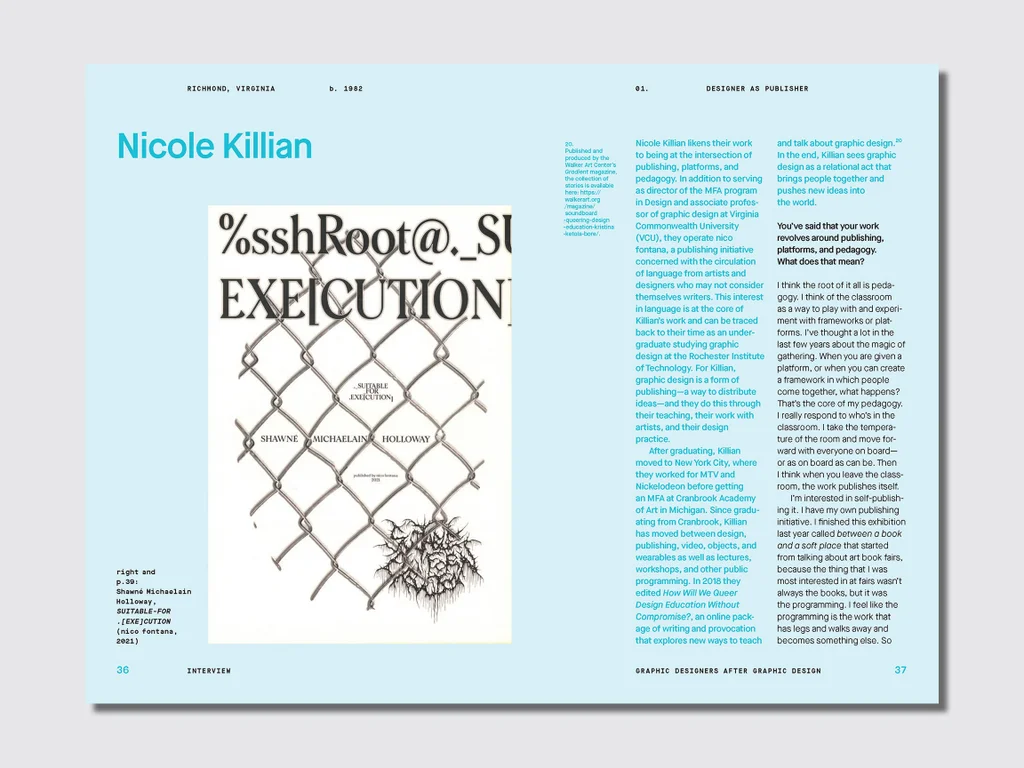
The idea of, I will give a lot of talks, and that money gives me space so that I can sit and write a book. But that also gives me an audience that I can test these ideas with for when I go to write the book. Or talking to Nicole Killian, who has this publishing practice, and they get grants from their university that they put toward publishing the work of other artists. They have this ratio of what they bring to book fairs so they can be sure that money will come back to them. All that’s embedded in there sort of secretly, without being explicitly a how-to book.
But then, in some ways, I’m also a millennial. I’m also part of this cohort. The book was a way for me to validate what I’m doing. I come from graphic design, but like you, do stuff that doesn’t really look like graphic design. Being in dialogue with these people was also a way to put my work, that sometimes can feel isolating, into some sort of larger cohort or generational thing.
The podcast, the writing that I do for Fast Company and other places, are all ways to test out these ideas. Then they go back into the classroom, or the classroom goes out into an essay. They’re all testing out the same ideas in different places.
What you said about writing reminds me of two of the conversations in the book. First, Tiger Dingsun was talking about how in poetry, you see the interior of the person, but in design you do not. Similarly, Silvio Lorusso was talking about how writing and design to him are not the same. He said that design is all about being straightforward, getting to the point, and writing has more romance, essentially.
Is that something you thought about, as you were writing your book?
That’s a really good question. I’m conflicted about it because I understand both of their arguments, and I think the argument that I’m trying to make is a “yes, and” argument. Yes, I agree with that, but can’t design also be like that too?
Why do we say design has to be efficient and immediate and trying to sell you something, or trying to communicate something in a clear way? Why can’t design be poetry? I want graphic design that’s more poetry and less graphic design that’s problem-solving, in some way. I think the collection of people here are trying to make that case: It can be both. It doesn’t just have to be the commercial, efficient, market-capital way we think about graphic design.
All too often, we let the profession and the industry win out, and this other stuff, the cultural side of it, gets pushed to the side and is seen as outside of graphic design or alternative. Or we call it something else. This isn’t graphic design because it’s not doing these other things, so we’re going to call this art or fine art or studio practice.
I’m trying to have a big umbrella for graphic design, to say it can include all of those things, and it does include all those things. So why do we keep segmenting them out as different?
There’s a really interesting thread of a lot of the people I talked to had a similar experience of waffling between feeling optimistic about design, then constricting, and finding ways to make it work. Many tried to get away from design, and then came back to it with a bigger understanding of it.
I love that that is a theme, and it’s something that’s very relatable if you are working in this blurry state of design. In your book, Nicole Killian also talked about how they wouldn’t be able to do the work they’re doing now without having the design knowledge. It’s an empowering narrative.
It seems that for many, design becomes this psychological process, which feels very honest and relatable. In Mindy Seu’s section, she talks about finding the thing that you think about obsessively. I really loved it when she said that after graduating undergrad and studying design, her peers were getting these design jobs, and she felt like, why am I not doing that type of work?
Then she saw that her peers were more interested in form, and she realized that was never her thing. She leaned into what she does naturally, which is gathering resources. I appreciated that part of the conversation because it shows that we’re all different, and we all have different strengths. In your book they’re all valid options.
Right, and why do we have to say that one is right and one is wrong? I think that’s the tension that Mindy’s talking about. You see these people getting these quote-unquote good jobs, and you think you’re supposed to be doing that, and it’s actually much more pluralistic.
That’s where the book is very biographical for me too. I wanted to be a designer for a really long time. I go and study it, and then I get my first job as a graphic designer in New York, thinking I’d made it. I just didn’t like it. I was like, oh, this is not as interesting. There were all these other parts of design that were also interesting to me, and there was no space for that in those types of jobs.
I had to find new ways to keep doing the thing that I was doing, but in different sorts of contexts. That’s Mindy. I mean, that’s everybody. That is the book. It’s to show that that’s not a departure from design. It’s an expansion of graphic design.
Just now when you said “bioGRAPHICAL” I’m reminded of the suffix—graphical—you articulated in the book. I didn’t know that that word came from both to draw and write together, which is so perfect.
Yeah, that’s my big surprise in the book. That’s the thing that I feel explains everything that comes before it. We think of graphic design as visual. We think of “graphic” in graphic design as visual, but that’s actually a very limited definition of that word.
As we’re talking about all these different paths for design, I’m noticing there is a lot of confidence in deciding, “Okay, I’m going to do this my way.” Everyone in the book does it. You can make an argument that any working creative person has made the decision to do it their way, but it’s hard to communicate that to students or designers earlier in their journey.
There is a lot of risk in choosing to do these things that are unconventional, or at least, not a one-to-one path you can follow. What about design education could help people make that leap?
I have a couple ways that maybe I would answer that. Graphic design education—whether that’s communication design or graphic and experience, whatever the subterms are, this shared world that we’re both in—there is often, in many programs, by necessity, an immediate need to create focus areas. Are you going to focus on branding? Are you going to focus on interaction? When I was in school, literally, when you got to your junior year, it was, are you going to be a print designer or a web designer? Then you just took classes in one of those. I think we should encourage much more commingling of these and much more multidisciplinary thinking.
Graphic design is medium-agnostic. It’s not actually about the medium that is the end result. It’s not about the book or the website or the logo or the painting or the film. It’s about all the ideas, and then how those ideas take a shape.
What would design education look like that more about, how do you give ideas form? Those forms can take any form. More of that early, less about outputs and more about process, and that shift from idea to form, is one way to start doing that.
The second is to—and I hesitate to say this—not be so tied to industry. Not to look at what the jobs that companies are hiring for, but to actually lead that in some way and say, here are the types of skills that we think are important as educators. Let’s feed that into the students, and then let industry respond to that.
I think that will create more confidence. That will create more entrepreneurial-type students because you’re building things on your own while you’re in school.
The last piece is that design education could have much more space for self-reflection. There should be work that you are making in response to things, but there should be almost a metapractice. What are the things you’re interested in? What’s the type of practice you want to have? How do we create spaces for you to try that and test those things while you’re in school, while you’re in a safe space, while you have the time to think about the kind of work you want to make, so you can start building on that?
When you graduate, you have a body of work that is not just making you employable, but is also saying something about you and the type of practice that you want to have. How do we build that into curriculums, right from the beginning?
I love that and agree. Those questions inherently build confidence, because you have to put something out into the world and stand behind it. To have it result in a form, you have to go through various decisions and side quests to finish it.
I think it’s a way to be a creative person in the age of AI also. If design is medium-agnostic and it’s not actually about the form of the thing or the medium of the thing, AI can do that. You can tell AI, make me a book with this kind of layout. Make me an app with this sort of thing. Make me a logo that looks like this. That’s the easy part now. The actual production of it is done.
What designers have to do is have a point of view, a set of ideas, be able to have a thing that they want to say that only they can say. That’s the stuff AI can’t do.
I was going to say that I like that your book doesn’t explicitly talk about AI, but it’s between the lines in a lot of things. What Nat Pyper was saying about being in grad school and figuring out how to make this work that they think should exist, and using design to get it out—I think that’s it right there. That’s really what AI cannot do. For example, AI cannot make that series of letterforms inspired by queer counterculture.
Right. Somebody who read the book said the message of the book is, “Make design weird again.” I think that’s kind of true. All of the standard stuff is the stuff that AI is going to take first, so we need to lean into the weirdness, the humanness, the strange, the stuff that only we can communicate. That’s a great example of that, and that conversation is a great case study in that.
I love “Make graphic design weird again,” I think Santa Cruz, California, has a similar slogan. Maybe we can borrow it.
One of the other questions I had was about a sense of humor in design. It’s related to our conversation about confidence, but knowing about visual forms and what they communicate and having control over it, allows you to make jokes in a way that people who aren’t as versed in that, can’t. Nat brought up the idea of being a jester, for example, and Nicole Killian’s project was called, “Come to my window,” a pun inspired by the ’90s song.
There’s this sense of play, along with the stand-up comedy approach to sharing work. There’s all those examples of breaking the script in the book. Like, Silvio literally said not using a script for PowerPoints. The thing that connects a lot of these practitioners is the willingness to be seen and to be energetic and funny.
That’s really smart. What that’s making me think of is, so much of our visual culture just looks the same. There’s so much copying. Every time there’s a rebrand, it looks like a thing that we’ve seen before. Every app on our phone basically looks exactly the same and has the same set of interaction patterns. You can go to any city and see similar-looking buildings. This is Kyle Chayka’s idea of airspace: All the coffee shops look the same.
It doesn’t have to be like that. The people in this book are maybe the extreme cases of that, but that doesn’t mean these ideas can’t actually make their way back into commercial design practices. That humor, that personality, that strangeness, that disorientation, that friction, that poetics—why can’t that be part of a brand or part of an app or part of a space?
I sometimes feel like the people in this book I’m describing are very different, but I think all that is a way to signal where all of this could go. It’s not just that you have to leave traditional graphic design practice. You can take these ideas and embed them into the work that you’re already doing also.
Then it goes back to that multidisciplinary model, and also being realistic, because it is an expensive world that we live in. Having diverse models of taking your skill set and applying it is useful.
Yeah, diverse models, and I would say diverse scales also. So often we think, in a globalized world, that everything has to reach everybody.
This idea that you can have a small practice and a small cohort, a small public—not everything has to be global—is an interesting way to think about this moment also. What is the scale of the practice that you want? I don’t really talk about that in the book specifically, but there’s questions underlying a lot of these conversations.
Again, that feels very empowering to me. What it touches on is, essentially, how do you define success, whether within graphic design or personally? All of these people are chosen partially because of their professional track record. There’s something refreshing about seeing how everyone interpreted that for their own practice.
Yeah, I think that’s right.
In terms of AI, did you intentionally not want to talk about it or was it just not a priority? Do you think the conversations were a reaction to AI without needing to spell it out?
I didn’t want to write about it. I didn’t want this to be an AI book. Going back to your very first question, there’s always something that design is reacting to, and if it’s not AI, it will be something else.
In some ways, this book is reacting to a bunch of things. It’s reacting to AI. It’s probably reacting to the Trump presidency and the reordering of the world order. It’s probably reacting to the 2008 financial crisis, which a lot of these people graduated into. It’s reacting to Brexit for a lot of the people that I spoke to in Europe. There are a lot of things that are informing all of this.
My interest was not in what we were reacting to, but in what we were making next. This is really a book about people, and maybe that also is the subtle way that this is a reaction to AI: these are people who are doing things. The book is called *Graphic Designers After Graphic Design*. Who are these designers? Maybe that’s a subtle protest of AI too.
In the foreword, Ellen Lupton writes about mistaking the title of your book for Graphic Design After Graphic Designers, which is a very different reading and much more apocalyptic. She wrote about it better than I’m articulating, but it preserves your hopeful perspective, or why at least it felt optimistic to me.
Optimistic is right. It’s very much a celebration. I write this in the beginning: I feel like graphic designers are really insecure people. We, as an industry, as a discipline, don’t feel respected. We feel like there’s always people outside of design who think that they can do it. It’s hard to actually describe what it is that we do.
You’ve used this word a couple times, and I really like it: confidence. This is a book about saying we should actually own all of those things. We should own the fact that this is really hard to define. We should own the fact that no one quite understands what it is. We should own the fact that everyone else thinks that they can do it also. We should own the fact that it’s always changing.
Let’s call ourselves graphic designers again. We don’t have to run from that. If you want to make paintings, if you want to make films, if you want to write essays, if you want to do any of these things, why can’t that be graphic design too? At the end of the day, that’s all this book is trying to do. It’s trying to say all of these things can be graphic design.



