
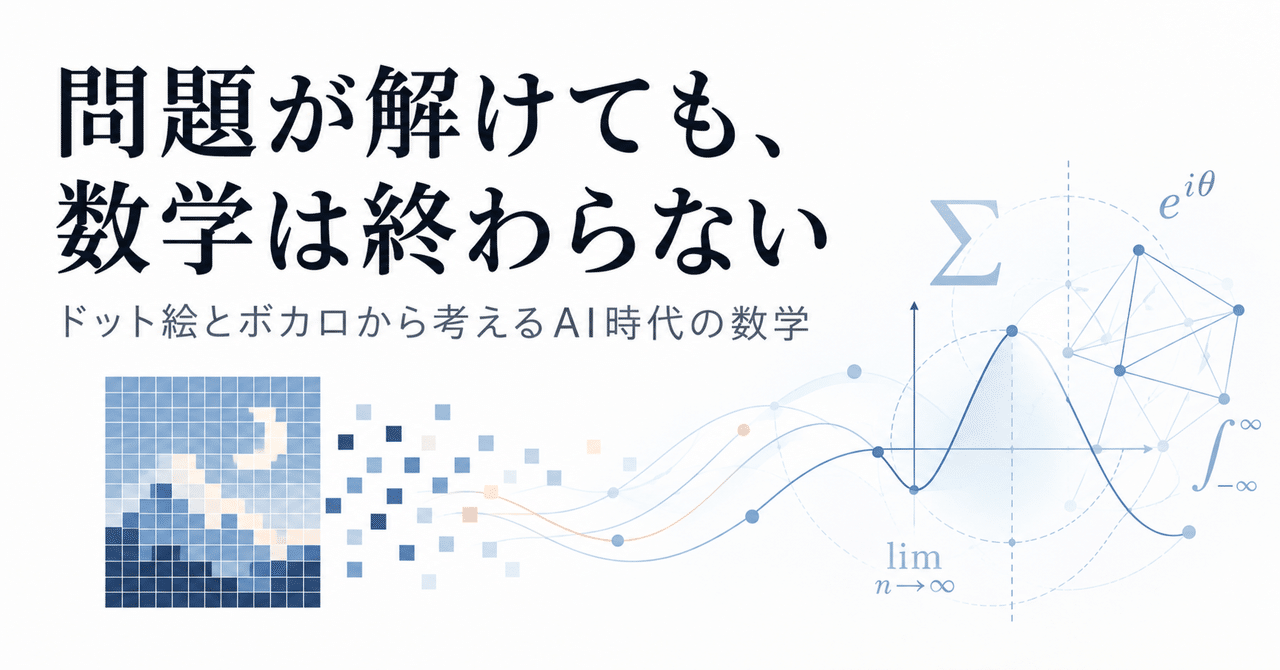
AI is developing rapidly and has begun to solve difficult mathematical problems.
Along with this, I sometimes see discussions about whether human mathematics will come to an end if AI solves it.
I believe that the way mathematical research is conducted may change significantly. The position of the mathematician as a profession will likely change in the future as well.
However, I do not believe that mathematics itself will end.
This time, I would like to consider this issue through a slightly unusual thought experiment.
What if game consoles had been high-performance from the beginning?
Even today, many games using pixel art are being produced.
In the past, game consoles had strict limitations on the number of pixels, colors, and processing power that could be displayed. Pixel art is an expression that developed within those constraints.
However, the situation is different today.
Even in an era where high-definition 3D graphics can be realized, pixel art has not disappeared. On the contrary, new expressions like “HD-2D,” which combine modern lighting effects with three-dimensional backgrounds, have even emerged.
Here, I would like to consider one thing.
If the performance of game consoles had been at the current level from the beginning and everyone could use them cheaply, would the pixel art game culture have been born?
I think it is highly likely that it would not have developed in the same form as it does today, at least.
If high-definition graphics could be easily handled from the start, there would be little need to go out of one’s way to develop production techniques tailored to limitations in pixel count and color count.
Of course, it is possible that someone might have come up with the idea of arranging pixels.
However, “being able to invent something” and “actually being invented and becoming widespread” are different things.
Since time, funds, and human resources are limited, it is not guaranteed that a large amount of resources will be invested in technology with low necessity.
Thinking about it this way, pixel art is not just an old technology.
It is an expression that was born within technical constraints and has continued to develop as an independent culture even after those constraints disappeared.I think.
Isn’t Vocaloid the same?
There is a similar example in music.
It is singing voice synthesis technology, such as Vocaloid.
Early singing voice synthesis had a unique resonance that was different from the human singing voice. However, that characteristic was embraced, and it gave birth to various songs, characters, and creative cultures.
So, what would have happened if singing voice synthesis technology had been at a level indistinguishable from the human singing voice from the very beginning?
The technology itself, which allows for the free creation of singing voices, would certainly have been used.
However, it is unclear whether the same Vocaloid culture we have today would have emerged.
This is because there is a history of singing voices that differ from humans being accepted not as a flaw in expression, but as a unique personality.
If the technology had been perfect from the start, the music and expressions that should have been born along the way might never have existed.
The same can be said for chiptune in game music.
If it had been possible to freely reproduce sounds close to real instruments from the beginning, it is unclear whether the techniques for mastering limited sound sources would have developed as they have today.
Would the abacus or scientific calculator have been invented?
Let’s consider a slightly more familiar example.
If, from the beginning of the history of computing, the same level of computing power as today’s smartphones had been available at a low cost, would the abacus or scientific calculator have been invented?
Historically, the abacus existed long before electronic computers. However, here I am considering a hypothetical world where the order of technological emergence is swapped.
I think it is unlikely that dedicated devices like scientific calculators would have developed in the same way they have today.
If a device capable of easily performing advanced calculations existed from the start, the motivation to develop new tools that only perform specific calculations would be smaller.
The abacus might still be devised as an educational tool for handling numbers visually and physically. However, there is no guarantee that it would actually be invented and widely adopted.
What the examples so far have in common is the following:
In a world that reaches advanced technology quickly, there is a possibility that the technologies and cultures that should have been born along the way may never come into existence at all.
So, is it better for technological progress to be slow?
I do not think so.
What happens if difficult mathematical problems are solved quickly?
Let us return to the topic of mathematics here.
If AI solves difficult problems one after another, proofs that humans have spent decades searching for might be obtained in a short period.
In that case, there is a possibility that mathematics that should have been born in the process of searching for other methods will end up undiscovered.
This is similar to the story about pixel art mentioned earlier.
However, mathematics also has another aspect.
In mathematics, even after a problem is solved, there is great significance in searching for other ways to solve it.
For example, the Four Color Theorem.
The Four Color Theorem has already been proven, but what if a short and clear proof that does not rely on large-scale case analysis by computer were discovered?
That would not only shorten the proof, but might also reveal new principles regarding graph coloring.
The same applies to Fermat’s Last Theorem.
Even now, with the existence of the proof by Wiles and others, searching for a proof using elementary or classical methods can have independent research significance.
Of course, it is unknown whether such a proof exists.
However, if it were discovered, there is a possibility that a mathematical structure completely different from the current proof would be found.
It is also conceivable that this structure could lead to the resolution of other difficult problems.
In other words, solving an already solved problem in a different way is not merely a re-challenge.
Discovering a different proof can become a catalyst for creating new mathematics.
The demand itself is newly created
Here, there is one more important thing.
Demand for technology and culture does not necessarily exist from the beginning.
In a world where pixel art did not develop, the demand to create games using pixel art might not have emerged to the extent it has today.
Conversely, because pixel art, which was born from technical constraints, became a form of expression loved by many, a new demand arose to use pixel art even on high-performance game consoles.
I think this is the same for mathematics.
When a difficult problem is solved, the initial demand to find a proof for that problem is satisfied. However, the demand to understand the discovered proof more easily, to prove it in a different way, or to apply it to new theories may arise.
Furthermore, newly acquired knowledge can sometimes create problems that were previously inconceivable.
Research does not progress only because there is demand. As research progresses, new demand itself is born.
If we are to think about the future of mathematics, I believe it is insufficient to count only the demand that currently exists.
That said, there is no need to delay the resolution of difficult problems.
This is a point I do not want to be misunderstood.
Just because there is value in the process of technological and mathematical development, I do not think we should delay solving problems.
There are people who are troubled because mathematical problems remain unsolved, and there are likely AIs waiting for those problems to be solved as well.
If they can be solved, they should be solved quickly.
In the first place, the resolution of difficult problems often gives birth to new concepts and methods.
By utilizing solved theorems, we can sometimes tackle other problems that were previously unthinkable.
Also, if new proof techniques are born, research to understand, improve, and apply them to other problems will begin.
While there may be search paths lost by solving problems quickly, there are also search paths that are born precisely because they were solved quickly.
What I want to say is not that we should slow down the progress of mathematics.
There is no need to measure the value of mathematics solely by how many unsolved problems remain—that is what I mean.
In the AI era, the culture of mathematics itself may change.
From now on, the opportunities for AI to participate in mathematical research will likely increase more and more.
We may be entering an era where new theorems and proofs are discovered at a speed that would have been unthinkable for humans alone.
If that happens, the profession of mathematician and the research system will likely change significantly.
However, it does not necessarily mean that the act of doing mathematics itself will become unnecessary.
Trying to prove known theorems more simply.
Trying to prove them using methods from different fields.
Trying to generalize theorems.
Trying to apply the concepts used in proofs to completely different problems.
Or, using already known results as a starting point to create new questions that no one has thought of before.
Mathematics has such ways of being enjoyed.
And it is not necessarily only humans who will engage in those activities.
AI itself may also think about mathematics, find new methods, and advance research with other humans or AIs.
I am looking forward to such a future.
It is not just mathematics. Technologies and cultures that will be born from now on
I have been thinking about the future of mathematics up to this point, but I think the same applies to fields other than mathematics.
For example, let’s assume that AI has made it possible for anyone to easily produce high-quality images, music, and videos.
Some conventional production techniques may lose their necessity. However, that does not necessarily mean that creative culture itself will end.
Rather, there is a possibility that new culture will be born through expressions that could not be realized for technical reasons until now, and by people who could not participate in production.
Games are the same.
Creating game worlds and stories together with AI, and having the content change significantly based on the player’s actions. Or, AI itself participating as a player and discovering new ways to play together with humans.
If such games become commonplace, a different kind of game culture might develop than what we have today.
And here, too, changes in demand will become important.
In the past, producing high-quality visuals was a major challenge in itself. However, if that becomes easy, new demand may arise for how to use those visuals and what kind of experiences to create.
When technology solves one problem, that solution leads to the discovery of new challenges and ways to enjoy things.
Of course, not every new technology will create a new culture. Conversely, there will likely be forms of expression and culture that are lost due to technological advancement.
However, we cannot predict future culture based solely on current demand.
Before pixel art and Vocaloid were born, there surely was no one waiting in anticipation for that culture.
Cultures that do not yet exist may have demands that do not yet exist.
I do not want to view the progress of AI and other technologies simply as things that replace human activity.
When new technology combines with the creativity of humans and AI, there is a possibility that a culture we cannot currently imagine will be born.
That is precisely why I want to think not only about what will become unnecessary due to technological progress, but also what new things will be born beyond that.
Even if technology is perfected, culture is not necessarily perfected.
Pixel art did not disappear even as game console performance improved.
Rather, expressions born from the constraints of the past are combining with modern technology to create a new culture.
The same thing might happen in mathematics.
Even if one problem is solved, the meaning of approaching that problem from a different angle remains.
Mathematical methods born in the past may combine with new theories to create entirely different mathematics.
And with the development of AI, new ways of enjoying mathematics that we haven’t even imagined yet might emerge.
Of course, if the path of technological development changes, some things will likely be lost.
However, at the same time, new things will also be born.
It is a great waste to think about the future of mathematics solely by the metric of whether humans can solve problems faster than AI.
Being able to solve problems is not the same as mathematics coming to an end.
I do not believe that the era in which AI solves difficult problems marks the end of mathematics.
Rather, I feel the potential for a different kind of mathematical culture to begin.
After all, even if technology is perfected, it does not mean that culture is perfected as well.
#Mathematics #AI #MathematicalResearch #PixelArt #Vocaloid #GameCulture #TechnologicalInnovation #CreativeCulture #FutureOfMathematics



