
It’s well known that alcohol has profound consequences on the way the brain works, and research shows that even low levels of the drug can damage your brain.
But how does alcohol actually cause brain damage at the cellular level?
In a surprising discovery reported in Immunity, scientists found that alcohol doesn’t just interact with neurons.
New findings show the drug also affects immune cells in the brain called microglia, triggering them to dismantle the extracellular matrix that structurally supports brain cells.
“For years, alcohol’s effects on the brain were largely viewed through the lens of neurons, and for good reason: alcohol acts directly on neuronal receptors,” says neuroscientist and senior author of the study Dimitrios Davalos from the Cleveland Clinic.
“By following microglia in real time, we were able to see that they aren’t simply responding to damage. They drive the detrimental changes alcohol causes in the brain.”
Microglia are specialized immune cells that continually monitor and maintain the brain by detecting threats, clearing out dead cells and damaged tissue, and pruning neuronal connections.
To explore how microglial activity is affected by alcohol, researchers investigated a mouse model of heavy alcohol consumption, designed to mimic the effects of binge drinking and high-intensity drinking.
In experiments, mice were given an oral dose of ethanol, or repeated doses over consecutive days, and the researchers monitored the drug’s effects on microglia and neurons in living animals using two-photon microscopy and other imaging techniques.
The researchers found microglia underwent significant changes in shape and activity within approximately one hour of alcohol being administered, prior to peak sedation from the drug.
The branches that extend from their bodies reduced in number and length, and their surveillance territory shrank, with the effects becoming more pronounced after repeated exposures to alcohol.
The researchers also observed microglia damaging the extracellular matrix, a network of structural molecules that supports brain cells and helps to enable stable communication between neurons.
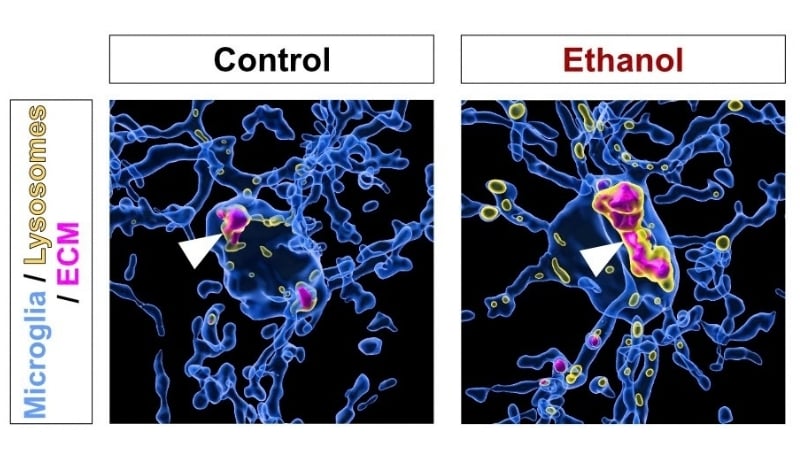
In mice given alcohol, microglia began to engulf and digest components of the matrix, breaking it down and weakening the structure.
This, the researchers suggest, results in a loss of synaptic connections, contributing to neuronal dysfunction, and possibly some of the sedative effects of alcohol.
However, in a separate experiment using genetically engineered mice, the researchers disabled a protein in microglia called MyD88, which plays an important role in activating immune responses.
In animals that had their MyD88 gene silenced, alcohol exposure resulted in significantly less neuronal damage, reduced changes in microglial shape and activity, and less pronounced sedation.
In separate tests with these protected, genetically engineered mice, the researchers degraded the animals’ extracellular matrix using an enzyme, and doing so brought back synapse loss, motor impairment, and sedation when the animals were given alcohol.
According to the researchers, this shows that the disruption of the extracellular matrix is a key, causal process that directly produces some of alcohol’s damaging effects on the brain.
While the primary findings were shown only in experiments on mice, a separate analysis of human brain tissue sourced from six deceased people with alcohol use disorder showed signs of extracellular matrix disruption compared to controls, which suggests a similar kind of microglial-driven brain damage may happen in people who abuse alcohol.
That could make MyD88 a strong therapeutic target for future research, and possibly beyond the effects of alcohol too.
“We discovered a specific neuroimmune route that alcohol activates, but it’s possible that other drugs can turn that pathway on as well,” Davalos says.
“My lab is looking into how we can target microglia or protect the brain’s ECM to prevent or limit brain damage, from substance use and possibly even other neurological diseases.”
The findings are reported in Immunity.
This article was fact-checked by Fiona MacDonald and edited by Fiona MacDonald. While we pride ourselves on our process, we are only human. If you spot a mistake, please let us know.



