
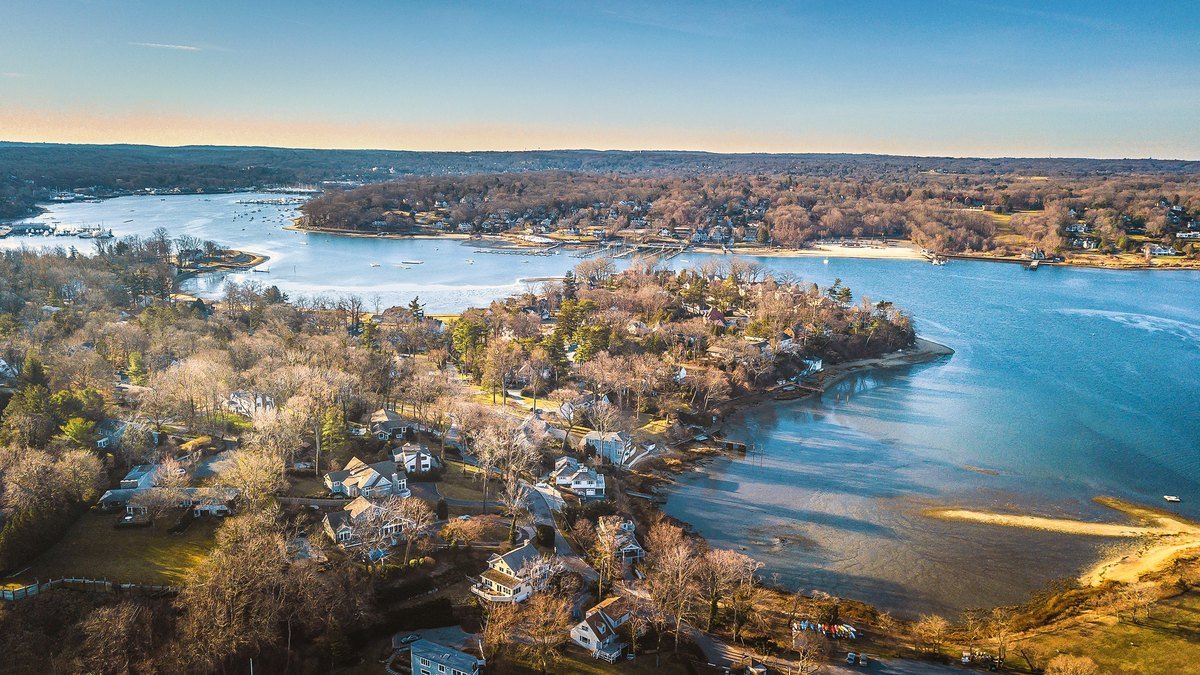
The four-bedroom waterfront home on Long Island’s North Fork hadn’t even hit the market when Diane Mollica‘s colleagues began imagining another use for it.
“Several of them commented that it would be a fabulous rental property because it has all of the perks that you want on vacation,” Mollica, a real estate agent with the Gambino Group at Compass, tells Realtor.com®.
It was easy enough to see their point: Beyond walls of glass stood a swimming pool, a sandy beach, and the sparkling blue waters of the Long Island Sound. Upstairs, a rooftop deck offered yet another picturesque view.
But Southold, the town encompassing much of the North Fork, wants fewer homes operating as short-term rentals.
A newly proposed permit lottery would allow just 119 properties across the town’s North Fork hamlets to offer stays shorter than 30 days—that’s less than one-fifth of the 640 active vacation-rental listings in October.
Officials hope the regulation would help protect residential neighborhoods from revolving vacation guests and preserve housing for people who live and work there year-round. But research from cities that have tried similar restrictions shows mixed results.
A town fighting for its year-round community
Mollica knows what draws people to the North Fork. Roughly 25 years ago, she came from Brooklyn for a weekend and ended up buying a house herself.
“What I love about the North Fork is the people are very embracing. They’re very community-minded,” she says.
The area has long attracted weekenders and summer vacationers, but the COVID-19 pandemic brought a wave of newcomers who began putting down more permanent roots.
“People made a mad rush to the North Fork because they saw the opportunity really to live and not to shelter in place,” Mollica recalls. “They enrolled their children in school. They got to know their friends and neighbors. … So a lot of those people stayed.”
Others eventually returned to the city while keeping their North Fork properties as second homes, leaving year-round residents, seasonal homeowners, and vacationers with competing visions for the community.
At an October civic forum, residents complained about pool parties, weddings, traffic, and unfamiliar guests coming and going.
“I’m in a residential community; this is where I want to live,” one resident told officials. “I don’t want to live in a business district.”
Then there’s the growing difficulty of affording a home at all.
By the end of 2025, the median price of a single-family home on the North Fork had reached a record $999,000—more than eight times Southold Town’s median household income of $116,667. Meanwhile, an estimated 54% of town renters spent at least 30% of their incomes on housing, according to U.S. Census Bureau data.
Even Town Councilwoman Alexa Suess, a Greenport native who campaigned on affordability, recently said she would have to move after her landlord raised her rent above $4,000 a month.
“I don’t know anybody my age who I went to school with that is still here,” she told a September housing forum.
The problem with turning vacation homes into housing
Naturally, that friction has put a renewed spotlight on the town’s massive share of vacation properties: Nearly 37% of its housing stock consisted of seasonal residences in 2020, according to the town’s 2023 Community Housing Plan.
At first glance, those seasonal homes might seem like a natural solution for Southold’s problems: a reservoir of untapped housing just waiting to be unleashed. But the town’s own experience regulating vacation rentals reveals just how difficult it can be to turn those properties into year-round housing.
The town banned stays shorter than 14 nights in 2015, but officials have struggled to enforce the rule. Its housing plan subsequently identified vacation rentals as one possible contributor to the shortage.
Now, officials want to go further, requiring permits for stays shorter than 30 days, limiting them to 1% of single-family homes in each hamlet, and strengthening enforcement. The proposed system could begin in January 2028, although lawmakers have yet to formally adopt it.
The question is what happens to those homes once renting them out becomes more difficult.
Asked whether the cap could flood Southold’s for-sale market, Mollica replies: “I’m going to say no.”
Many of her clients already prefer monthlong or summer rentals, and she cautions that she works with few buyers seeking properties solely for rental income.
“Our clientele really come out to enjoy their home,” she says. “They spend their summers here. They’re looking forward to Thanksgiving and other holiday vacations here.”
She recalls one family that moved back to New York City for personal reasons but kept their North Fork house as a second home. While they initially sought longer seasonal renters, they turned to Airbnb when finding tenants proved difficult.
“They wanted to rent it [out] … to supplement their income in order to carry the mortgage,” she explains.
And that supplemental income can be substantial.
Average summer nightly rates in Southold’s vacation-rental market climbed from $463 in 2019 to $764 in 2026, a 65% increase, according to an analysis of AirDNA data provided to Realtor.com. Yet the median summer reservation lasted just three nights. The figures cover ZIP-code-based North Fork markets, including separately regulated Greenport Village.
“A 30-night minimum removes the weekend and short-stay premium, and a whole-season lease must cover all of an owner’s income in a single booking,” says Bram Gallagher, AirDNA’s director of economics and forecasting.
It’s true that owners may decide that renting out their homes is no longer worth the trouble. But that doesn’t mean they’ll sell or make those properties available to year-round tenants.
Alexander Marsella, an economist at Berry College, says the outcome depends on an owner’s next best use of the property.
If that alternative is “a second home for the family,” he says, “then restricting short-term rentals isn’t going to do much to improve housing affordability.”
Research from cities that have already restricted vacation rentals suggests he’s right. A 2024 study of Berlin found that the crackdown targeting only commercial operators—not occasional hosts—significantly increased long-term rental supply.
New York City saw a similar disconnect. Short-term listings on Airbnb fell 87% after its 2023 crackdown, but rents barely budged and conventional rental inventory showed no unusual increase, according to Marsella’s August 2026 working paper, which has not yet undergone peer review.
And Marsella suspects the effect on year-round housing could be even smaller in a seasonal market.
“If I don’t see it happening in New York City so much, I feel like I would be less likely to see it happen in a seasonal market,” he says.
What happens to the homes next?
Town officials have already acknowledged that restricting vacation rentals won’t necessarily determine what happens to the properties themselves.
“Owners are going to have to make a decision about what to do with the houses,” Planning Director Heather Lanza said in 2024. “They can go to summer rentals or year-round.”
At Mollica’s waterfront listing, that decision will soon belong to someone new.
The four-bedroom home is preparing to hit the market, and prospective buyers may already waiting.
“I have several people that are waiting for the right property,” Mollica says.
Its swimming pool, private beach access, and sweeping views of Long Island Sound make it an enticing vacation retreat. But those same qualities could appeal to someone looking to put down permanent roots.
Mollica herself came to the North Fork for a weekend nearly 25 years ago and ended up staying.
The next buyer might do the same—or simply return for summer vacations. Southold’s proposed rules could influence how the property is used, but whether it becomes a year-round home will ultimately be the buyer’s decision.
Get real estate news in your inbox



